Tokyo Motor Show 2017: An Insider's Look with Fumio Ogawa
Tokyo Motor Show 2017 | Tokyo Motor Show 2017
Tokyo Motor Show 2017: An Insider's Look with Fumio Ogawa
The Tokyo Motor Show 2017, Japan's largest auto show held every two years, has opened. This is a summary of the show from the perspective of a motor show journalist who toured the press day events before the public opening. This is the second installment, featuring Fumio Ogawa.
Tokyo Motor Show 2017: An Insider's Look with Hirohisa Kaneko
Text by OGAWA FumioPhotographs by ARAKAWA Masayuki & others
Motor Shows Are Always Interesting
The 45th Tokyo Motor Show in 2017was interesting. For me, motor shows are always interesting. I've seen articles in newspapers and other media suggesting it was "lackluster," but I wonder why they felt that way.
The reason it was interesting is that I saw a wide variety of cars. It's a very simple reason. German manufacturers, in particular, put in a lot of effort.
Although there were concerns about fatigue following the Frankfurt Motor Show in September, their well-conceived exhibits gave the show substance.
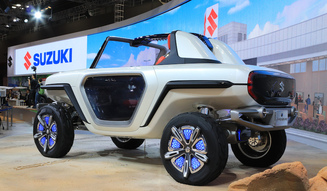
Suzuki e-Survivor
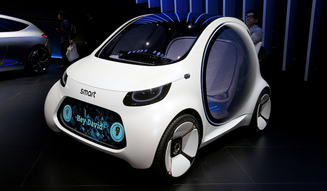
smart vision EQ fortwo
As expected, the dominant trend in exhibits was EVs. Variations such as electric sports cars, electric SUVs, and electric personal mobility vehicles caught the eye.
As a show car, Suzuki's "e-SURVIVOR" (even if not entirely realistic) was uplifting. Honda's "Sports EV Concept," with its distinctive round headlights, had a similar effect.
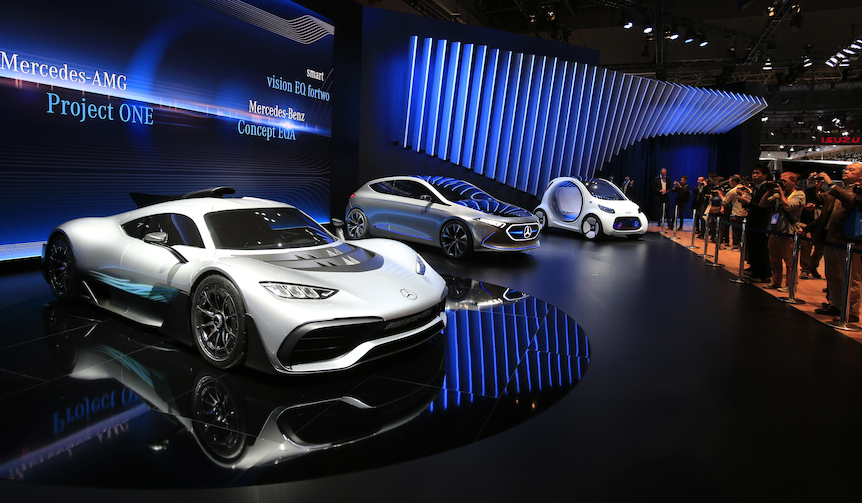
Among them, Mercedes' booth left a strong impression. The company recently launched "EQ," a brand overseeing its EVs. They brought three EVs to Tokyo, including the fuel-cell "GLC F-Cell."
The "smart vision EQ fortwo" from Smart is a key player in the "CASE" future smart city concept proposed by its parent company, Daimler. It's a personal mobility vehicle that proposes fully autonomous driving.
Tokyo Motor Show 2017 | Tokyo Motor Show 2017
Tokyo Motor Show 2017: An Insider's Look with Fumio Ogawa (Part 2)
It's Interesting Because You Can See the Real Thing
The concept of presenting individual models within an overall vision is easy for visitors to understand. Audi also does this well. Their highlight was the new "A8," equipped with an advanced "Level 3" driver assistance system that still requires driver intervention.
Next to it was the " Elaine concept," an electric concept car. Audi used this to promote "Audi AI," a comprehensive concept for automated driving that they recently announced. The integrated concept made their model lineup easy to understand.
BMW emphasized "driving pleasure." The "Concept 8 Series" and "Concept Z4" feature sporty styling that appeals to car enthusiasts. Both have already been announced, but the intricate details can only be appreciated in person.
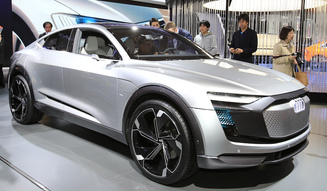
Audi Elaine
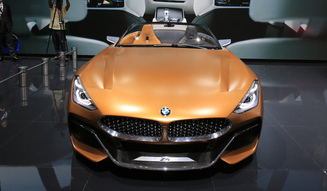
BMW concept Z4
Another astonishing supercar was the "Project ONE" from Mercedes-AMG. Describing it as a high-performance version of the AMG "GT" is an understatement. It combines an F1 engine with four electric motors.
Because the turbocharger is electrically driven, there is no turbo lag, which is caused by exhaust pressure fluctuations. This is also an "EQ" model, but it's a special one called "EQ Power+".
The regenerative braking system is always set to maximum, allowing for maximum acceleration at all times. The total output exceeds 1,000 horsepower, and it can accelerate from a standstill to 200 km/h in six seconds.
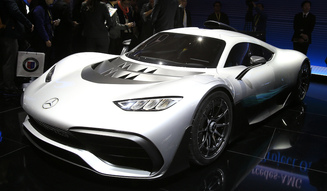
Mercedes-AMG project One
According to a development representative I met at the venue, "Development is ongoing with the aim of a 2019 launch." The price is said to be close to 300 million yen (not officially disclosed by the manufacturer). However, all 275 limited units have reportedly been sold out.
Its styling, with a large fin for cornering like an F1 car, and its F1-inspired interior, were already revealed at the Frankfurt Motor Show, but the impact can only be truly grasped by seeing the actual vehicle.
Tokyo Motor Show 2017 | Tokyo Motor Show 2017
Tokyo Motor Show 2017: An Insider's Look with Fumio Ogawa (Part 3)
Japanese Cars Are Interesting Too
Toyota Motor Corporation announced the next-generation "Century" and the "Crown Concept," which is believed to be the next model, among others. The "JPN TAXI," proposed for taxi services, was also interesting. There was a strong sense of effort across the board.
However, if I may be so bold, it's also true that the wide range of models made its positioning at the show feel somewhat undefined. If this was a consideration for us who expect novelty from motor shows, I almost felt apologetic.
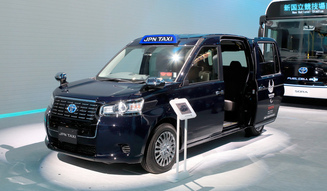
Toyota JPN Taxi
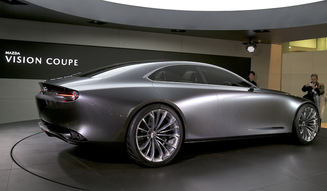
Mazda Vision Coupe
Mazda and Daihatsu expressed the idea that the charm of a car lies simply in its style. Mazda's "Vision Coupe," a large coupe styling concept, and the "Kai Concept," a four-door with a hatch gate, were major topics of discussion.
They attempted to capture the beauty of complex surface treatments through lighting. Regardless of EVs or autonomous driving, I want to commend this approach as suitable for a motor show.
Daihatsu's proposal of the "DN Compagno," a small four-seater coupe, seemed popular. The original Compagno (1963), designed by Vignale of Italy, only came in sedan and spider versions, so it's fun to think of this as an addition of a coupe.
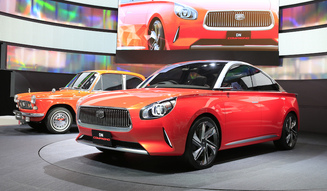
Daihastu DN Compagno
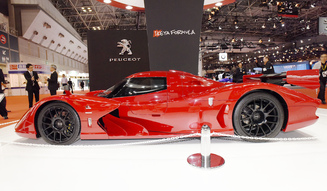
Ikeya Formula IF02RDS
Finally, let's look at a model that warrants attention from a technological standpoint: the "IF-02RDS" from Ikeya Formula, known for its tuning parts. This model is equipped with their independently developed "Seamless Transmission."
It's described as a system that aims to combine the best of both worlds: the lightness of a two-pedal single-clutch system and the low drive loss of a twin-clutch system. It pairs dog clutches with a manual transmission.
With its lightweight, simple, easy-to-handle, and low-drive-loss characteristics, we have high expectations for its future refinement. The vehicle it's mounted on didn't necessarily need to be a WEC (World Endurance Championship) machine.
Tokyo Motor Show 2017: An Insider's Look with Hirohisa Kaneko