An Interview with Shuichi Yamashita, Porsche AG Exterior Designer | Porsche
Porsche
Porsche AG Exterior Designer
An Interview with Shuichi Yamashita
Designing While Inheriting Porsche's DNA
Under the theme of "Evolution and Challenge: A Roadmap to the Future Sports Car," the "Panamera Sport Turismo" made its Japan premiere. The exterior design of this vehicle was handled by a Japanese designer. We conducted an interview with Mr. Yamashita, an Exterior Designer at Porsche AG.
Photographs by ARAKAWA Masayuki & Porsche AGInterview & Text by HARA Akira
The Rear Was the Most Challenging
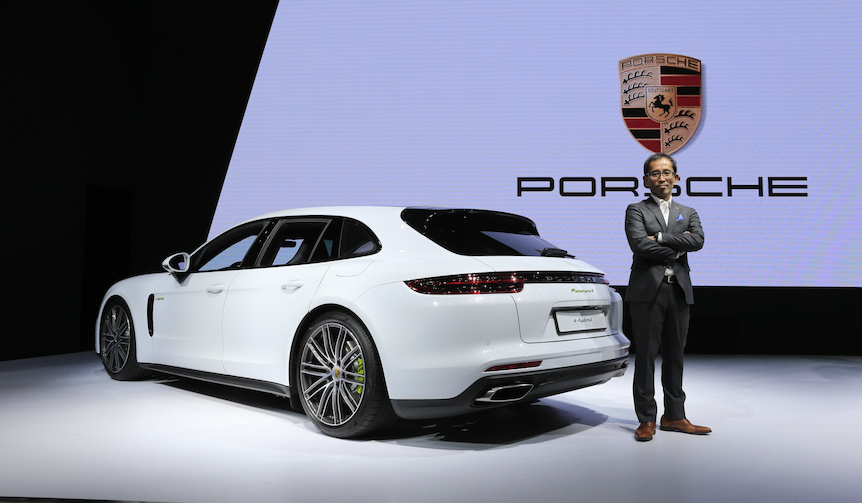
Tokyo Motor Show 2017Porsche's " at the Tokyo Motor Show 2017, making its Japan debut.Panamera Sport Turismo" is a shooting brake version that expands the rear seat and luggage space of the Panamera Saloon, offering a new proposal for Porsche luxury.
The exterior design of this car was actually handled by Shuichi Yamashita, a Japanese designer. He is currently based at Porsche's Weissach R&D Center and returned to Japan for this Tokyo Motor Show. Immediately after finishing the press conference attended by numerous reporters, we had the opportunity to speak with Mr. Yamashita, who was enjoying his long-awaited return to Japan.
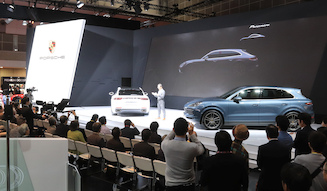
Scenes from the press conference
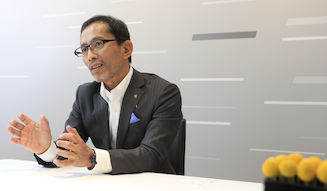
Porsche AG Exterior Designer Shuichi Yamashita
—First, what kind of company is Porsche?
After working at Mercedes-Benz and Saab, I have been in charge of exterior design at Porsche since 2006. What sets Porsche apart is the extremely high demands placed on design by management. In particular, at management meetings where everyone from top executives to designers gathers, even the smallest line on the body is discussed, and sometimes rejected.
—Could you tell us about the design of the new Panamera Sport Turismo, which you were in charge of and which made its Japan premiere at the Tokyo Motor Show?
We inherited Porsche's DNA of "instantly recognizable as a Porsche from any angle" and "looks like a sports car." To achieve this, the front features a sharp, central V-shaped hood reminiscent of the "911", flared fenders on either side, and four-point headlights inspired by the "919 Hybrid," a racing car competing in the WEC (World Endurance Championship).

Porsche Panamera Turbo S e-Hybrid Sport Turismo

The most challenging part this time was the rear. We spent a long time agonizing over how to maintain the enlarged interior space (for five occupants) while still creating a tapered line towards the rear, like a sports car, and drawing wide rear fenders. We also adopted a retractable active rear spoiler as a solution to achieve a sleek roofline while enhancing aerodynamic performance. We were conscious that this car is a "Sport Turismo" and not a "wagon"; what do you think?
Porsche
Porsche AG Exterior Designer
An Interview with Shuichi Yamashita
Designing While Inheriting Porsche's DNA (2)
Even with Electrification, Porsche Remains Porsche
—Does the image of "Porsche = 911" have an impact on designers?
It's both an advantage and a constraint. However, translating the DNA of the 911 into a design is an enjoyable task.
—As new powertrains like EVs are introduced in the future, how will they be reflected in Porsche's design?
Internal combustion engines require large openings for cooling, but motors do not need such large openings. Electrification, for example, increases design freedom. Nevertheless, the "Mission E" (a concept car showcasing Porsche's approach to e-performance) is a good example, where the design is consistently recognizable as a Porsche from any angle.

Porsche Panamera Turbo S e-Hybrid Sport Turismo

Porsche 356
—At this motor show, the "356 Speedster," which debuted in 1948 when founder Dr. Ferdinand Porsche said, "I was looking for a small, lightweight, and energy-efficient sports car that I envisioned, but I couldn't find one anywhere, so I decided to build it myself," is on display. What does the 356 mean to you, Mr. Yamashita?
It's the origin of the 911, or rather, the generation before its DNA. Perhaps it's like a grandfather. A compact sports car is also an ideal for me. I used to own a "Miata" (Mazda Roadster) years ago; it didn't have much power, but it was compact and agile, and I loved it.
After this, we took a commemorative photo with the Panamera Sport Turismo displayed at the motor show venue. As expected, Mr. Yamashita chose to stand at the rear side, a position that clearly shows his special attachment to the rear design, which he found so challenging.