Attending the Launch Event for the New Porsche Cayenne | Porsche
Porsche Cayenne | Porsche Cayenne
Attending the Launch Event for the New Porsche Cayenne
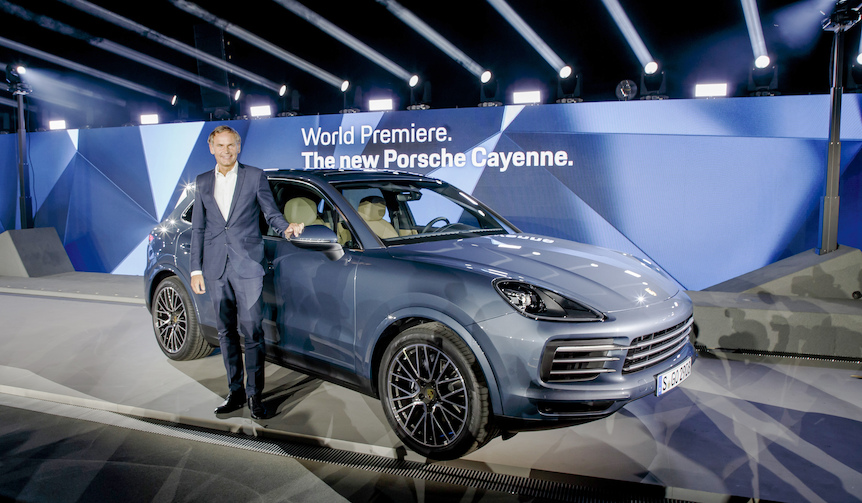
On August 29 (German time), Porsche unveiled the third-generation "Cayenne" to the world. Mr. Hirohisa Kaneko attended the launch event.
Text by KANEKO Hirohisa
A Museum Tracing the History of the Cayenne
I attended the launch event for the new Porsche "Cayenne".CayenneThe venue was the Porsche Museum at the company's headquarters in Stuttgart.
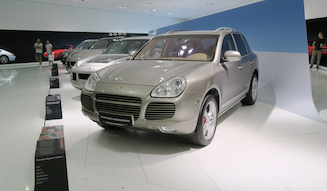
Before the rooftop ceremony at 9 PM, we were given a guided tour of the museum. To coincide with the new Cayenne's launch, a section of the floor displayed previous Cayenne models and off-road-oriented Porsches, such as the Paris-Dakar specification of the "959" derivative. The implication was, "The new Cayenne was developed as an extension of these."
Among them, the "Cayenne S Transsyberia" was particularly moving. These were rally-spec Cayenne S models, 25 of which were built in Weissach for the Transsyberia adventure rally, a race from Moscow, Russia, to Ulaanbaatar, Mongolia. They were converted to two-seaters, reinforced and optimized in various areas, with two spare tires, a jack, and tools installed in a custom trunk.
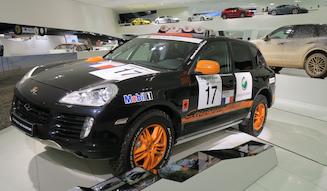
Porsche Cayenne S Transsyberia
Porsche Cayenne
As I participated in this adventure rally as a navigator in 2007 and 2008, I felt a strong sense of nostalgia seeing the Cayenne S Transsyberia again after 10 years.
The one on display belonged to the French team. The Japanese team's machine is now being restored and enjoying its retirement with a Dutch collector.
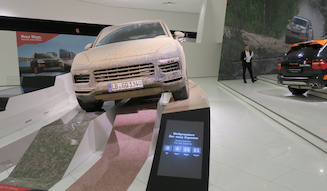
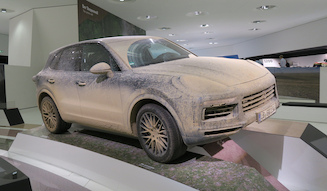
Next to the Cayenne S Transsyberia was, boldly, a prototype of the new Cayenne. It was displayed slightly elevated, still covered in mud from test runs on some off-road course. While elements like the taillights were clearly dummies, the body was distinctly different from the current model, suggesting it would be released in this form.
Porsche Cayenne | Porsche Cayenne
Attending the Launch Event for the New Porsche Cayenne (2)
A Sports Car Maker's Challenge That Changed the Tide
I have another sentiment to share. It's about how much the Cayenne has grown to reach its third generation.
When I first heard rumors that Porsche, a sports car manufacturer, would build an SUV, I thought it was a joke. I couldn't foresee its success. Yet, it has grown to become the backbone of Porsche, and the driving force behind the creation of its smaller sibling, the "Macan" and the sedan "Panamera". Back then, I couldn't have imagined it.
The SUV category itself was, in a sense, born from the success of the Cayenne.
Even before the Cayenne debuted in 2002, vehicles like the Land Rover, Jeep, Toyota "Land Cruiser," and Mercedes-Benz "G-Wagen" already existed.
However, these were classified as "off-road four-wheel-drive vehicles" and were recognized and treated as belonging to a specialized category, distinct from passenger cars like sedans, coupes, and station wagons.
Certainly, vehicles like the Mitsubishi "Pajero" and Toyota "RAV4" achieved temporary success, but they were still perceived as "different from passenger cars" or "a curveball for a change of pace."
But SUVs born after the Cayenne were all "cars that could be driven just like passenger cars." They were no longer a "curveball" but the main pitch.
Even so, contemporary Range Rovers, for instance, offered considerable on-road performance and comfort. However, the emphasis for off-road four-wheel-drive vehicles was still on their off-road capabilities, with on-road performance being merely secondary.
The Cayenne changed that entirely. It demonstrated equal, unwavering performance both on-road and off-road.
Porsche Cayenne | Porsche Cayenne
Attending the Launch Event for the New Porsche Cayenne (3)
The Cayenne Established the SUV's Status
I still vividly remember driving the first-generation Cayenne in Seville, Spain, shortly after its release. On-road, I was astonished by its firm ride and sharp handling, reminiscent of the "911", and off-road, it tackled challenging sections without requiring any special skills.
Its off-road capability was at a high level, almost unbelievable for a first attempt. It could handle any terrain with its low-range gearbox and air suspension, and the precise, electronically controlled distribution of power to all four wheels ensured its performance.
It was in no way inferior to the various off-road four-wheel-drive vehicles mentioned earlier. I was amazed by its ability to achieve a high level of performance on both on-road and off-road conditions. This was unequivocally proven in its participation in the Transsyberia Rally.
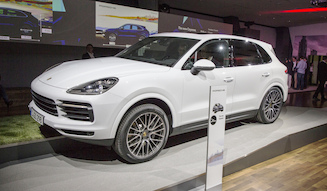
Porsche Cayenne S
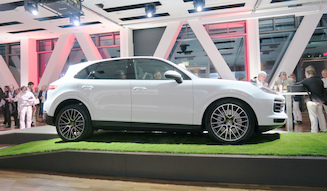
No such car had existed before. No one expected on-road performance from vehicles excelling off-road, and vehicles excelling on-road couldn't handle off-road conditions satisfactorily.
However, the Cayenne broke down the barriers between on-road and off-road. It was a car that could seamlessly traverse any surface at high speed and in comfort. Porsche established the SUV category as we know it today.
While the term "SUV" didn't originate with Porsche but rather comes from America, it's arguable that the Cayenne's innovation ultimately boosted the global popularity of SUVs.
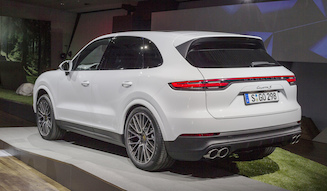
Porsche Cayenne S
Not just direct followers of the Cayenne, but SUVs came to be recognized as vehicles that could be driven without concern for on-road or off-road conditions (whether they could actually handle them is another matter).
As a new category, SUVs alone generated demand and have continued to be globally successful. They are no longer a temporary trend but have grown into a genre of their own.
The fact that not only Jaguar and Maserati but even Bentley are producing SUVs, and that Rolls-Royce and Lamborghini have announced their entry into the SUV market, shows how unimaginable it was for SUVs to become such mainstream vehicles.
Porsche Cayenne | Porsche Cayenne
Attending the Launch Event for the New Porsche Cayenne (4)
The Mature Third Generation: Integrating Needs and New Technology
The second-generation Cayenneomitted the low-range gear, weakening its off-road orientation. According to the developers, this was because "surveys of first-generation owners revealed that off-road and towing usage was less than expected." Instead, the adoption of PDCC (Porsche Dynamic Chassis Control System) enhanced on-road performance.
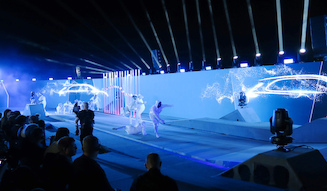
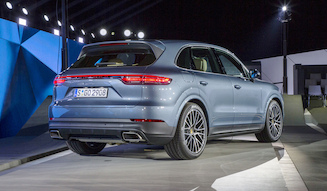
And now, the third generation. Unveiled at the museum's rooftop ceremony with a dance performance, the new Cayenne retains the image of its predecessors with its large front air intakes and overall silhouette. The taillight and headlight units are reminiscent of the 911 and Panamera.
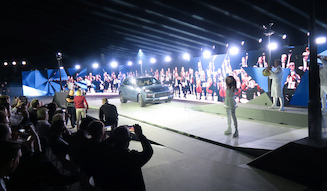
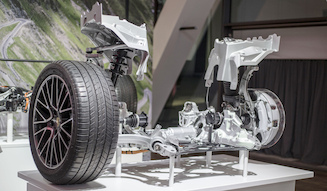
The technical details announced were extensive, but notable for the first time were the staggered tire sizes (different front and rear) and rear-axle steering.
Driver assistance and connectivity features are also in line with the 911 and Panamera.
The engine for the "Cayenne" is a 3.0-liter V6 turbo, producing a maximum output of 340 hp and a maximum torque of 450 Nm. Interestingly, the high-performance "Cayenne S" has a slightly smaller displacement of 2.9 liters. The S version generates 440 hp and 550 Nm through powerful twin-turbocharging.
Only V6 gasoline turbo engines were announced this time; diesel, the top-tier V8 gasoline turbo, and plug-in hybrid variants were not presented.
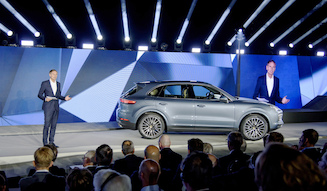
Paired with an 8-speed "Tiptronic S" automatic transmission, the performance figures show a top speed of 245 km/h for the Cayenne and 265 km/h for the Cayenne S. The 0-100 km/h acceleration is a swift 5.2 seconds for the Cayenne S, compared to 6.2 seconds for the Cayenne. This model change also involved significant weight reduction, making it approximately 65 kg lighter than the previous generation. The Cayenne weighs 1,985 kg, and the Cayenne S weighs 2,020 kg.
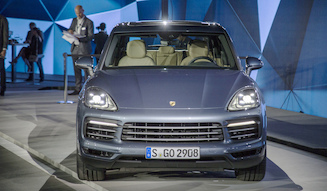
Porsche Cayenne
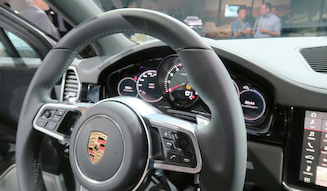
The interior has been further refined for enhanced quality and luxury. It also follows the Panamera's lead, featuring the characteristic large central tachometer in the instrument cluster, complemented by a 12.3-inch full HD screen in the center console for connectivity. The switchgear on the center console, now a flat, glass-look surface, is also a fresh touch.
My first impression is that this is a logical and steady model change. Based on observation and the explanations given, it aligns with the 911 and Panamera, comprehensively equipped with Porsche's interpretation of the technologies and features demanded by modern high-performance cars, rather than focusing solely on the SUV aspect. I'm eager to drive it soon. Ideally, across vast wilderness, much like the Transsyberia.