The Artisans Behind Rolls-Royce | ROLLS-ROYCE
Rolls-Royce
The Essence of Craftsmanship
The Artisans Behind Rolls-Royce
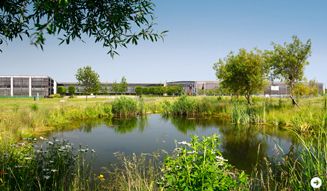
Based in Goodwood, England, Rolls-Royce crafts luxury automobiles tailored to the diverse preferences of its owners by skilled artisans. What are the key elements that make this car so special, beyond its price tag? Fumio Ogawa delves into the essence of craftsmanship.
Text by OGAWA Fumio
A Special Car Born in Britain
Rolls-Royce Phantom Series II, newly launched in JapanThis car stands out not merely as a mode of transport; owning a Rolls-Royce is a unique experience. One reason for this is the exquisite finish achieved by its skilled craftspeople.
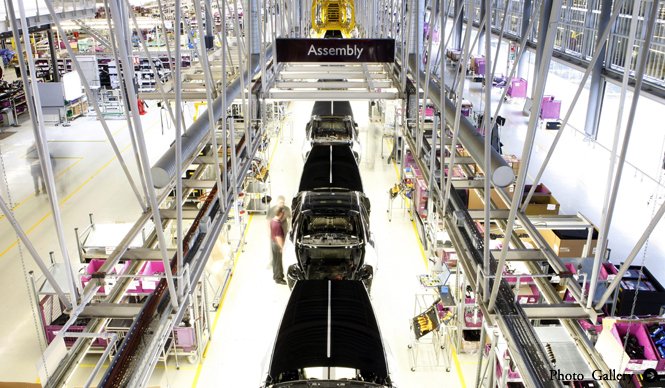
While Rolls-Royce, headquartered in Goodwood, England, employs robots for precise assembly, the finishing touches are entrusted to numerous artisans. It is natural for owners of cars exceeding 40 million yen to desire bespoke specifications. To meet this demand, the company has focused on its "Bespoke" program.
The Presence of Skilled Artisans
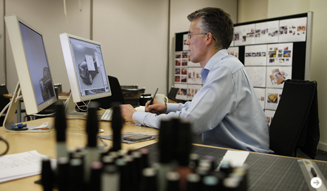
The core elements are wood, leather, and paint color. To this end, Rolls-Royce has traditionally maintained specialized departments such as a Wood Shop for processing interior wood panels, a Leather Shop for crafting leather for seats and dashboards, and a Paint Shop responsible for everything from color application to body finishing. Currently, these departments are being further enhanced.
Recently, in Nice,a test drive event for the Phantom Series IIwas held at the luxurious hotel Le Cap-Ferrat, where the aforementioned departments temporarily relocated. There, we had the opportunity to speak with representatives from each department about the essence of craftsmanship that makes a Rolls-Royce such a special automobile.
Rolls-Royce
The Essence of Craftsmanship
The Artisans Behind Rolls-Royce (2)
Woodworking Specialists
As its name suggests, the Wood Shop specializes in processing wood primarily used for the car's interior. Woodworking itself is further subdivided into specialized areas such as pressing, trimming, and sanding. The processed wood for the panels is transported from a factory in Milan, owned by a specialized German company, to the body shop in Goodwood.
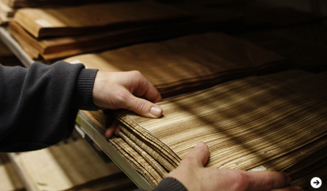
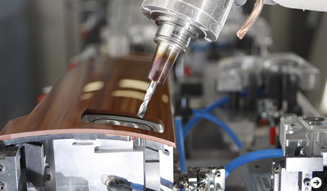
The specialist we spoke with described himself as a "veneer specialist." Delving into his work, he explained the art of "marquetry," where intricate patterns are created by inlaying different woods. "Marquetry is beautiful as an accent on the dashboard and appeals to the owner's pride due to its intricate nature. Once an order is placed, the concept is solidified through sketches, then drawn with pencil and ruler onto thin wood veneers. Finally, it's cut with a fine blade. The most crucial aspect is cutting perfectly straight lines without deviation."
The staff member who explained this entered the craft at 16, and after a four-year apprenticeship, began working on authentic Rolls-Royce projects. His deft hands skillfully cut thin wood veneers and meticulously combined different wood colors to create patterns, showcasing remarkable dexterity.
Rolls-Royce
The Essence of Craftsmanship
The Artisans Behind Rolls-Royce (3)
Painting Work Requiring a Tactile Sense
Given the Phantom's imposing length of nearly six meters, painting a Rolls-Royce is a substantial undertaking. The paint department employs a large staff, with currently 100 individuals working in two shifts. This work likely requires a human touch for tasks like sanding and polishing, incorporating artisanal handwork, presumably in certain areas.
The gentleman we spoke with in Nice has worked in the Goodwood paint shop for 10 years and now specializes in coachlines and accent details with small paintings. Coachlines are the thin lines that run along the sides of the body from front to rear. These are hand-painted. He demonstrated the technique, holding a specialized brush as fine as a toothpick. "The brush tips are 2mm and 3mm. I dip them in enamel paint and draw the line directly onto the car body. It's nerve-wracking at first, as there's no ruler. The bristles are made from squirrel tail hair. The brushes I use are made by a German manufacturer."
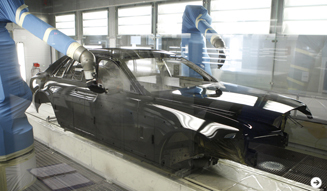
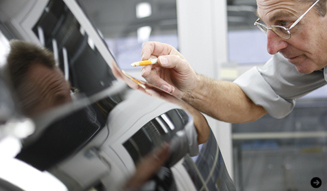
It took about six months to achieve mastery. "The qualities of a good artisan? Technical skill is essential, of course, but so is emotional control and talent. Innate sensibility is crucial; without it, one cannot progress." With an air of confidence, he demonstrated drawing a line with a smooth, fluid motion and then effortlessly sketched the Rolls-Royce mascot, the "Spirit of Ecstasy", onto a metal plate. It's not something everyone can do.
Rolls-Royce
The Essence of Craftsmanship
The Artisans Behind Rolls-Royce (4)
Meticulous Leather Color Matching
It is said that the hides of 11 cows are used for one Phantom. Consider the extensive use of leather: headliners, door panels, consoles, pillars, seats, dashboards, and steering wheels – the list is extensive!
Consequently, the Leather Shop employs 100 people, involving numerous specialists in cutting, covering (wrapping synthetic resin components with leather), and sewing. It takes five people to finish the seats for a single Phantom.
They use hides from European cattle, specifically from those raised for food in natural environments, to minimize waste. The processing method, drying, and tanning significantly impact the final finish of the leather. Rolls-Royce also differentiates the processing for the "Phantom" and the "Ghost". The surface treatment of the leather greatly affects its texture and visual impression, which in turn influences the car's overall character.
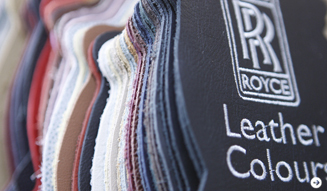
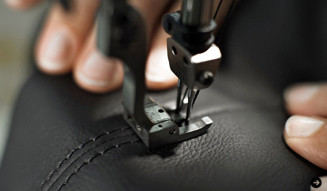
What both the Phantom and Ghost share is that Rolls-Royce dyes both the surface and the reverse side of the leather to achieve a deeper color. "Since we use hides from 11 cows, the most important thing is to match the colors precisely. Otherwise, the sense of luxury is lost. Some colors are easier to work with than others, while some are more challenging. Regardless, we meticulously match the colors through the same process." This was explained by a sewing machinist.
Her work involves embroidering leather. While monogram embroidery of initials on headrests is relatively common in Western countries, many owners request unique designs, such as an eagle's head, or treat the leather seats as a canvas for special patterns.
Projecting Oneself onto the Car
There are also many bespoke requests, such as tailoring the interior like a yacht or incorporating a picnic cabinet. Rolls-Royce's approach as a luxury car manufacturer is to be prepared to fulfill all kinds of requests in various forms. Japanese people are not as enthusiastic about projecting their individuality onto their cars as those in Europe, the US, or the Middle East.
Perhaps one reason is a reluctance to showcase personal tastes. While extremely bold body colors might be considered a social nuisance (laughs), when purchasing a car that can be customized to one's exact specifications, it might be worthwhile to enjoy personalization, not in the sense of fashion, but perhaps akin to customizing a home.