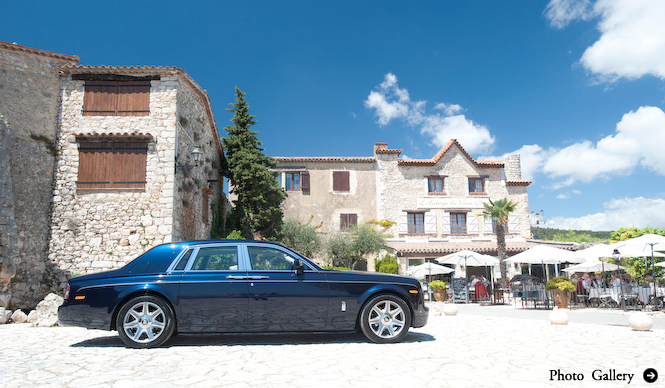
Driving the Rolls-Royce Phantom Series II Through the South of France | ROLLS-ROYCE
Rolls-Royce Phantom
The World's Ultimate Saloon
Driving the Rolls-Royce Phantom Series II in the South of France
At the Geneva International Motor ShowThe Rolls-Royce flagship model, the "Phantom," has debuted as the Series II after a minor model change. The Rolls-Royce flagship is, in essence, the world's ultimate saloon. A press test drive event for the "Phantom Series II" was recently held in Nice, in the South of France.
Text by OGAWA Fumio
An Unchanged Form
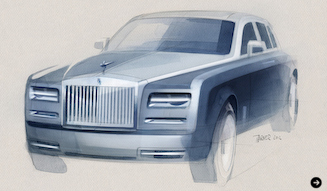
The Phantom is defined by our head of public relations as a "car with timeless appeal." Even upon meeting the Series II, no significant changes are apparent.
"Our customers desire it. In a survey we conducted among our clients, many expressed that they did not want the Phantom to change much, so this time we focused on enhancing its refinement."
This was stated by Rolls-Royce's development team, standing before the actual car in the gardens of Le Cap Estel, a luxury hotel beloved by European and American actors and musicians since before the war.
Currently, the Phantom family is broadly divided into the four-door saloon and the two-door coupe for private users. Furthermore, the saloon has a "Extended Wheelbase" specification, which extends the already long 3,570mm wheelbase to 3,820mm. In contrast, while the saloon boasts a total length of 5,842mm, the coupe, with a 3,320mm wheelbase and a relatively compact body of 5,612mm, also includes a "drophead coupe" with an electrically operated retractable roof.
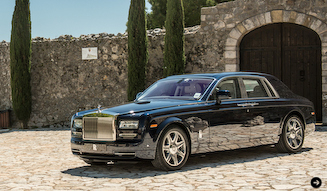
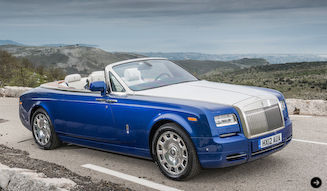
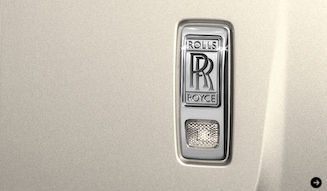
This minor model change sees the gearbox upgraded to eight speeds and the rear differential revised, resulting in a reported 10 percent improvement in fuel efficiency. Additionally, the body has undergone refinements, with the development lead noting that the "chassis has been strengthened." The headlamps have also been redesigned, along with the rear bumper shape. A notable feature of the Series II is the integration of the side coach lamps with the RR emblem.
Rolls-Royce Phantom
The World's Ultimate Saloon
Driving the Rolls-Royce Phantom Series II in the South of France (2)
The Phantom Offers Driving Pleasure Too
We test drove the saloon (standard wheelbase specification) and the drophead coupe. From Le Cap Estel, in what is known as the French Riviera, a route to Monaco along the coastal road called Basse Corniche and back to around Côte d'Azur Airport seemed like a reasonable test drive course.—Or so I thought.
However, the course prepared by Rolls-Royce was a mountainous route of nearly 400km. It included lunch at a restaurant with views of the Mediterranean Sea from a hilltop, and the route was designed to allow us to enjoy both the comfort-focused saloon and the comparatively sportier coupe.
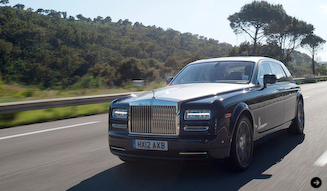
Rolls-Royce currently offers the "Ghost" with a 3,295mm wheelbase and a 5,400mm four-door body, intended for owner-drivers. This means the Phantom is a car best enjoyed from the rear seats rather than from behind the steering wheel. Of course, the rear seats are a superb place to be, as you can create your own comfortable space by choosing the seat material, the type of wood for the door trim, and even the curtains that shield you from external eyes.
However, Rolls-Royce also offers models with a "dynamic package" that includes chassis reinforcement. As Rolls-Royce states, "The Phantom offers driving pleasure too."
Rolls-Royce Phantom
The World's Ultimate Saloon
Driving the Rolls-Royce Phantom Series II in the South of France (3)
A Dream Car
The appeal of driving the Phantom Series II saloon—lies first in its substantial ride quality, weighing in at 2,560kg, despite the extensive use of aluminum. Even with the enormous 21-inch tires, there is absolutely no harshness. The ride, which can be described as flat on any road surface, is superb. This is the pinnacle of a car designed for passengers in the rear.
Yet, the handling is also excellent. With BMW overseeing the entire operation, it quickly became clear while driving that the development team's earlier claim, "The Phantom offers driving pleasure too," was true. The relationship between the slightly thin steering wheel and the car is excellent. While not overtly sporty, the steering response is quick, and the car moves faithfully to the driver's intentions, making the nearly 6-meter-long body feel surprisingly manageable.
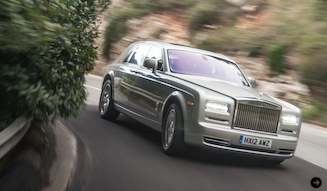
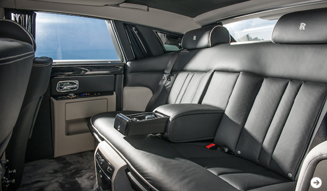
The mountainous areas behind Nice have many narrow roads. Unlike in Japan, there are no guardrails; only low, 10cm-high stones mark the edge of cliffs. There are many places where you must slow down considerably to pass oncoming traffic. While the Phantom might seem more suited to places like the casinos of Monaco, as a driver, I did not feel out of place at all.
The impeccably controlled suspension, precise steering, and the immense 720Nm of torque from the V12 engine, which responds instantly to even slight accelerator input, combine to make driving the car exceptionally enjoyable. This might also be due to the model I drove being equipped with the dynamic package, which includes a cross member in the front to reinforce the chassis's torsional rigidity. It corners eagerly and accelerates powerfully.
The rear seats, with their near-vertical backrests, are another unique feature, and the space, shielded from external view by thick pillars, is wonderful. However, the driver's seat is by no means inferior. The driving experience is so profound that a family trip to the South of France in a Phantom feels like a dream. I hear there are owner-drivers in Tokyo who handle the steering wheel themselves; it is indeed the right choice.
Rolls-Royce Phantom
The World's Ultimate Saloon
Driving the Rolls-Royce Phantom Series II in the South of France (4)
Enjoying the Scent of the South of France with the Drophead Coupe
Rolls-Royce has a unique philosophy in car manufacturing. One aspect of this is the absence of manual transmissions. Deceleration is achieved solely through braking. One might think ceramic brakes, like those on super sports cars, would be appropriate, but Rolls-Royce's philosophy seems to be that the natural feel of conventional brakes prevents discomfort for passengers. On descents, while the brakes are used considerably, they showed no signs of fading.
The same applies to the drophead coupe. This model has a shorter wheelbase and a more compact body than the saloon. It is fundamentally a personal, two-seater vehicle, and to enhance its sportier handling, it comes standard with a front cross member.
The steering wheel is smaller than in the saloon, and the driver's seat is slightly more snug, making it a car for those who enjoy driving themselves. It perfectly suits locations like the Riviera coast, where the wealthy gather from around the world. The interior, with its use of wood reminiscent of yacht construction, complements the atmosphere perfectly.
The handling is also more agile than the saloon's; acceleration is brisk from a standstill, and the body responds more quickly to initial steering inputs. With the top down, the sea breeze, the scent of trees, the fragrance of flowers, and even the aroma of freshly baked bread—various scents that make up the towns of the South of France—enhance the mood.
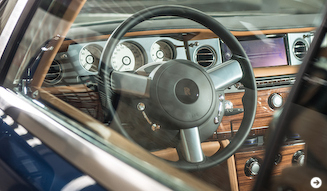
I previously drove the Series I of the same car along the coast of California, past Big Sur, where stylish resort hotels now stand. That was also a wonderful experience, but in terms of the sheer joy of changing scenery, I would give the edge to driving in the South of France.
While the saloon's interior, with its sophisticated dark brown tones, evokes old houses and elegant hotel receptions, which is appealing, the manufacturer seems to recommend choosing interior colors for the drophead coupe with open-top driving in mind. The white seats of the powerboats moored in the bays of the Côte d'Azur are beautiful, and selecting an interior to match their color scheme for the drophead coupe would be the height of chic. It's easy to see why the test drive was held in this location.
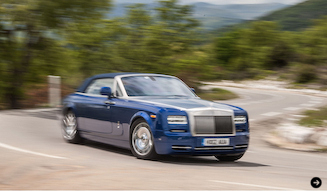
However, the drophead coupe is not a sports car. In tight corners, the steering's self-centering force is weaker, making it easy to lag behind by about half a turn when returning the wheel. And while it's called compact, a body measuring 5.6 meters in length and 2 meters in width is undeniably large.
The steering characteristics are nearly neutral, but even so, one hesitates to enter small, blind corners at high speed. In this regard, while not in the same class, cars like Bentley's "Continental GT" offer a more engaging driving experience.
Rolls-Royce Phantom
The World's Ultimate Saloon
Driving the Rolls-Royce Phantom Series II in the South of France (5)
Elements That Create the Phantom
The South of France seems to hold a special significance not only for Rolls-Royce but also for the British and Americans. When organizing this test drive event, Rolls-Royce explained, "The Côte d'Azur was a place where one of our founders, Frederick Henry Royce, had a summer villa and would invite Rolls-Royce engineers to discuss new car development during the summer months." Rolls-Royce also has models named after locations in the South of France, such as the Corniche.
Incidentally, while names like "Phantom" and "Ghost" might sound somewhat unsettling in Japan, in Britain, they carry a rather positive connotation, signifying "a being with power beyond human capabilities." Perhaps recalling the three ghosts from the 19th-century British novelist Charles Dickens's novel "A Christmas Carol" might help in understanding the nuance of the naming.
A car is said to be a comprehensive work of art, and in this way, various elements—the land of the South of France, the brand's history, literary works—all contribute to creating the Phantom. Its parent company, BMW, understands this well. Perhaps from a foreign perspective, the Phantom's worldview might seem a bit too classic. However, its established unique value, such as "sufficient power for necessity" and the serene drive provided by low cabin noise and comfortable ride, is deeply impressive.

Rolls-Royce Phantom Series II
Body size | Length 5,842 x Width 1,990 x Height 1,638mm [Length 5,612 x Width 1,987 x Height 1,566mm]
Wheelbase | 3,570mm [3,320mm]
Minimum turning radius | 6.9m [6.55m]
Trunk capacity | 460 liters [315 liters]
Weight | 2,560kg [2,630kg]
Engine | 6.75-liter direct injection V12
Maximum output | 338kW (460ps) / 5,350rpm
Maximum torque | 720Nm / 3,500rpm
Maximum speed | 240km/h
0-100km/h acceleration | 5.9 seconds (5.8 seconds)
Fuel consumption | 14.8ℓ/100km (approx. 6.75km/ℓ)
CO2 emissions | 347g/km
* Figures in brackets are for the Drophead Coupe