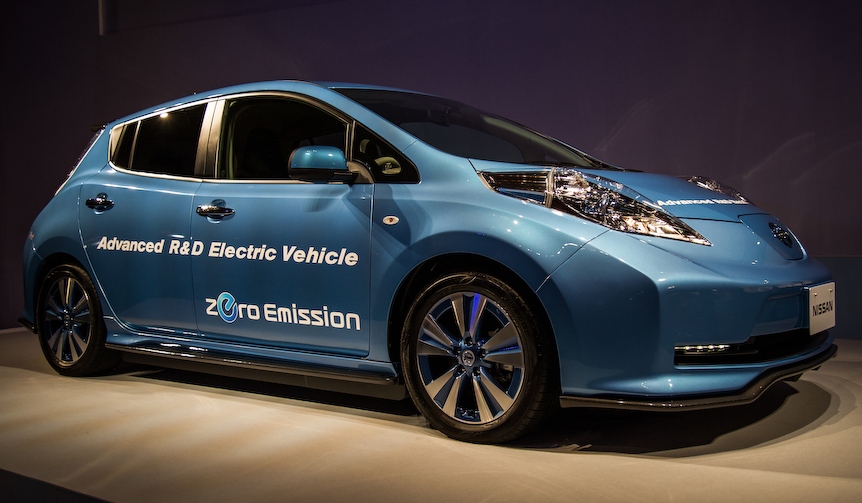
Nissan's Future Cars, Revealed Through Advanced Technology: Part 1 | Nissan
The Rapidly Evolving Electric Car
Nissan's Vision of the Future Car, Part 1: Advanced Technologies
Nissan Motor Corporation garnered significant attention by exhibiting the autonomous electric car "IDS Concept" at the Tokyo Motor Show. Already making EVs a common sight with the "Leaf," how does Nissan envision the cars of tomorrow? Tatsuya Otani visited Nissan's Advanced Technology Development Center (NATC) and reports on the "future car" they are aiming for, based on the cutting-edge technologies introduced. Part 1 primarily focuses on electric cars and their surrounding environment.
Text by OTANI Tatsuya
Practical Driving Range Is Just a Matter of Time
Nissan's vision is clear. They believe the future of automobiles hinges on two key aspects: "zero emissions" and "zero traffic fatalities." To achieve these, they see the "electrification" of vehicles and further "intelligentization" as essential. To put it more simply, electrification refers to the advancement of electric cars, while intelligentization pertains to the practical implementation of autonomous driving.
The primary concerns with electric cars are the perceived insufficient driving range on a single charge and the inconvenience and time required for recharging.
The most direct way to increase driving range is to expand battery capacity. Nissan is indeed working on this, having developed a 60 kWh battery pack, approximately double the capacity of the current Leaf (24-30 kWh), which was also showcased at this technology event. If the weight increase associated with greater battery capacity is not excessively large, it could not only significantly surpass the Leaf's current range of 280 km (30 kWh) to reach the 400 km range, but potentially even approach 500 km.
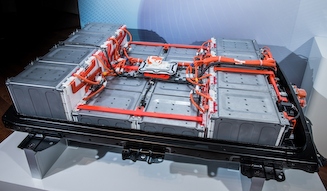
60 kWh Battery

Thin battery cells developed for 60 kWh
If this is achieved, the driving range of electric cars should be considered perfectly adequate for practical use. Furthermore, this battery is expected to be implemented within a few years. This suggests that, while cost will be a factor, the era of explosive EV adoption may not be too far in the future.
Another benefit of increased battery capacity is its connection to reduced charging times. Naturally, if charging proceeds at the same rate as before, a larger capacity battery will take longer to fully charge. However, larger battery capacities can more readily accept higher power inputs in a shorter time, which in turn leads to reduced charging time for a given driving distance. In other words, to charge enough for 100 km of driving, a 60 kWh battery will charge faster than a 30 kWh battery.
This can be easily understood by likening the battery to a narrow-mouthed bottle and electricity to water. No matter how much water you have, if the bottle's opening is narrow, it's difficult to pour water in quickly. However, if you have multiple narrow-mouthed bottles, the total speed at which you can add water increases. The same phenomenon occurs when increasing battery capacity, thus contributing to shorter charging times.
The Rapidly Evolving Electric Car
Nissan's Vision of the Future Car, Part 1 (2): Advanced Technologies
Demanding Realism in Aerodynamic Research
In terms of saving charging time, the practical implementation of contactless charging, which allows electric cars to charge simply by parking in a designated spot without connecting a cable, is also effective. Nissan is prototyping a high-power 7 kW contactless charging system, but efficient contactless charging requires highly precise parking alignment.
This leads to the idea that if parking is automated, it can be handled by autonomous driving. Incidentally, Nissan's future goal is "high-power/high-gap" contactless charging, which can deliver high power even with a significant distance between the charging unit and the electric car. If this becomes possible, an era may arrive where charging occurs simply by driving in "contactless power transfer lanes" established like side roads along highways. This means charging without the need to stop.
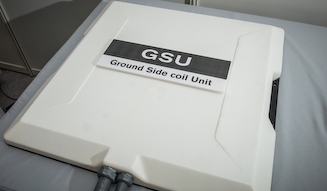
Contactless charging ground coil unit
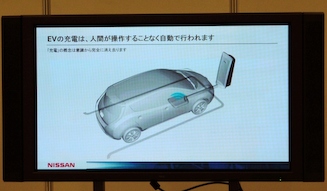
Contactless charging requires no manual effort
Similarly, reducing rolling resistance also contributes to extending the driving range of electric cars. This includes measures such as decreasing air resistance and reducing vehicle weight. Both are methods also employed to improve fuel efficiency in gasoline cars.
Regarding the reduction of air resistance, Nissan made an interesting announcement this time.
Typically, when developing aerodynamics through wind tunnel tests or computer simulations, cars are assumed to travel in a perfectly straight line, and wind is assumed to blow directly from the front. However, in real-world driving conditions, wind can come from any direction, and cars are not always traveling in a straight line.
Therefore, Nissan is developing aerodynamics that reduce air resistance even when the car's direction of travel and the wind direction are slightly misaligned, working to achieve a reduction in air resistance that is effective under actual driving conditions.
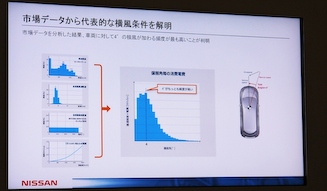
To improve aerodynamics, Nissan conducted tests at a 4-degree crosswind angle, the most frequent condition in actual driving.
In fact, similar development is common in the world of motorsports like F1, but this is the first time I've heard of it being applied to mass-produced vehicles.
The Rapidly Evolving Electric Car
Nissan's Vision of the Future Car, Part 1 (3): Advanced Technologies
Aerodynamics: The Key to Improving EV Efficiency
Nissan is keenly focused on reducing air resistance for a clear reason. For gasoline cars cruising at 100 km/h, heat loss (referring to heat released into the atmosphere through engine cooling) accounts for nearly 60% of energy loss, while loss due to air resistance is a relatively small 13%. This means that for gasoline cars, efforts to reduce heat loss are more likely to lead to improved fuel efficiency.
Conversely, in electric cars, heat loss for cooling motors and batteries accounts for less than 10% of the total loss, while air resistance represents a relatively large 59%. In absolute terms, the value of air resistance is not vastly different between gasoline and electric cars (theoretically, electric cars can achieve lower air resistance due to less need for cooling), but because the total amount of loss is smaller in electric cars, the proportion of loss attributed to air resistance becomes larger.
In other words, Nissan's focus on aerodynamic development is not unrelated to their mass production of the Leaf.
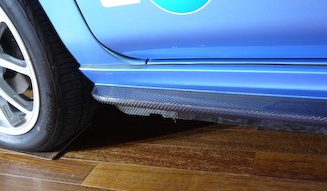
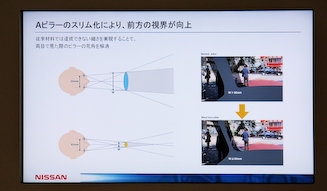
Other methods to reduce driving resistance include reducing rolling resistance and vehicle weight (i.e., weight reduction). However, reducing vehicle weight also leads to reduced rolling resistance and improved dynamic performance, making weight reduction a "universal solution" that enhances various aspects of a car's performance.
Nissan is therefore researching lightweight materials and, as usual, is actively pursuing the adoption of carbon composites. What's unique about Nissan, however, is not just making the car lighter, but using high-strength carbon composites for components like the A-pillars to reduce their cross-sectional area, thereby improving visibility. Such flexible thinking is rarely seen from other manufacturers.
The Rapidly Evolving Electric Car
Nissan's Vision of the Future Car, Part 1 (4): Advanced Technologies
Beyond Transportation: New Uses for EVs
While efforts are being made to overcome the disadvantages of electric cars, another significant advantage lies in "leveraging the EV's ability to store and supply electricity for the benefit of the local community."
For example, Nissan connects employee-used Leafs for commuting to the company's power grid. By storing electricity in the Leaf's battery beforehand, they are working to reduce electricity costs by suppressing peak power consumption within the company building. In essence, by charging the Leaf during off-peak hours and discharging from the Leaf during peak hours, they lower the peak demand for electricity purchased from the utility provider.
This leads to electricity bill savings because the basic charge is determined by the peak power consumption. If the total amount of electricity used is the same, reducing the peak value results in lower overall electricity costs.
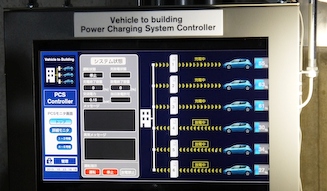
A controller that manages the charging status of each vehicle and its supply to the building in "Vehicle to Building"
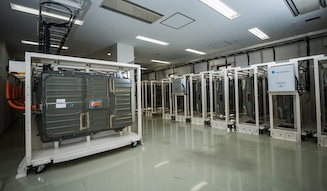
4R Energy is experimenting with suppressing peak electricity demand and reducing electricity costs by using Leaf batteries that are no longer suitable for automotive use.
Taking this concept a step further, there are initiatives to suppress peak power consumption within facilities by utilizing systems composed of multiple batteries that have reached the end of their lifespan for EV use.
Currently, 4R Energy, a joint venture between Nissan and Sumitomo Corporation, is conducting demonstration experiments at Nissan's Advanced Technology Development Center (NATC) in Atsugi City. Here, they operate a system connected to 24 Leaf batteries, each with a capacity reduced to about 70% of their original state. Once commercialized, the aim is for users to reduce their electricity bills by 10% at no cost to them, simply by providing space for the 4R Energy system and contracting with a power company designated by 4R Energy.