Nissan's Future Cars, Revealed Through Advanced Technology: Part 2 | Nissan
Aiming for Considerate Autonomous Driving
Nissan's Future Car, Revealed Through Advanced Technology: Part 2
Nissan Motor Corporation garnered significant attention at the Tokyo Motor Show with its exhibit of the autonomous electric vehicle "IDS Concept." Already making EVs a common sight with the "Leaf," how does Nissan envision the cars of the future? Tatsuya Otani visited Nissan's Advanced Technology Development Center (NATC) and reports on the "future car" they are aiming for, based on the cutting-edge technologies introduced. This second part primarily examines how Nissan intends to achieve autonomous driving, a technology that major automakers are pouring resources into developing.
To Nissan's Future Car, Revealed Through Advanced Technology: Part 1
Text by OTANI Tatsuya
Is Autonomous Driving Achievable?
What about intelligence, the other pillar of Nissan's efforts alongside electrification?
Autonomous driving is, without a doubt, the most talked-about technology today, with major automakers worldwide pushing its development. However, "autonomous driving" itself encompasses a wide spectrum. In fact, Mercedes' "Distronic Plus with Steering Assist," an advanced adaptive cruise control that pioneered the field, is also a form of autonomous driving. While agencies like the U.S. National Highway Traffic Safety Administration (NHTSA) and Japan's Ministry of Land, Infrastructure, Transport and Tourism classify this as Level 2, Level 3, where the car handles all driving operations, and Level 4, where the human merely inputs the destination and the car autonomously makes all decisions and operations, lie further ahead.
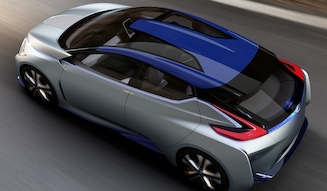
The autonomous EV "IDS Concept" unveiled at the Tokyo Motor Show.
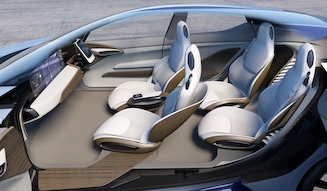
But is autonomous driving truly feasible from a technological standpoint? I personally believe that fully autonomous driving will eventually become a reality. Of course, this will require access to powerful computers and memory capable of far more advanced calculations than currently available, at a lower cost. The development of algorithms that can make swift, appropriate decisions will also be crucial.
Nevertheless, looking back at the technological advancements of the past 20 years, or even the last decade, it's clear that progress in these areas is achievable with sufficient time. The remaining challenges are the creation and updating of highly detailed 3D map data, and the reduction in cost of laser scanners.
At this event, Nissan announced a "mass-production prototype laser scanner." This signifies that they have a clear path to reducing the cost of laser scanners to a level suitable for mass-produced vehicles. Before delving into the details, let's explain what a laser scanner is.
Aiming for Considerate Autonomous Driving
Nissan's Future Car, Revealed Through Advanced Technology: Part 2 (2)
Technology Alone Won't Lead to Adoption
A laser scanner is a device that precisely measures the distance to an object using laser light and captures its detailed shape in 3D. While already in practical use for industries like civil engineering, its size, comparable to a large briefcase, and cost, ranging from several million to ten million yen, make it unsuitable for automotive integration.
However, Nissan's prototype, with its innovative design that eliminates mechanically moving parts internally, has achieved a significant reduction in size—to about the dimensions of a compact smartphone for the visible components—while also bringing the cost down to a level feasible for mass-produced vehicles.
Unlike conventional laser scanners, this unit cannot cover a full 360-degree range on its own, necessitating the installation of four units around the vehicle—front, rear, left, and right. However, their design, which integrates more seamlessly with the car's aesthetics than the bulky, roof-mounted laser scanners of the past, is expected to play a significant role in the practical realization of autonomous driving.
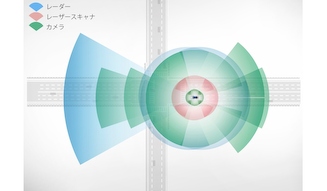
With the advent of practical laser scanners, one might say, "All the necessary element technologies for autonomous driving are now in place." However, there is a significant gap between technological feasibility and the acceptance of autonomous driving within real-world traffic society.
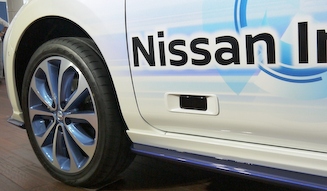
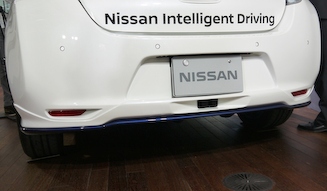
While autonomous driving is expected to be gradually implemented in the coming years, autonomous vehicles will not only need to coexist with human-driven cars but also be accepted as "fellow members of traffic society" by pedestrians and cyclists sharing the same roads.
However, replicating the nuanced communication that has traditionally occurred between pedestrians and drivers on the road is proving difficult between pedestrians and autonomous vehicles. This is because autonomous vehicles may operate without a human driver present, potentially eliminating the possibility of communication through eye contact or gestures.
Aiming for Considerate Autonomous Driving
Nissan's Future Car, Revealed Through Advanced Technology: Part 2 (3)
Becoming a Considerate Driver
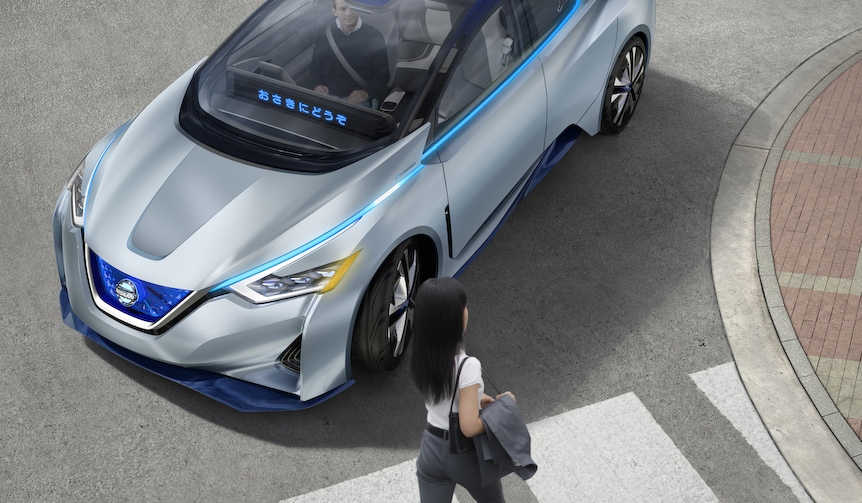
In this area, Mercedes has proposed new communication methods with its concept car "F015 Luxury in Motion." Nissan, on the other hand, has developed a device featuring an LED array encircling the entire body. When pedestrians or cyclists are detected, the LEDs facing them illuminate brightly, signaling that the autonomous vehicle is aware of their presence. Additionally, they propose a message display using an electronic signboard positioned low on the front windshield, capable of showing messages like "After you." These features were showcased in the "IDS concept" car at the Tokyo Motor Show.
However, what captured my interest more than these announcements was Nissan's intention to leverage artificial intelligence to integrate autonomous driving seamlessly into the "natural flow of traffic."
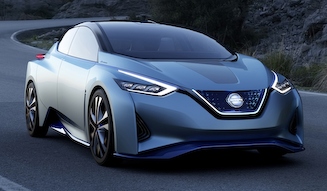
Nissan IDS Concept

Nissan IDS Concept Autonomous Driving Mode
For instance, when encountering a car with priority at an intersection, the basic protocol is to yield and wait. However, if a pedestrian intending to cross appears before the priority vehicle, that vehicle may have to stop. In such scenarios, there might be cases where I, despite not having priority, could proceed first. Conversely, failing to do so might frustrate the driver behind me, perceiving it as "inconsiderate driving." In other words, even with autonomous driving, demonstrating "consideration" is crucial for maintaining the natural flow of traffic.
However, programming a computer to execute this is surprisingly difficult. This is where artificial intelligence comes in. By thoroughly understanding the surrounding traffic conditions and "reading" the flow of traffic two or three steps ahead, much like in Go or Shogi, AI can determine the most efficient course of action. Nissan is conducting research to achieve autonomous driving that avoids causing frustration to others by making such judgments.
Aiming for Considerate Autonomous Driving
Nissan's Future Car, Revealed Through Advanced Technology: Part 2 (2)
Incorporating the Owner's Habits
However, this type of "considerate driving" can easily lead to "predictive driving" and potentially cause accidents. When I raised this concern with Dr. Liam Pedersen, who led the presentation, he responded, "That is because actions are based on incorrect predictions. We only act based on correct predictions. Furthermore, by performing multiple predictions hierarchically, we have built a system that can respond flexibly to changing situations."
Incidentally, Dr. Pedersen, who currently works at Nissan's research center in Silicon Valley, previously worked at NASA, where he was involved in research on vehicles for traversing extraterrestrial bodies.
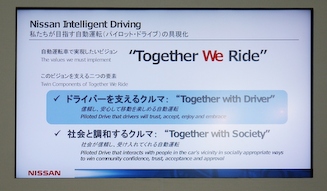
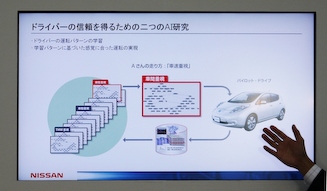
Furthermore, Nissan believes that it is important for the widespread adoption of autonomous driving that the system learns the driver's preferences during manual operation—such as how much space they leave when avoiding roadside obstacles—and closely mimics these during autonomous driving. This would help alleviate any anxiety for the person inside the autonomous vehicle (though the term "driver" might be inappropriate, as they are not actually driving).
In essence, Nissan's development of autonomous driving is shifting its focus from "Can it drive autonomously?" to "How can it be more smoothly integrated into current traffic society?"
While Eikichi Yazawa declares "Do it, Nissan" in the TV commercials, Nissan is not attempting anything reckless. Rather, they are striving to create a considerate form of autonomous driving that understands human emotions.
To Nissan's Future Car, Revealed Through Advanced Technology: Part 1