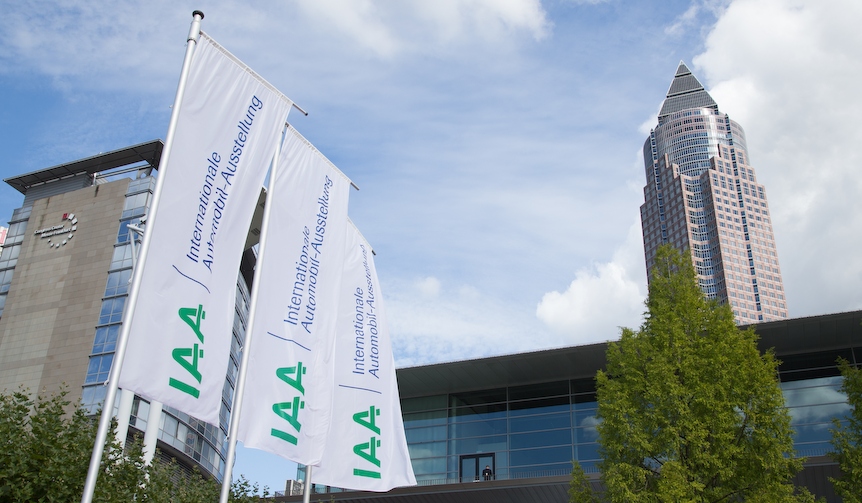
Eco Strategies from Each Brand Seen at Frankfurt | IAA 2015
Frankfurt Motor Show 2015 (IAA 2015)
Eco Strategies from Each Brand at Frankfurt
Eco has always been the main theme at recent motor shows. This year's Frankfurt Motor Show was no exception, with a wide range of eco-conscious models, from concept cars to production vehicles, unveiled by each brand. Fumio Ogawa reports on the eco-friendly initiatives of various companies, based on what he saw, heard, and asked about during his visit to the show.
Text by Fumio Ogawa
The 2020 Problem Will Change the Era
The Frankfurt Motor Show, held in Frankfurt, Germany, in September 2015, was an "on-parade" of eco-cars. From Porsche's electric vehicles to numerous electric and plug-in hybrid offerings from Audi, Volkswagen, Mercedes-Benz, and BMW, the show was dominated by green technology.
The reason for this is the "2020 Problem" problem that automakers are currently grappling with. As readers may already know, the European Commission has mandated that the average CO2 emissions for vehicles sold in the European market must not exceed 95g per kilometer by 2020. Exceeding this limit will result in substantial fines.
For automakers, who are conscious of their social responsibility and for whom environmental compliance is a must for investor relations, finding a solution by 2020 is paramount. Consequently, plug-in hybrids (PHVs), which can be charged and where electric motors play a larger role than the engine, are currently drawing significant attention.
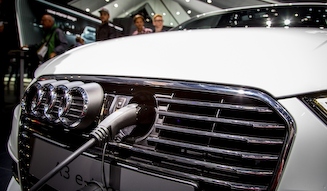
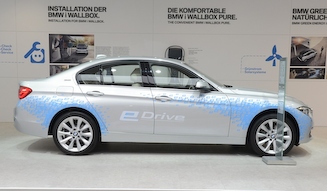
Not long ago, PHVs were considered a luxury. They were expensive, and owners found themselves in a peculiar dual position: conscious of their social responsibility while also displaying a privileged status. That perception has now shifted. In Germany, the prices of plug-in hybrids have been strategically lowered, with models now appearing that are comparable in price to gasoline-powered cars.
"Plug-in hybrids can achieve emissions below 90g per kilometer. We want to encourage their widespread adoption to avoid penalties," explained a spokesperson from the Munich-based manufacturer at the show.
Volkswagen and Audi, in particular, are advancing their eco-car strategies with a strong lineup of PHVs.
Frankfurt Motor Show 2015 (IAA 2015)
Eco Strategies from Each Brand at Frankfurt (Part 2)
PHVs in SUVs and Sedans
"Our newly developed 2-liter, 4-cylinder gasoline engine is more fuel-efficient than the previous 1.4-liter, resulting in lower CO2 emissions," stated Dr. Ulrich Hackenberg, head of technical development at Audi AG, proudly at the Frankfurt Motor Show during the unveiling of the new Audi A4.
The new 4-cylinder engine in the A4 utilizes the Miller cycle, rather than the conventional Otto cycle. While Toyota is also a proponent of this technology, it essentially involves adjusting the timing of the intake valve closure to make the expansion ratio larger than the compression ratio, thereby improving combustion efficiency.
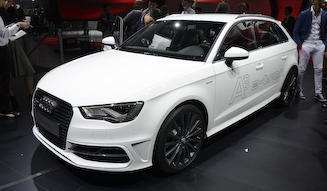
Audi A3 e-tron
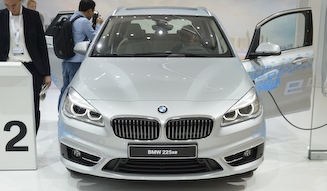
BMW 225xi
"The future will move towards greater energy conservation and CO2 reduction. In this context, urbanization will increasingly steer towards intelligent mobility solutions," stated Dr. Martin Winterkorn, Chairman of the Supervisory Board of the Volkswagen Group. "Intelligent" is a trendy keyword in the automotive industry today, referring to the use of electronic assistance to improve fuel efficiency, encompassing everything from engine combustion control to autonomous driving systems that enable more efficient driving than a human.
SUVs continue to be globally popular, and this show featured new models from Bentley, "Bentayga", and Jaguar, "F-Pace". Volkswagen also announced a new version of its SUV, the Tiguan, but the real highlight was the simultaneously revealed "GTE" plug-in hybrid model (though its release is scheduled for a later date).
While the fully redesigned "7 Series" was the centerpiece of BMW's display at the show, the plug-in hybrid model, the "740e," particularly stood out. Achieving nearly 50 km per liter and emitting only 49 grams of CO2 per kilometer, it boldly declared itself a benchmark for the future of luxury sedans. Furthermore, plug-in hybrid variants, denoted by the "e" suffix, were also introduced for the "X5", "3 Series", and "2 Series" models.
Frankfurt Motor Show 2015 (IAA 2015)
Eco Strategies from Each Brand at Frankfurt (Part 2)
The Future of Sports Cars in an Era of High Efficiency
"Sports cars and EVs have traditionally been seen as incompatible, but we have succeeded in merging them," said Matthias Müller, CEO of Porsche AG, as the "Mission E", a four-door concept model, was unveiled at the show.
"This will serve as an example of what a pure EV sports car can be," Müller explained. The Mission E boasts supercar-level performance, accelerating from 0 to 100 km/h in 3.5 seconds. With a charging time of just 15 minutes, it was emphasized as a Porsche that can be used daily in any situation. However, the Mission E, with its suicide doors and distinctive curved body panels, remains a concept model for now.
While the rumored 4-cylinder model of the "911" did not appear, the news was that the "911 Carrera Now Features Turbocharging" now incorporates turbocharging. Müller stressed that the future direction for the 911 will involve increasing torque from lower RPMs, thereby improving fuel efficiency.
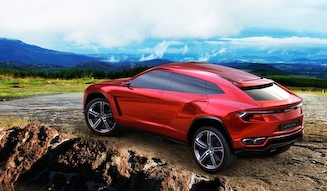
Lamborghini Urus
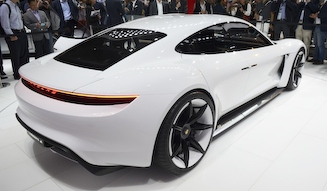
Porsche Mission-e
"We understand the importance of efficiency," said Stefano Domenicali, CEO of Automobili Lamborghini.
"However, we will not be immediately fitting turbocharged V6 engines into the "Aventador" or the "Huracán", as our fans do not expect that. However, for the SUV we will be announcing soon (reportedly to be released in 2018 under the name ""Urus"), we will likely use a turbocharged engine. Although it will use a platform developed by Audi (within the same group), it will be a model that fully embodies Lamborghini's unique character."Huracán LP610-4 Spyder" Lamborghini, which also unveiled the "Huracán" at the Frankfurt Motor Show, may also be at a crossroads as it heads into a new era.