Audi's Vision for the Future: A Drive of the A1 & A3 e-tron
Audi A1 e-tron
Audi A3 e-tron
Audi's Vision for the Future
Test Drive: A1 & A3 e-tron (1)
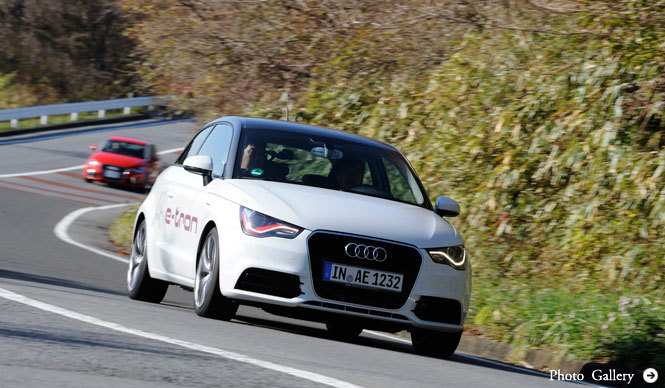
Audi brought "the future" to Hakone. In November 2011, they rented out the Hakone Turnpike for a test drive event of their zero-emission vehicles, dubbed "e-tron."
By Fumio OgawaPhotos by Nobuhiro Takahashi
The A1 e-tron as a Range Extender
e-tron represents Audi's new concept for mobility. Two models were brought to Japan from Ingolstadt, Germany, bearing their local license plates: theA1 e-tronand theA3 e-tron.
Audi has launched an "e-mobility" project, and it is said that more concept models for the future, including electric and hybrid vehicles, will be announced.
The A1 e-tron is based on the most compact model in Audi's lineup,the A1, which was also introduced to the Japanese market in 2011. This 2-door, 3,970mm long vehicle embodies the range extender concept.
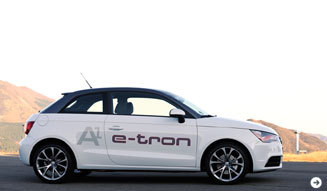
A range extender is a form of electric vehicle. It runs on an electric motor and battery, but when the battery charge gets low, an engine starts (automatically) to supply electricity to the battery. The aim is to extend the driving range, which is a bottleneck for electric vehicles. While it's impossible to achieve zero local emissions, a small engine suffices, and reliance on charging infrastructure is relatively light. It's a practical concept. There are already precedents in the market, such as theChevrolet Volt.
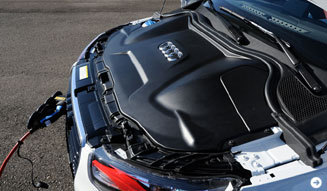
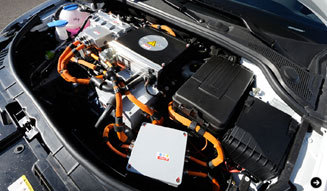
The A1 e-tron's powertrain features a 45kW continuous output and 150Nm of torque. The unit, comprising the motor and converter, is mounted transversely at the front. The 12kWh lithium-ion battery is housed in the center tunnel and under the rear seats. Electricity is supplied by a 254cc single-disc NSU rotary engine, allowing for a more compact overall design compared to a pure EV. The engine is mounted at the rear.
Audi A1 e-tron
Audi A3 e-tron
Audi's Vision for the Future
Test Drive: A1 & A3 e-tron (2)
The A3 e-tron: A Pure EV with a 140km Range
The A3 e-tron is a pure EV concept model. It utilizes the body of the 4-door hatchback A3 and is equipped with a 60kW water-cooled electric motor and a single-speed transmission. The lithium-ion battery consists of 30 modules, distributed under the luggage compartment, rear seats, and in the center tunnel. This distribution, we are told, is to prevent the large battery from encroaching on passenger or cargo space.
With a fully charged battery, the A3 e-tron can travel approximately 140km. "This is sufficient for daily urban driving," states Audi. Although not yet installed in the test vehicles, three driving modes are currently being considered: "Dynamic" mode for maximum electric motor power, "Auto" mode to limit system power and extend range, and "Efficiency" mode to maximize range by limiting the electric motor output to 50kW and reducing the top speed from 145km/h to 110km/h.
Reducing vehicle weight is also effective for efficiently using power and extending range. The A3 e-tron weighs 1,592kg, which is "only slightly heavier" (according to Audi) than the A3 Sportback 2.0 quattro TDI (not available in Japan). They are considering new-era cars from various angles to make them more practical. It's understandable why Audi emphasizes that "what sets this apart from competing models is its suitability for everyday driving, with no compromises for the driver."
Audi A1 e-tron
Audi A3 e-tron
Audi's Vision for the Future
Test Drive: A1 & A3 e-tron (3)
The A1 e-tron: Agile Like a Sports Car
The A1 e-tron and A3 e-tron. Both carry the "e-tron" sub-name, but as discussed, the A1-based vehicle is a range extender with a gasoline engine, while the A3-based one is a pure EV.
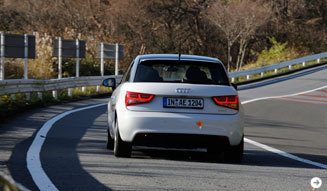
The driving experience also differs significantly. First, the A1 e-tron. The impression upon driving it was one of surprising agility, with excellent responsiveness when turning the steering wheel. It corners nimbly, reacting obediently to steering input like a sports car, which is truly exhilarating. While the A1 itself is known for its handling, this is on another level. Thanks to the electric motor's instant maximum torque, we experienced a power comparable to a large-displacement gasoline engine car, even on the steep Hakone Turnpike.
Paddle Shifters Adjust Engine Braking
Regarding this responsive handling, an Audi product strategist who accompanied the vehicles to Japan explained: "The small power unit is only at the front. Heavy components like the battery are mounted near the axles and compactly, and the small 65kg rotary engine unit is mounted at the rear, bringing the front-rear weight distribution close to ideal."
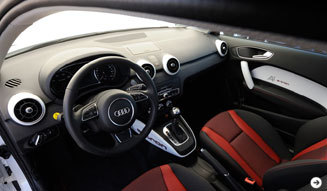
The steering column has paddles, but these are not for the transmission. Pulling the right-hand paddle towards you adjusts the engine braking in five stages. The left-hand paddle releases them incrementally. This allows control over the regenerative braking, which supplies electricity to the battery during deceleration. For example, selecting "5" engages strong engine braking when you lift off the accelerator, which is somewhat helpful for slowing down before corners.
"In typical EVs and hybrids, regenerative braking engages when you lift your foot off the accelerator, but this often feels unnatural. Audi prioritizes a natural driving feel, so we adopted paddle shifters for the driver to control regenerative braking intentionally," explained an Audi technician at the test drive venue.
Audi A1 e-tron
Audi A3 e-tron
Audi's Vision for the Future
Test Drive: A1 & A3 e-tron (4)
An Era of Cars with New Driving Pleasures
The A3 e-tron's handling feels closer to that of a standard A3. Despite housing 30 lithium-ion battery modules kept within an optimal temperature range of 20 to 55 degrees Celsius by liquid cooling, the space is not compromised due to the clever distribution of the battery across three locations, contributing to a favorable weight distribution and center of gravity height.
The weight is also similar to the normal model, around 1.6 tons. Consequently, the torque remains consistent from startup to high speeds, and the rapid acceleration feels almost otherworldly. The 270Nm of maximum torque doesn't make the car feel heavy. In the commercially available model with the 1.4-liter turbo engine, the mapping prioritizes fuel efficiency, leading to early upshifts that can sometimes feel less than smooth, or even slightly bothersome if you focus on the shift shock. If there's a downside to the conventional model, the e-tron version has none.
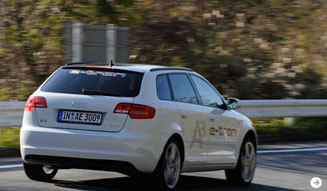
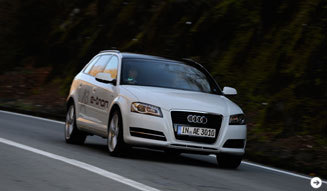
It possesses agile and comfortable handling thanks to its well-tuned suspension. Therefore, it feels like you can fully appreciate its strengths on roads like the Hakone Turnpike, with its series of high-speed curves winding up the mountain. Audi's choice of this location for the test drive demonstrates a deep understanding of its products. The completion level was so high that the words of an Audi product strategist from Germany, "The launch of EV models is still some way off," seemed overly cautious.
If asked which I prefer between the A1 e-tron and A3 e-tron, I would personally choose the former for its sportier nature. However, Audi engineers stated that the decision to develop the range extender on the A1 and the pure EV on the A3 was "a coincidence," and that "various combinations are being considered for the future."
"For researchers, the question is no longer whether electric mobility will take hold, but when."
This is a quote from a German professor of automotive engineering cited by Audi. Based on the results of these two vehicles, one can only hope that "when" arrives as soon as possible. For car enthusiasts, an era of cars with new driving pleasures is finally dawning.