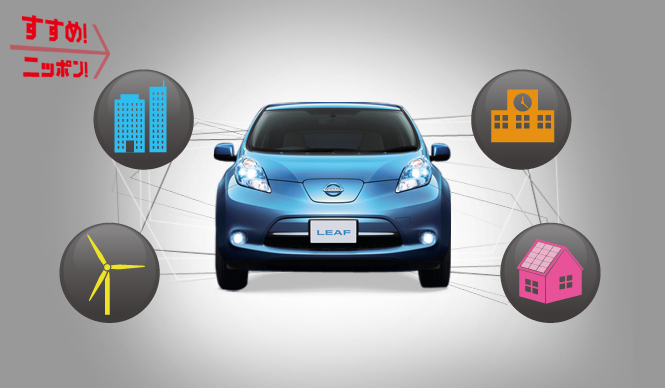
People and Companies Building a New Era: Nissan Motor Co., Ltd.
People and Companies Building a New Era――Nissan Motor Co., Ltd.
EVs Offer Driving Enjoyment and Function as Batteries (1)
The environment surrounding automobiles has been changing since the Great East Japan Earthquake. Not only were factories affected, but for users, the gasoline shortages that struck the Tohoku region immediately after the earthquake are still vividly remembered. Electric vehicles are once again drawing attention. We spoke with Toru Futami of Nissan Motor Corporation's Electronic Technology Development Division about the future of cars and their potential.
Text by Fumio OgawaPhotos by Tomo Kadoi
The Key to EVs is "the Cloud" and Renewable Energy Generation
EVs have recently garnered attention as alternative fuel vehicles, not equipped with the internal combustion engines of conventional cars. The news that Nissan Motor Corporation provided 65 LEAFs to disaster-stricken areas suffering from gasoline shortages as support vehicles immediately after the earthquake also became a topic of discussion. On the other hand, the question is also being raised: "In these times of calls for power conservation, is it right to have cars that run on electricity?" However, at OPENERS, we believe EVs are indispensable for building a new society based on renewable energy.
"What's important for EVs is 'the cloud,' and self-generation usingrenewable energy," says Toru Futami, an expert leader in Nissan Motor Corporation's IT & ITS Technology Planning Group, Electronic Technology Development Division, with a surprising statement. When Mr. Futami joined the company, it was a time when automotive electronics were becoming mainstream. Mr. Futami himself has been involved in engine computer control technology and safety technologies integrated with car navigation and airbags.
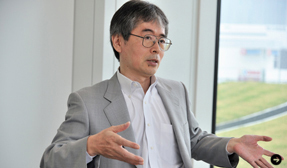
"Mr. Toru Futami"
Currently, 70 percent of the LEAF, and even 35 percent of the FUGA, are composed of electronics-related parts. "Cars are not mechanical products; they are essentially consumer electronics," says Mr. Futami.
Mr. Futami is now working on the evolution of cars and electronics – specifically, new automobiles and new regional infrastructure based on renewable energy.
――Are EVs incompatible with power conservation?
That's probably because they charge up and run on electric motors. Power consumption is high during the day, but if charging is done during the night when electricity is abundant, there's no problem at all. Electricity cannot be stored, so EVs can be said to be vehicles that use energy more effectively. Including the effective use of electricity, EVs hold the potential to elevate cars from mere personal transportation to public assets. In terms of electricity, they also have a function as storage batteries. Normally, cars are on the road for only about an hour out of 24 hours a day. They are stopped for the remaining 23 hours. They are doing nothing during that time. But if EVs are charged while stopped, they can be used to generate power during blackouts.
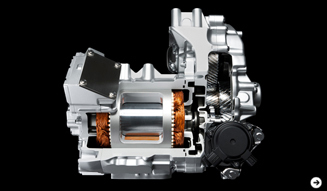
The motor mounted on the front.
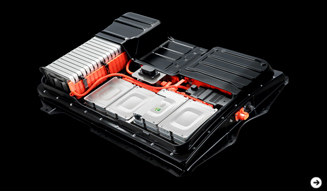
Battery pack
――Could you tell us a little more about the "public" role?
storage batteryAs this function evolves, the situations where EVs play an active role will increase when the entire city becomes a self-generation system. Nissan Motor Corporation currently operates a global data center and links LEAFs with mobile phones and PCs using the internet, leveraging the know-how of its proprietary telematics service, Carwings. In its advanced form, it will be possible to grasp the status of EVs, including LEAFs being charged, within the area covered by community hubs such as government offices, schools, and convenience stores. For example, by understanding the battery status of 10 EVs, it will be possible to supply electricity from cars with ample charging capacity to homes and offices with insufficient power. While providing driving enjoyment to drivers, EVs hold the potential to function as mobile storage batteries for the community.
Single-family homes and buildings are equipped with solar generators, and the electricity generated during the day is stored in home batteries or EV batteries. There may also be a business model where EVs are sold as a set with solar generators and conditioners that convert to household current.
Furthermore, we combine this with a system that manages information on servers, similar to G-mail. This is cloud computing. Through these, cars will possess functions that were impossible with gasoline cars. This is the public nature of EVs.
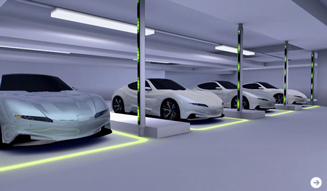
People and Companies Building a New Era――Nissan Motor Co., Ltd.
EVs Offer Driving Enjoyment and Function as Batteries (2)
Communities Supplementing Power Shortages Centered Around the LEAF
――How high is the feasibility of this?
It might not be a story of the distant future. First, equipping EVs with power outlets, and in parallel, having self-generation facilities like solar panels at homes and offices, along with storage batteries. With these three in place, the first stage will be complete. Next, centers will be established in each region to manage vehicle information. If the buying and selling of electricity generated at home is permitted, power transmission facilities will also be necessary. There are local governments, like Yokohama City, which is promoting the Yokohama Smart City Project, that are enthusiastic about regional energy management. Infrastructure development will likely progress sooner rather than later.
――What are the benefits?
For example, 2,000 LEAFs can supply power to 7,000 households, so cars can become a power source during blackouts in times of disaster. Also, regarding the purpose of infrastructure development, it is economical to use electricity generated at home. Furthermore, if a system is built within the community for power generation and transmission, electricity can be sent from areas with surplus to areas with shortages. The advantage of using a small region as a single unit is that transmission losses are eliminated, allowing for more efficient electricity usage.
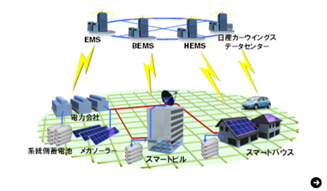
With the consent of LEAF owners, the Carwings Center globally manages the driving patterns, charging, and electricity consumption history of LEAFs.
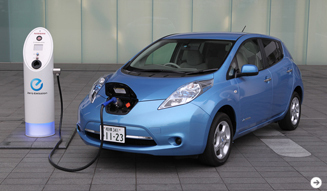
Using a rapid charger, it can be charged to 80 percent in about 30 minutes.
――It seems that the maximum benefit will be achieved when this is possible not only with Nissan Motor Corporation but with EVs from all automobile manufacturers. Isn't it urgent to standardize specifications among manufacturers?
In Japan, there is a tendency for specifications to converge on the standard of the manufacturer that has gained market dominance, which is called a de facto standard, so I believe all automobile manufacturers are working hard on this. In Europe, on the other hand, emphasis is placed on de jure standards set by standardization organizations such as ISO. Therefore, we are receiving requests from various European organizations to "lend us a LEAF (for verification)" for the construction of new energy systems. Since the networking of EVs will only be truly meaningful when it is done among all automobile manufacturers, not just one company, we intend to work towards creating an environment for this.
――Some might criticize that what we've just discussed is, after all, just a pipe dream at this stage.
We sometimes receive criticism that there's no point in driving an EV if the charging infrastructure isn't fully in place, but once people use it, I believe they'll realize the practicality of EVs more than they expect. I myself commute in a LEAF, and I have never felt any problems; there are no practical dissatisfactions. You can search for charging spots, and information on newly established ones is reflected immediately. Systems to support EV usage, such as charging reservations and range information provision, have been built. Without these, it would be difficult to use an EV. The LEAF is a practical EV.

Toru Futami
Graduated from the Department of Electronic Engineering, Faculty of Engineering, The University of Tokyo in 1981. Joined Nissan Motor Co., Ltd. in 1981. Conducted research on electronic systems in the Central Research Laboratory. From 1987 to 1990, developed in-vehicle electronic systems in the Electronic Design Department. In 1991, planned and developed IT systems. In 2005, was responsible for planning and development in the IT & ITS Development Department. Currently, he is involved in the planning and development of IT & ITS systems and EV-IT systems.
Below is Mr. Futami's explanation of the "Smart Grid 3D Interactive Theater."