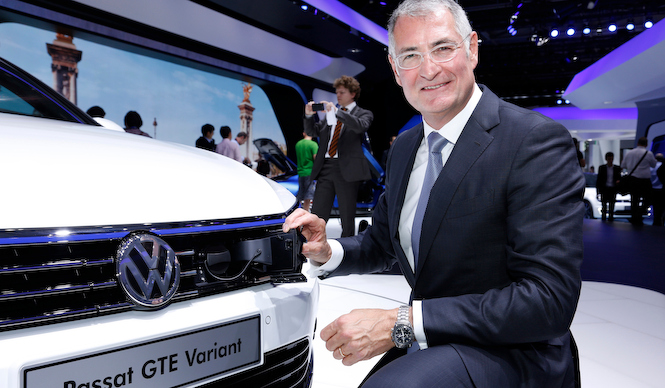
The Future of Volkswagen's Powertrains | Volkswagen
Volkswagen Group
The Future of Volkswagen's Powertrains
Engine downsizing is now a global trend. The Volkswagen Group has been a leader in this major shift, which aims to improve fuel efficiency by reducing displacement and using superchargers to compensate for power. On the other hand, as we reported previously,E-mobilitythe company is also showing an active stance towards electrification, which is truly interesting. What are their views on the future of automotive power sources? Fumio Ogawa asked the head of powertrain development at the Volkswagen Group directly.
Text by OGAWA FumioInterview Photographs by MOCHIZUKI Hirohiko
Electric Motors, Plug-in Hybrids, and Downsized Engines
Perhaps the most important component in cars today is the engine, driven by the need to comply with increasingly stringent European CO2 regulations. In this context, Volkswagen, which has boldly implemented engine downsizing and the widespread adoption of hybrid technology, is drawing attention. We spoke with Dr. Heinz-Jakob Neusser, Member of the Board of Management responsible for Powertrain Development at the Group, about their strategy.
—European CO2 regulations are becoming stricter. A new standard has been set, allowing a maximum emission of 95 grams per kilometer by 2020, with penalties for exceeding this limit.
NeusserCO2 emission regulations are not limited to Europe. The US has similar targets, and China is said to be aiming for a fuel economy standard of 5 L/100 km (20 km/L).
—What measures are being taken to meet these regulations?
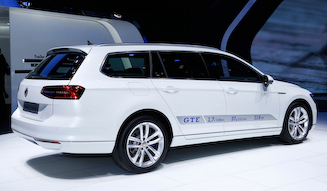
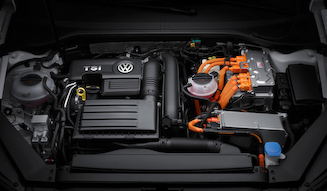
NeusserWe will be focusing on the development of E-mobility, which stands for environmentally friendly vehicles. Specifically, this means expanding our lineup of electric vehicles (EVs) and plug-in hybrids (PHVs).
—While the importance of E-mobility is understandable, charging infrastructure is not yet sufficiently developed, even in developed countries. In developing countries, won't the demand for gasoline engines remain strong?
NeusserThat's correct. In those markets, we will focus on improving the efficiency of gasoline engines. Our current goal is to achieve a 25% improvement in fuel economy. As you may already know, we believe that downsizing displacement and combining it with turbocharging will continue to be an effective strategy. By using turbocharging and fine-tuning aspects like the oil lubrication system and cylinder friction reduction, we can achieve the same power from a three-cylinder engine as from a four-cylinder.
Volkswagen Group
The Future of Volkswagen's Powertrains (2)
Downsizing Isn't Everything
—You mentioned earlier that a three-cylinder can match a four-cylinder. What is the specific displacement?
NeusserA 1.6-liter naturally aspirated four-cylinder engine can be replaced by a 1-liter turbocharged three-cylinder engine.
—On the other hand, within the same group, you also have brands likeBentleyandLamborghiniwhich use large displacement engines. What are your plans for those engines?
NeusserWe will continue development to improve their fuel efficiency. We will also adopt technologies such as cylinder deactivation systems, flexible valve trains, and more efficient turbochargers. In fact, development of new generation V6 and V8 engines is underway.
—However, it's also true that some owners associate the number of cylinders with status.
NeusserOwners of the brands you mentioned prefer multi-cylinder units like V12 or W16, and tend to view large displacement as a status symbol. It's true that introducing a four-cylinder engine wouldn't be welcomed in that context. The Lamborghini 'Asterion LPI 910-4,' which we unveiled at the Paris Motor Show, is a plug-in hybrid concept model. We are considering adopting new systems like this.Lamborghini "LPI910-4 Asterion"is a plug-in hybrid concept model. We are considering adopting new systems like this.
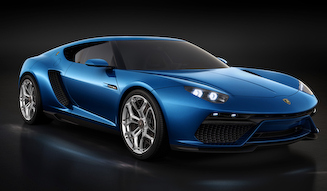
Lamborghini Asterion LPI 910-4
—In terms of efficiency, mild hybrids, which use electric motors for boost during acceleration and energy regeneration during deceleration, also represent a technology with high potential. However, this would require upgrading the automotive battery from the current 12 volts (specifically 12.6 volts) to 48 volts. Volkswagen announced its transition to 48 volts in 2011. What is the current status?
NeusserThat is indeed an important consideration. However, we don't believe that all vehicles can be powered by 48 volts. It would also require a complete review of the energy storage system, as well as all electrically powered systems such as steering and brakes. Reflecting those costs would likely start from the "Passat" model and above in the VW Group lineup. The Passat is on the borderline.
Volkswagen Group
The Future of Volkswagen's Powertrains (3)
The Freedom of Not Charging
—Are you also considering technologies to replace the current TSI (turbocharged/direct injection) engines?
NeusserThe current lineup of powerplants is designed to be mounted on the MQB (Modular Transverse Matrix) platform, taking the transverse engine models of the VW Group as an example. In other words, we don't develop engines in isolation; they must align with the plans for the MQB platform, which is produced in various countries worldwide, including China, Mexico, and South America. The advantage of this platform is that it can accommodate not only gasoline and diesel engines but also plug-in hybrids and EVs.MQB(Modular Transverse Matrix). In other words, we don't develop engines in isolation; they must align with the plans for the MQB platform, which is produced in various countries worldwide, including China, Mexico, and South America. The advantage of this platform is that it can accommodate not only gasoline and diesel engines but also plug-in hybrids and EVs.
—Nevertheless, technology is evolving at an astonishing pace.
NeusserOf course, we understand the necessity of developing with an eye on the next generation and beyond. Peripheral technologies are also key factors. In the case of EVs, Tesla already offers charging at virtually 100 kW, and generally speaking, the performance of automotive batteries will become more efficient over the next two years.
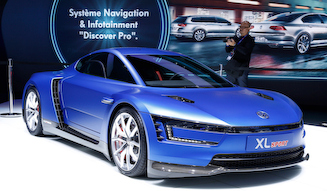
Volkswagen XL Sport
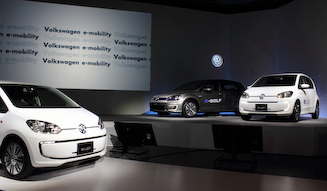
VW's electric vehicles, announced for introduction to Japan in October 2014"e-Golf" and "e-up!"
—Are EVs the environmentally friendly vehicles of the near future?
NeusserFundamentally, we believe it's not good for the car to be heavily influenced by infrastructure development. Drivers should also have the freedom not to charge. Current plug-in hybrids are a bridge technology for the Volkswagen Group, connecting to the next generation of powertrains.
—What lies beyond that?
NeusserOne idea is dual powertrains. We will offer various combinations, such as gasoline and electric motor, hydrogen and electric motor, or natural gas and electric motor. In fact, it is possible to equip the Passat with powertrains that use natural gas or hydrogen as fuel. Most importantly, technologies that can be adapted to as many markets as possible are crucial. This also allows for cost reduction.
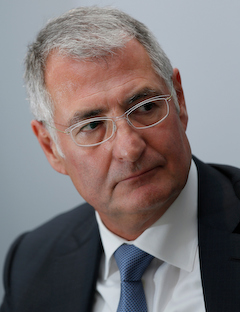
Dr Heinz-Jakob Neusser
Born in 1960. Appointed Member of the Board of Management for Development at Volkswagen Brand in July 2013. He has been Head of Powertrain Development at the Volkswagen Group since October 2012. After working at FEV Motorentechnik, specializing in providing internal combustion engine and automotive technology development services, he joined Porsche AG in 1996 as a project manager. As head of engine development, he made significant contributions to the development of V-engine families and new-generation boxer engines. From 2001 to 2011, as head of drivetrain development at Porsche, he drove the development of new four-wheel-drive systems and dual-clutch gearboxes. In 2011, he was appointed Head of Powertrain Development for the Volkswagen brand at Volkswagen headquarters. He is an avid fan of historic cars and the WRC (World Rally Championship).