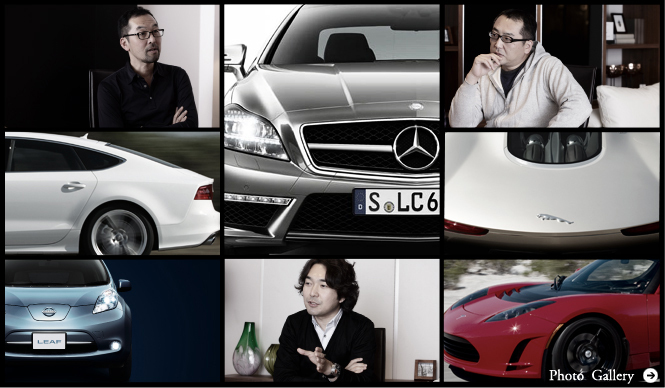
2010-2011 | Three Experts Discuss the State of the Automotive World, Part 2
Three Experts Discuss the Automotive World of 2011
What Kind of Cars Will Be in Demand in 2011? Special Roundtable, Part 2 (1)
This installment is the latter half of our roundtable discussion looking ahead at the automotive industry. From an analysis of the recent boom in European four-door coupes, to a look at the cutting-edge technologies aimed at improving environmental performance, and finally to the automotive world of 2011, we invite you to enjoy the uninhibited conversation of our three panelists.
Panelist: Fumio OgawaYasuhisa ShimashitaToshifumi WatanabePhotos: JAMANDFIXSummary: Dai MatsuoPhoto Cooperation: BoConcept GINZA
The Four-Door Coupe Trend
—Could the four-door coupe category be considered a new segment for European cars? In Japan, the Toyota Carina ED was a huge hit in the mid-80s, but it ultimately didn't catch on. Now, however, we're seeing an increase in these models from high-end European manufacturers.
ShimashitaThis category emerged as people grew tired of sedans, then tired of SUVs, and were looking for something new.
OgawaVolkswagen has the Passat CC, a four-door car characterized by a sleek, coupe-like roofline. When it was released, I heard it was aimed at wealthy businessmen working on Wall Street. A new category: the stylish sedan.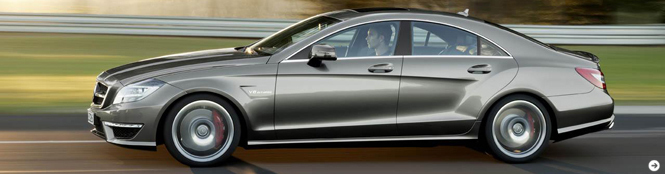
ShimashitaJaguar used to occupy this category, but they inexplicably left. The low, stylish sedanXJbecame a conventional sedan in its previous generation. Then Mercedes-Benz introduced theCLSand it was a hit.
OgawaI recall that the CLS's popularity in Japan was also partly due to the fact that the S-Class's model change from the previous to the current generation was quite delayed, and there was a segment of buyers eager for something new.
WatanabeFirst, the overall market for coupes is shrinking. In America, the market for large luxury two-door coupes has virtually disappeared.
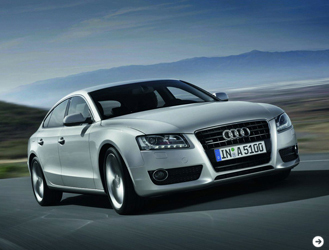
OgawaSpeaking of which, what exactly is a four-door coupe? Perhaps it's worth discussing the premise now, even if it's a bit late? For example, while the CLS and theAudi A5 Sportbackare sometimes perceived as belonging to the same four-door coupe category, they are actually different types of cars.
ShimashitaIn the sense that they are chosen because a regular sedan isn't exciting enough, they are the same. I think that applies to the A5 Sportback as well.
WatanabeIn Europe, perhaps,A6is strongly associated with company cars. Therefore, the A5 Sportback andA7likely exist to fulfill the desires of those who don't want to be seen that way.
OgawaPorsche PanameraandAston Martin Rapideare in a different category, aren't they? Those target the niche of four-door sports cars.
ShimashitaIt probably looks like a pyramid with the Rapide and Panamera at the apex, which might give the impression that the entire segment is thriving.
WatanabeIn other words, it's probably within the framework of a 'personal four-door sedan.' If that's the case, then theJaguar XJandMaserati Quattroportewould also fall into that category.
ShimashitaIn 2011, we'll see the new CLS and the Audi A7 Sportback arrive. It feels like the cast is finally assembling.
OgawaSo, in essence, everyone wants a four-door car? As you mentioned, Watanabe-san, perhaps this is a category for people who want to assert that they bought it with their own money, not a company car. But in Japan, it's popular because it's stylish, right? It's good that many stylish cars are coming out.
EVs and Infrastructure Issues
—Let's move on to advanced technologies that are likely to develop further in 2011.
OgawaI'd like to hear both of your opinions on theNissan Leaf.I think it's a fun car to drive, a good car, but is the world ready for EVs? Isn't it a bit too soon? I saw news about rental car companies in Okinawa purchasing a total of 220 units. It feels like there's an unnatural acceleration happening.
WatanabeI think it's impressive that Chairman Carlos Ghosn has not only developed EVs but also engaged in political negotiations in various countries.
OgawaWould you consider buying one yourself?
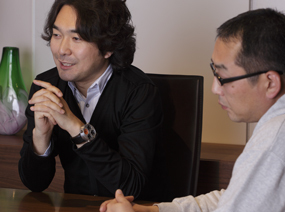
WatanabeSimply put, considering my own lifestyle, I couldn't buy one. I live in a multi-unit dwelling, and I couldn't even make the round trip to the test drive event in Hakone.
Ogawa(Laughs) It would be great if there were rapid chargers wherever you go, but won't there be a scramble for them once EVs become more common?
—Even with rapid chargers, having to wait 30 minutes doesn't seem very practical.
WatanabeThat's a scenario that only works when there are few vehicles. It won't hold up once the numbers increase.
ShimashitaSome people might say, 'There were no gas stations when gasoline cars first came out.' However, the situation is different now. With the sheer number of 'cars' already existing in the world, EVs entering this landscape are fundamentally different from gasoline cars appearing in a time when there were no cars.
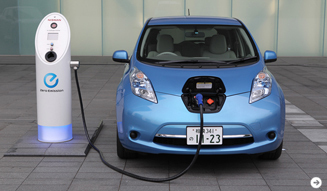
NISSAN LEAF
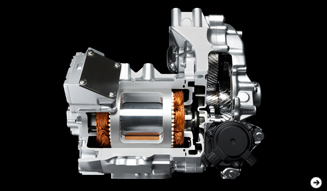
LEAF Motor
OgawaI wonder how they refueled in the early 20th century. I'd like to know.
ShimashitaBack then, if a car broke down, it might have only inconvenienced the driver. But now, if a car stops on an uphill section of the Shuto Expressway Route 3, it would cause a huge problem. It's not just about that one person thinking, 'It's an EV, so it can't be helped,' or 'I accepted this risk by driving something advanced.' They are entering an existing automotive society.
WatanabeThe resulting traffic jams would negate any environmental benefits in an instant. However, there are always growing pains with new developments, so we should probably look at it with a broader perspective.

OgawaSo, would you say it's okay to buy the Leaf right now?
WatanabeIf I were to be a bit cynical, I'd say it will probably be the car that makes you look the 'wealthiest' in 2011. Because if you see a Leaf in Ginza, where we're talking now, the driver would likely live within a 50km radius and own a home with charging facilities. The same applies to LA or London.
OgawaHmm, so EVs are a symbol of home ownership, in a way.
ShimashitaWhen discussing Nissan, I want to emphasize that they aren't solely focused on EVs. They cover all the so-called environmental technologies, including hybrids, direct-injection turbochargers, and clean diesels. Unlike Toyota or Honda, who might say 'Only hybrids!', Nissan has been steadily preparing.
The Three Experts Discuss the Automotive World of 2011
What Kind of Cars Will Be in Demand in 2011? Special Roundtable, Part 2 (2)
The Current State of Fuel Cell Vehicles
OgawaIndeed. Nissan's 'Pure Drive' strategy is steadily expanding. They also seem to have an electric city commuter plan. Regarding that electric city commuter, there's been a major stir at Renault in France because an executive allegedly leaked confidential information (as of January 2011). Renault is speculating that 'the buyer is China,' but regardless of the truth, EVs are certainly strategic vehicles. By the way, how is the development of FCVs (Fuel Cell Vehicles) progressing?
WatanabeDevelopment is ongoing, but there haven't been any significant leaps forward, and it doesn't seem to be generating much buzz. The key is whether the component technologies can achieve dramatic cost improvements. It feels like we're waiting for that.
OgawaBut it remains true that fuel cells are one of the ultimate powertrains, right?
ShimashitaThe cost has come down considerably. The problem is the infrastructure. The difficulty of establishing hydrogen infrastructure is incomparable to installing charging stations.
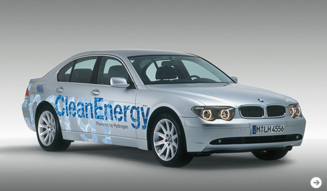
OgawaWhat happened to theHydrogen 7,BMW's first mass-produced hydrogen car, which was an improved version of the 7 Series released in 2006?
WatanabeThey are likely still developing fuel cells, but it seems they have abandoned direct hydrogen combustion.
ShimashitaIt seems that fuel cell vehicles have reached a point where they can be sold for around 15 million yen.
WatanabeToyota is aiming to bring the price down to under 5 million yen by around 2015.
ShimashitaHowever, it's difficult for passenger cars. Perhaps it would be more realistic to start with commercial vehicles that follow fixed routes, such as buses and trucks.
OgawaWhile the Leaf's styling is conventional for a passenger car, with EVs and FCVs that don't have engines under the hood, we can expect significant changes in packaging, can't we?
WatanabeWhen they debated the Leaf's design, they probably decided to retain some connection to the cars currently on the road. They likely intentionally avoided making it look radically futuristic.
OgawaI wanted more innovation in the interior, especially around the seats, but was that also a result of their choices?

Function, Packaging, and Beauty
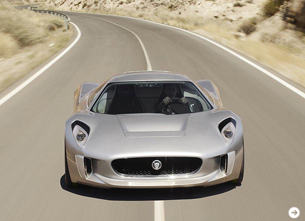
WatanabeHere's an interesting story I heard in 2010. Jaguar unveiled the C-X75 at the Paris Salon, a plug-in hybrid vehicle that combines a gas turbine with an electric motor, seemingly an homage to the XJ13. When I asked Ian Callum, the design chief, 'With such a different powertrain, couldn't you have proposed a completely different Jaguar elegance?' he replied, 'Even if electric cars become widespread, the human body won't change. As long as human proportions remain the same, packaging won't change that easily.' Perhaps I was swayed by his eloquent designer's charm, but I thought he made a good point.
OgawaOf course, we don't want to forget 'beauty,' but this presents a new challenge: balancing function, packaging, and beauty.
WatanabeVehicles like 'people movers,' essentially minivans, have a lot of potential. The concept of a hood also becomes unnecessary.
OgawaBut we still need to reduce the drag coefficient (Cd). I noticed the Leaf's headlights have an interesting shape; was that to improve airflow?
WatanabeIn that sense, I think the Prius is the most refined right now. It demonstrates how to incorporate factors like Cd values and present them without compromising the overall package.
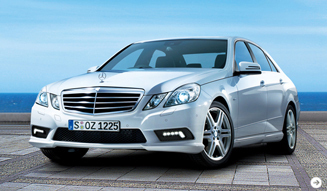
Mercedes-Benz E 350 BlueTEC Avantgarde
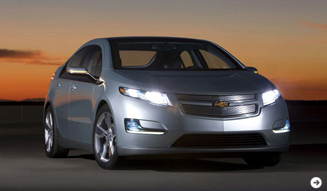
Chevrolet Volt
ShimashitaWhat is the Cd value of the Leaf, I wonder?Mercedes-Benz E-Class Sedanis 0.25. That's incredible.
OgawaIndeed, it looks conventionally designed, yet achieving such a low Cd value is remarkable.
WatanabeA longer body alone provides a significant aerodynamic advantage.
ShimashitaIn that case, considering functionality, it might not be a matter of 'smaller is better.' In an extreme scenario, we might even see a situation where 'to be eco-friendly, it had to become larger.' Thinking about it this way, new and interesting possibilities could emerge.
OgawaPerhaps Japan should have a more in-depth discussion about road occupancy area. Large cars in narrow spaces – that's also an environmental issue.
WatanabeWhen discussions about environmental taxes arise, will they properly incorporate that aspect?
Will the EV Market Expand?
—So, looking beyond the distant future, what kind of year will 2011 be? For example, when is the right time to buy an EV?
WatanabeSpeaking from a Tokyo perspective, I think EVs will become a common sight. From a general public mindset, it will be a year where people feel that era has arrived.
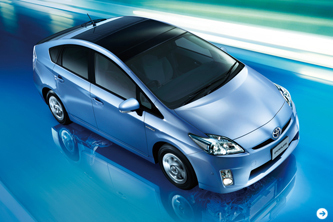
OgawaThis is just my personal thought, but perhaps Toyota's first year for EVs will be when currentPriusowners consider replacing their vehicles. Perhaps in about four or six years.
WatanabeOnce they start using them regularly, they might find that electricity costs aren't as low as expected, or they might get tired of waiting in line to charge, and think they should have just stuck with a conventional internal combustion engine.
OgawaWe get annoyed even just charging our mobile phones (laughs). The morning panic of 'I forgot to charge the car!' will likely happen in many households.
WatanabeWireless charging, where charging starts as soon as you park, would be ideal. Japan must reduce CO2 emissions by 65% compared to 2005 levels by 2020. To achieve this, they aim for EVs and hybrids to constitute 50% of new car sales by 2020. This translates to 1 million units annually based on registered vehicles. In that context, simply plugging in chargers won't be sufficient.
ShimashitaWe talk about hybrids so casually, but globally, the number of available models like the Prius, Insight, and Fit is still quite small. Among imported cars, we're just starting to see models like theLexus LS600hand the Mercedes-Benz S500 BlueEfficiency, and the BMW ActiveHybrid 7. It seems 2011 will finally see a surge in new models, so it will likely be a year for the market to broaden its base.
WatanabeImport car manufacturers probably won't reach full EV sales yet. Although they are considering the Volt, I don't think it will be sold for another year or two. When it is sold in Japan, it might be classified as a plug-in hybrid rather than an EV.
GM is currently pushing hard for EVs because they need to have EVs available by 2012 in California. However, the Volt is not currently classified as zero-emission. I believe they will be striving to obtain zero-emission certification in 2011.
OgawaAn interesting EV is theTesla Roadster.Its price is steadily decreasing. That's because the company's strategy is to reflect battery procurement costs in the price. Wasn't it around 18 million yen when it first came out?
WatanabeWith a subsidy of about 3 million yen, it falls below 10 million yen, which is quite a feat.
ShimashitaI'm a bit uncomfortable with how taxes are being used like this...
WatanabeThis is the kind of car that wealthy individuals living in the city might consider as a second car, and their interest is piquing.
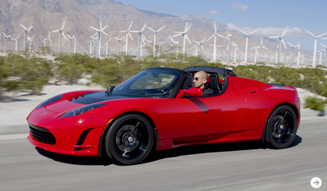
TESLA Roadstar
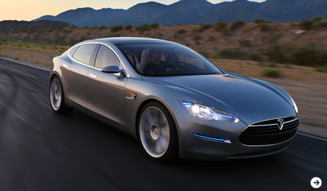
TESLA modelS
ShimashitaIt seems that many buyers are those who already own Ferraris or Lamborghinis. However, I don't see much potential in the current Roadster's technology. I'm hoping that with the upcoming four-door, more practical Model S, we'll see something that can lead to future developments.
OgawaAlso, in 2011, we might see movement from third-party companies selling cars. I was thinking that, and then Yamada Denki announced they would sell the Mitsubishi i-MiEV. The contents of the New Year's lucky bags at the start of 2011 included the i-MiEV (laughs). While it's amusing, it also sends a shiver down my spine.
WatanabeThey say electronics manufacturers can build them, but given the accidents involving even music players catching fire, I don't think they can build cars.
Three Experts Discuss the Automotive World of 2011
What Kind of Cars Will Be in Demand in 2011? Special Roundtable, Part 2 (3)
The Spread of EVs and Their Problems
ShimashitaPeople say 'anyone can build them,' but once EVs start running on the streets, the significance of car manufacturers building EVs might finally be understood in a real sense. Safety in collisions, electrical safety, what to do if it stops... For example, the Leaf has communication functions to try and prevent the car from stopping unexpectedly. The necessity and meaning of these things might only start to be realistically considered once EVs begin circulating in our cities.
WatanabeEven Nissan itself estimates that EVs will account for only about 10% of their sales by 2020. And for the market as a whole, perhaps around 2-3%. While EVs will become more tangible in 2011, I don't expect them to spread explosively.

OgawaEven though hybrids seem so popular, they only account for about 10% of new car sales. 90% are still conventional internal combustion engine vehicles.
WatanabeAchieving 50% in just about nine years is a considerable challenge. Since it's a national policy, manufacturers have no choice but to push them out.
OgawaAs is often said, it's a problem that there are no car enthusiasts in politics.
ShimashitaEven if they aren't car enthusiasts, anyone with a bit of imagination would wonder what will happen to the batteries once hybrids and EVs become more common. Is that truly environmentally friendly?
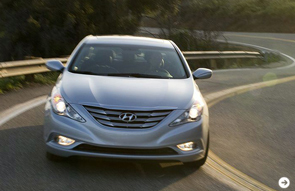
"Hyundai Sonata"
OgawaIt's said that it's difficult to repurpose batteries that are no longer usable in cars, as they can no longer perform at their intended capacity once they degrade. Is that true?
WatanabeThe hybridHyundai Sonatasold in the US reportedly uses lithium polymer batteries. Lithium polymer offers a dramatic improvement in size and molding flexibility. If this proves successful, it will change car packaging and give manufacturers with strong battery technology a significant advantage.
OgawaOPENERS readers will understand this, but I want you to think about what a car truly is.
Virtual Networking and the New Relationship with Cars
—I'm also curious about smart grid initiatives. And I'd like to ask if cars linking with the internet can build a different kind of society.
OgawaSmart grid experiments have already begun.
ShimashitaRegarding networking, we'll start seeing the early signs of it.
WatanabeThe hardware is already in place, so connectivity is possible.
OgawaIt will be difficult without cooperation between ministries like the Ministry of Land, Infrastructure, Transport and Tourism, the Ministry of Economy, Trade and Industry, and the National Police Agency. It would be meaningless if national highways were ready but prefectural roads weren't. We might also need to utilize traffic signals and power lines. It seems like a breeding ground for 'amakudari' (retired officials taking lucrative positions) (laughs).
WatanabeCurrently, it's at best like having Wi-Fi in the car. However, the potential for safety and environmental benefits is enormous. This is a field where Japan should excel.
The Automotive World in 2011?
—We touched on four-door coupes earlier, but what about imported cars in 2011?
WatanabeSports cars and coupes were also caught in the 'CO2 syndrome' in 2010. Ferraris now have idle stop, and Lamborghini has stated they are not pursuing top speed.
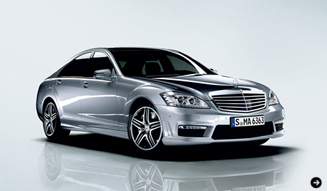
Then, in 2011, the full model change for thePorsche 911will arrive. The new 911 might come with idle stop on the base model, potentially bringing CO2 emissions down to around 200g/km. A car capable of 300 km/h with such CO2 emissions.
ShimashitaIncidentally, in Europe, there are three cars with nearly 450ps: theLexus LS600h,the Mercedes-Benz S500 BlueEfficiency, and the BMW ActiveHybrid 7. The Lexus emits 218g/km, the BMW 219g/km, while the Mercedes S500 achieves 219g/km even without hybrid technology.
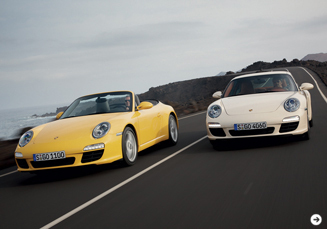
WatanabeThe CO2 emissions, and thus fuel economy, for cars in that class have improved significantly. The Mercedes S-Class can easily achieve over 10 km/liter on the highway.
ShimashitaNo one loses by becoming more fuel-conscious. I don't mind if Ferraris have idle stop, and if Lamborghinis focus on lightness, handling, and acceleration rather than top speed, that's fine too. After all, going from 300 km/h to 310 km/h top speed offers almost no practical benefit... In essence, we've reached the limit with the old rules. So, shouldn't we enjoy ourselves with new rules? That's how I see it. I'm really looking forward to seeing what new forms of automotive joy will emerge within these new rules.
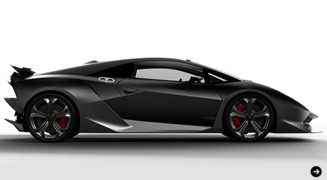
WatanabeI can see that trend emerging. For example, the Ferrari 458 Italia's potential is so immense that I can't even begin to interact with it. The speed is beyond my eyes and body's capabilities, and it corners at incredible speeds on its own. When it gets to this point, the sense of 'cherishing' it diminishes for enthusiasts like us.
ShimashitaIn this era, Japanese manufacturers earnestly say 'eco, eco.' European manufacturers, on the other hand, are thinking, 'Let's create something interesting under the new rules.'
Reducing displacement to improve fuel efficiency and lower CO2 emissions, yet simultaneously increasing output with a V8 twin-turbo – isn't that exhilarating? From the manufacturer's perspective, they must feel quite clever. It shows a sophisticated understanding and a deep-rooted car culture.
OgawaVolkswagen's moves are also interesting. Following theTouranin 2010, they are releasing the Sharan in early 2011. It's a minivan with sliding doors. They are actively targeting the Japanese market, believing that 'there must be people among minivan users who want high-quality foreign cars.' This is a new development.
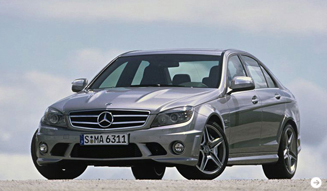
Mercedes-Benz C 63 AMG
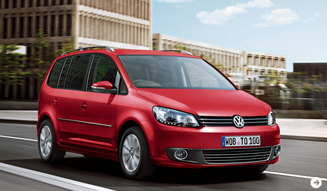
Volkswagen Golf Touran
WatanabeRegarding Mercedes, they've improved significantly since the previous generation. Cars that are pushing boundaries, like theSLS AMG,are taking bold steps.
ShimashitaThe E 63 AMG Performance Package was particularly good.
WatanabeThe C 63 AMG Performance Package Plus is likely a great car that will be remembered in the future.
ShimashitaBoth are excellent.
—It's impressive that they've met environmental standards while eliciting such strong praise from all of you.
WatanabeIf Japanese cars are to truly compete with these European models, they will need a fundamental overhaul of their powertrains.
ShimashitaAs we discussed earlier, if battery technology has reached its limits, then the fuel efficiency gains from hybrids are largely understood. What becomes important then are the engine and the chassis. Ultimately, even with hybrids, you can't create a good product without a solid foundation in car manufacturing. In that regard, Mercedes, for example, remains strong.
OgawaIt was interesting that they first released a hybrid system model on the long-wheelbase version of the S-Class, and then followed with the standard wheelbase.
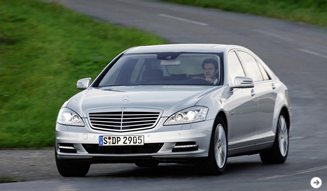
WatanabeThey're not holding back either. Mercedes-Benz has equipped the S-Class with a four-cylinder engine in the S 250 CDI BlueEfficiency. This would have been unthinkable five years ago.
OgawaWill downsizing become more prevalent in Japan?
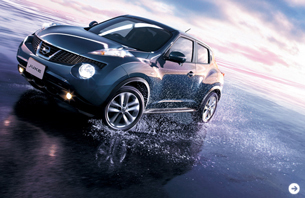
WatanabeThere's no clear movement from any manufacturer. Honda and Toyota seem to be slacking on engine development. At Nissan, the 1.6-liter turbo used in theJuke 16GTcould likely power a Teana, and they seem to be testing it.
ShimashitaConversely, if they were to bet on hybrids, Lexus, for example, should have released an LS300h alongside the LS600h – a model with fuel efficiency comparable to European diesels. They're neglecting engines. And they're not fully committed to hybrids either.
OgawaIn other words, the time has come for Japanese cars to compete on the same playing field as these European cars. If they remain isolated in their 'Galapagos' approach, they will be left behind. This is the reality of 2011.
Fumio Ogawa
After working for approximately 20 years at the editorial department of the car magazine 'NAVI,' which fused cars and culture, he eventually became its editor-in-chief. He then served as editor-in-chief for 'Motor Magazine' and 'Arigatto,' and is now a freelance journalist. He writes for numerous magazines, including automotive publications like 'ENGINE' (Shincho-sha) and 'EDGE' (Recruit), as well as covering a wide range of lifestyle topics such as gourmet food ('Shukan Post'), hotels, and fashion.
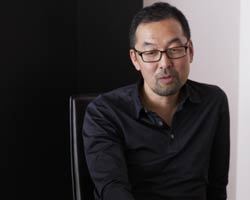

Yasuhisa Shimashita
Motor journalist. His writing covers not only driving performance but also advanced environmental and safety technologies, brand theory, driving, and all other social phenomena surrounding automobiles. He also gives lectures and works as an instructor on eco & safety driving. He was a juror for the 2010-2011 Car of the Year Japan. His recent publications include 'Gokuraku Hybrid Car Driving Techniques' and 'Gokuraku Gasoline Diet' (both published by Nigen-sha).
Blog: 'Blog Named Desire'
http://minkara.carview.co.jp/userid/362328/blog/13360020/

Toshifumi Watanabe
Born in Fukuoka Prefecture in 1967. After working in the editorial departments of motorcycle and car magazines at Kikaku-shitsu Neko (now Neko Publishing), he became a freelancer. His serialized column 'Car Nabe' in 'Shukan Bunshun' is very popular among women as a piece that vividly dissects societal trends and lifestyles through the lens of automobiles. In addition to automotive magazines, he also writes for numerous general interest magazines such as 'MEN'S EX' and 'UOMO,' gaining popularity.