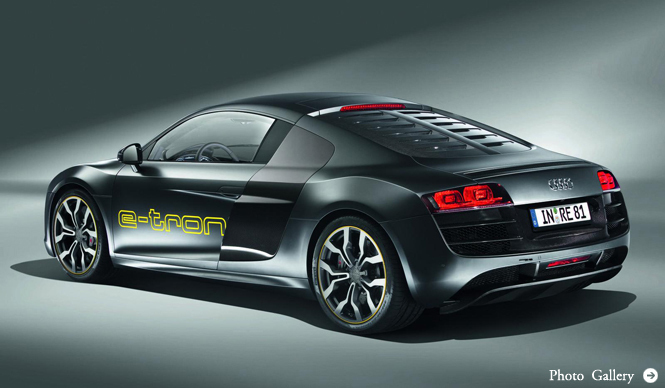
Audi R8 e-tron
Audi R8 e-tron | The Audi R8 e-tron
The Flagship Sports Car Goes Electric
AudiAudi has decided to put the "R8 e-tron Quattro," an electric sports car based on the "R8," into production in the latter half of 2012.
Text by Giraffe
Quattro + 4 Motors Deliver 313 PS
The "R8," Audi's flagship sports car with its unique mid-ship layout in the brand's history, stands at the pinnacle of the current Audi lineup. Its electric version, the "R8 e-tron Quattro," is slated for production in 2012 and is seen as a rival to the Mercedes-Benz SLS AMG E-Cell. With a total of four motors, two on each axle, it achieves a maximum output of 313 ps and a peak torque of 45.9 kgm, figures comparable to the R8's 4.2-liter engine.
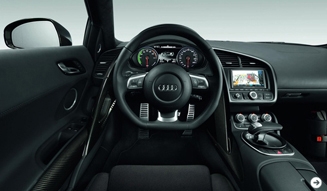
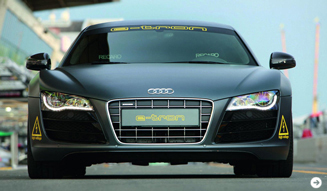
Furthermore, the powertrain incorporates Audi's signature "Quattro" all-wheel-drive system, enabling acceleration from 0 to 100 km/h in 4.8 seconds and a top speed of 200 km/h (with limiter). The 53 kWh lithium-ion battery provides a maximum range of 250 km. A full charge can be achieved in just 2.5 hours using a rapid charger, or in 6 to 8 hours with a standard household power outlet.
Detailed specifications of the R8 e-tron Quattro can be viewed on video-sharing sites. We encourage you to witness the performance of this new sports model in action.
BRAND HISTORY
The Audi emblem, "Four Rings," represents the four founding companies: Audi, DKW, Horch, and Wanderer. All were based in Saxony and were pioneers of the German automotive industry in the early 20th century. However, facing the fallout from the Great Depression after World War I, these four companies merged in 1932 to form Auto Union, each specializing in different vehicle segments: DKW for motorcycles and small cars, Wanderer for mid-size cars, Audi for premium mid-size cars, and Horch for luxury cars.
Following World War II, Saxony fell under Soviet occupation, leading to the dissolution of Auto Union. Anticipating this, the new Auto Union was established in Ingolstadt, Bavaria, in West Germany. Unlike BMW and Mercedes-Benz, Auto Union faced a challenging start without existing factories, but gradually regained strength through the production of vehicles like the DKW delivery van.
In late 1964, Auto Union came under the Volkswagen Group, and soon after, introduced new models bearing the Audi name. In 1969, it merged with NSU, known for its development of the Wankel engine and based in Neckarsulm, becoming Audi NSU Auto Union. In 1985, it was renamed Audi, as it remains today. Technologies like Quattro, dynamic performance backed by motorsport activities, elegant design, and high-quality finishes are the driving forces behind Audi's popularity.