ASTON MARTIN RAPIDE | Test Drive the Aston Martin Rapide
ASTON MARTIN RAPIDE | Aston Martin Rapide Test Drive (1)
Undeniably a Four-Door Sports Car
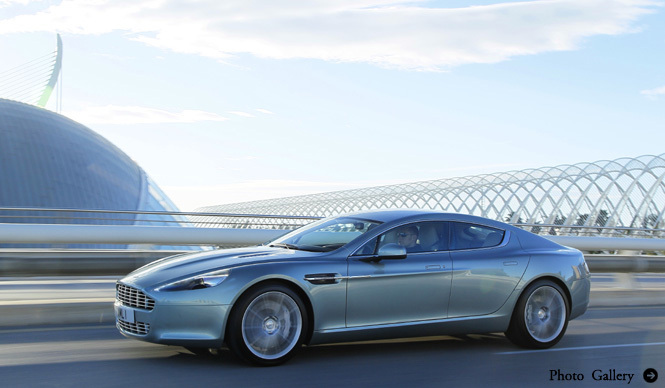
British sports car maker Aston Martin Lagonda held a press test drive event for the Aston Martin Rapide, unveiled in 2009. The Rapide is a model that the manufacturer itself proclaims as "the most beautiful four-door sports car in the world." It is a rear-wheel-drive vehicle equipped with a 6-liter V12 engine mounted at the front. The price has been announced at 22.68 million yen. Deliveries are expected to begin in June.
By Fumio Ogawa
An Aston Martin From Any Angle
Aston Martin chose Valencia, Spain, as the venue for the test drive of the Rapide, the company's first four-door model, featuring a body 5,019mm long with front and rear doors and a tailgate. Valencia, the capital of this southeastern Spanish region on the Mediterranean coast, is also known for the America's Cup and Formula 1 Grand Prix. The luxurious atmosphere not only suits the Aston Martin brand but also makes it a suitable location for sports car driving, with mountainous terrain in the background.
"This model is characterized by a design with a strong resemblance to our two-door models. In other words, the Rapide is also part of the Aston Martin family in terms of its muscular body and refined surface treatment," reads the explanation provided by Aston Martin in its press materials.
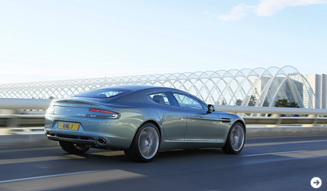
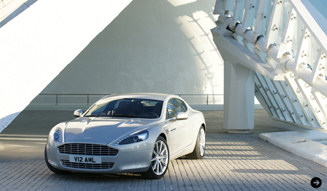
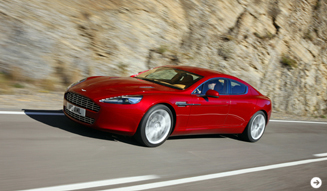
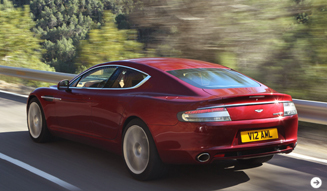
Indeed, the actual car is unmistakably an Aston Martin from any angle. While there are subtle differences, such as around the front grille or the design of the side strakes, the chrome accents behind the front wheels, the four-door body, which is 309mm longer than the DB9 with which it shares part of its platform, has been masterfully transformed into an "Aston Martin."
Same Engine Power and Torque as the DB9
The engine is a 5,935cc V12 producing a maximum output of 350kW (477ps) and a maximum torque of 600Nm (61kgm), numerically identical to the DB9's power and torque. The mechanical layout is also the same as the DB9: engine/clutch → prop shaft → converter → transmission → differential gear. In the case of the Rapide, unlike the DB9, a manual transmission is not offered; only a 6-speed automatic called Touchtronic 2 is available. While the two-door DB9 has a height of 1,300mm, the Rapide's height is kept to a mere 60mm more, at 1,360mm.
"Why does the Rapide look so similar to other Aston Martin models? One reason is that if we change it too much, customers might feel left behind. However, if you compare the 2000 model with the 2010 model, you'll see clear changes. In a sense, continuous evolution is Aston Martin's motto."
This is what Marek Reichman, the German design director, says. On the other hand, the Rapide also incorporates unique design elements, such as positioning the B-pillar, located between the front and rear doors, inward so that the side windows appear as a single pane of glass, and adding strong, edged character lines along the sides. These elements create a beautiful effect.
To achieve this design while suppressing noise transmission into the cabin, the side windows are made of double glazing with a laminated film sandwiched between them. Consequently, engineers developed a system where the window lowers slightly when the door is opened, rises to a first stage when driving begins, and then seals completely as speed increases. This is said to improve cabin quietness.
ASTON MARTIN RAPIDE | Aston Martin Rapide Test Drive (2)
Undeniably a Four-Door Sports Car
By Fumio Ogawa
Rivals Include the Porsche Panamera
When considering rivals, the Porsche Panamera is the most obvious comparison. The Rapide has a wheelbase of 2,920mm, which is 69mm shorter than the Panamera, and its overall length of 4,970mm is 31mm shorter than the Panamera. The Panamera S is equipped with a 4.8-liter V8 engine producing a maximum output of 400ps, falling short of the Rapide's 477ps. The Panamera Turbo, on the other hand, features the same unit with turbocharging, delivering 500ps. The Rapide's price in Japan is announced at 22.68 million yen. The Panamera S costs 13.74 million yen, and the Panamera Turbo is 20.61 million yen. There is a considerable price difference.
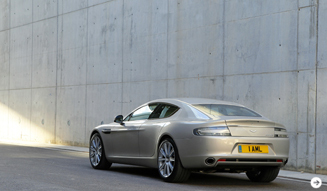
The Rapide, when seen in person, was indeed a beautiful car. Its powerful stance, supported by 20-inch Potenza tires (245 front, 295 rear), and its height, which Reichman boasted was "lower than the Panamera" (1,360mm, 60mm lower than the Panamera's 1,420mm), were impressive. Despite having four doors, the Aston Martin design identity, embodying sportiness, remained intact, which was truly admirable. The car is more beautiful in person than in images, with new discoveries to be made depending on the viewing angle. It is a car that will bring such joy to its owner.
The doors have a unique structure that opens upwards and outwards, creating a large aperture. Aston Martin calls this a "swan door," and it is indeed apparent when viewed from behind. The rear doors are equipped with dampers to prevent them from closing unintentionally. While entry and exit for the rear seats are not quite as effortless as in a large sedan, they are by no means difficult.
Aston Martin's First Model to Feature Practicality
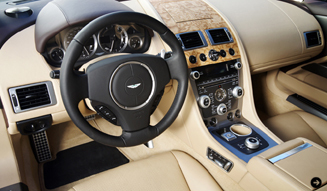
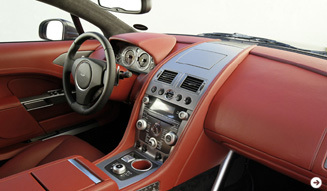
Sitting in the driver's seat, the view ahead is unmistakably Aston Martin. In line with the company's motto, "Truth to Materials," the interior is filled with a rich luster, composed entirely of genuine materials – real wood where it looks like wood, and real aluminum where it appears to be aluminum. Anyone familiar with driving an Aston Martin will be able to set off immediately without hesitation, including operating the Touchtronic selector buttons.
The seats are thin yet comfortable and excel in supporting the body with their shape. In this iteration, independent seats are also provided for the left and right rear positions, which are aesthetically pleasing and made with high-quality materials. The rear seatbacks can also be folded down to accommodate long items in the luggage compartment. It's likely that practicality has never been a topic of discussion for an Aston Martin before. However, due to the housing for the converter, transmission, and differential gear protruding into the cabin, rear passengers are provided with a slightly elevated center armrest.
ASTON MARTIN RAPIDE | Aston Martin Rapide Test Drive (3)
Undeniably a Four-Door Sports Car
By Fumio Ogawa
A High-Pitched Exhaust Note Reminiscent of Race Cars
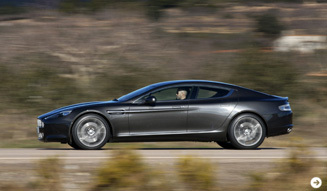
Once on the move, the car exhibits remarkable agility, belying its 1,950kg weight. Furthermore, selecting the sport mode via the switch on the center console delays the shift timing, significantly enhancing acceleration. Adjacent to it are switches for firming up the dampers for a sportier ride. The sport mode offers more spirited driving and allows you to fully experience the car's sports car character.
The damping characteristics might be a matter of personal preference; a normal mode provided plenty of enjoyable driving. For those who truly want to drive fast, there's the option of selecting sport mode and turning off traction control, but I believe the Rapide is best suited to a moderate level of sportiness. Even "moderate" is still quite fast, mind you.
In normal mode, above 3,800rpm, an electric flap in the exhaust system activates a bypass system. This reduces exhaust interference, improving power efficiency, and as a secondary effect, produces a high-pitched exhaust note reminiscent of a race car. While most manufacturers employ bypass systems in sporty luxury cars, Aston Martin's system delivers a sound that particularly emphasizes its racing heritage at 3,800rpm during engine operation. The reason for 3,800rpm, incidentally, is that it slightly exceeds 100 mph, a common cruising speed in the UK and continental Europe.
Agility That Makes You Forget the Car's Size
On the highway, the Rapide demonstrates stable high-speed cruising. The steering is composed around the neutral position, showing no nervousness even at high speeds. Here, the normal mode for both the shift schedule and damping is sufficient to enjoy the Rapide. Even in normal mode, the intermediate acceleration at high speeds is quite agile. The interior is remarkably quiet, thanks to the double-glazed windshield and side windows for noise reduction, and the door mirrors being mounted on the doors. Furthermore, the long wheelbase of 2,989mm contributes to a comfortable ride.
Leaving Valencia's city center for the highway, the initial urge is to test its top speed, but after a while, I opted to relax and enjoy the Rapide, listening to music on the optional Bang & Olufsen audio system. The rear seats are not entirely unusable for adults. However, due to the front mid-ship mounted V12 engine and the structural characteristic of housing major transmission components at the rear, the space in the longitudinal direction is limited. The rear seat cushions are somewhat flat, causing the thighs to lift slightly. However, their bucket-seat design does provide lateral support for occupants.
On winding roads, however, it reveals its sporty character, living up to Aston Martin's definition of a "four-door sports car." The outskirts of Valencia feature many mountainous areas with surprisingly wide roads, allowing for driving at relatively high speeds. Especially when the dampers are set to firm and the transmission is in sport mode, the car navigates corners with an agility that makes you completely forget its considerable size. The steering is set slightly light, a point some journalists questioned, but I personally didn't mind it. It provides good feedback from the road surface, and the car's response speed is quick, so I didn't perceive any issues. However, adjustments might be made in the future.
The acceleration and deceleration provided by the powerful brakes are undoubtedly a testament to its manufacturer's sports car heritage. However, the test day was unusually cold for Valencia, a region known for its oranges, and while it rained in the city, it turned to sleet at higher elevations. Therefore, while I confirmed its stability in sleet, I was unable to fully assess its cornering capabilities in depth.
ASTON MARTIN RAPIDE | Aston Martin Rapide Test Drive (4)
Undeniably a Four-Door Sports Car
By Fumio Ogawa
Surprisingly Soft Suspension in Standard Mode
A distinctive feature of the Rapide is its surprisingly soft suspension setting in standard mode. In medium-speed corners, when steering at around 80 km/h, the front end dips noticeably. While this doesn't negatively affect steering, it results in a unique driving feel, different from the on-rails sensation of the two-door models. Particularly with the transmission in normal mode, the driving experience becomes leisurely, almost languid.
I occasionally attend Aston Martin's overseas test drives, and the Rapide event was particularly enthusiastic, being the company's first four-door model. The slogan "Opening Doors" was displayed everywhere, and a dedicated website was launched. A thoughtful detail was finding a small box labeled "Opening Doors" on the pillow in my hotel room after the evening banquet. Inside were chocolates shaped like keys. Those familiar with European hotels may know of chocolate services offered for better sleep, but this was a meticulously crafted gesture, incorporating motifs of doors and keys.
Insisting on the Appeal of Complex Mechanical Watches
Is Aston Martin attempting to open the door to the luxury sedan market by having four doors? I asked Dr. Ulrich Bez, CEO of Aston Martin Lagonda, about the Rapide's positioning.
"The Rapide is strictly a four-door sports car. It is not a car to be purchased for carrying people in the rear seats. It's better to think of it as a car that offers convenience when you occasionally need to transport three people over short distances or have a lot of luggage."
Perhaps this is also intended to temper journalistic evaluations based on rear-seat comfort. The market, however, is more pragmatic, with many inquiries already coming in from customers who, even with children, do not want to give up their sports cars. Could the embedded monitors in the front seatbacks for viewing DVDs, etc., also be for children?
The current automotive trend favors engine downsizing (reducing displacement) combined with turbocharging. Dr. Bez, however, has a clear stance on this.
"For example, developing a six-cylinder engine and combining it with a turbocharger. While not technically difficult, I believe it's akin to insisting on the appeal of a complex mechanical watch. If we lose that essence, it ceases to be a luxury car."

ASTON MARTIN RAPIDE
Body | Length 5,019 x Width 1,929 x Height 1,360mm
Engine | 6.0L V12 DOHC
Max Output | 350kW [477ps] / 6,000rpm
Max Torque | 600Nm [61kgm] / 5,000rpm
Drivetrain | Rear-wheel drive
Transmission | 6-speed AT
Price | Undetermined