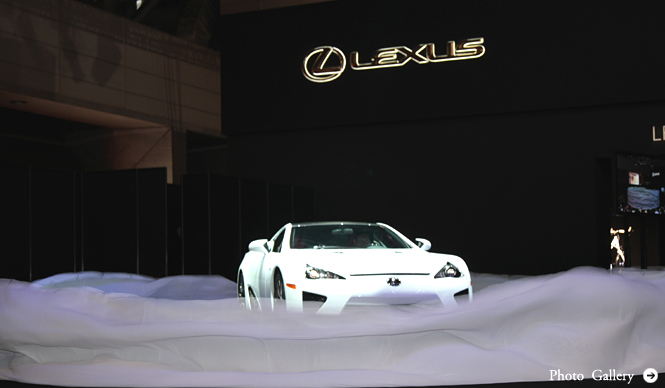
Lexus LFA | Pursuing "Emotion and Sensation" to the Extreme
LEXUS LFA
Pursuing "Emotion and Sensation" to the Extreme
Lexusannounced the "LFA," a two-seater supersports car scheduled for release at the end of 2010, at the press day of the 41st Tokyo Motor Show.
Photo by LEXUS
Power-to-Weight Ratio of 2.64kg/ps
The LFA is a two-seater FR supersports car developed as the pinnacle of the Lexus brand's premium sports designation, "F."FerrariThis model represents Lexus's direct challenge to the flagship models of prestigious European brands such as Ferrari's 599 and Aston Martin's DBS.
The model is said to have pursued the "emotion and sensation" derived from the joy of driving to the extreme. Its body, measuring 4505mm in length, 1895mm in width, and 1220mm in height, utilizes CFRP (Carbon Fiber Reinforced Plastic) to achieve both high rigidity and reduced weight. This results in a 100kg weight reduction compared to an aluminum body of the same shape. The vehicle's curb weight is kept to 1480kg, achieving a power-to-weight ratio of 2.64kg/ps.
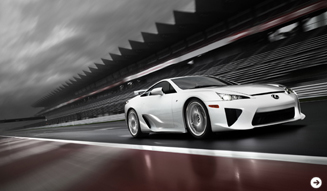
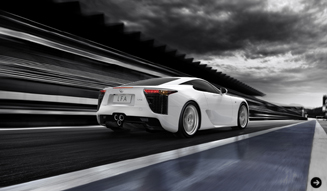
To achieve superior fundamental performance, the vehicle's packaging was meticulously refined. Specifically, heavy components such as the engine were positioned within the wheelbase, and the inertia moment was reduced by employing a rear transaxle and lightweight, long-life CCM (Carbon Ceramic Metal) brake discs. Furthermore, thorough weight reduction, including the adoption of a dry-sump lubrication system for the engine, contributed to excellent dynamic performance and vehicle stability. The front-to-rear weight distribution is 48:52.
V10 Unit with a 9000rpm Redline
The power unit is a newly developed 4.8-liter V10 engine, made more compact than existing V8s. This ultra-high-revving engine produces a maximum output of 412kW (560ps) at 8700rpm. To provide a continuous, powerful acceleration feel up to the 9000rpm redline, it incorporates titanium intake and exhaust valves, ultra-lightweight rocker arms with DLC coating, lightweight titanium connecting rods, and lightweight aluminum forged pistons. It also offers flexibility, with over 90 percent of its maximum torque of 480Nm (48.8kgm) available across a wide range from 3700 to 9000rpm.
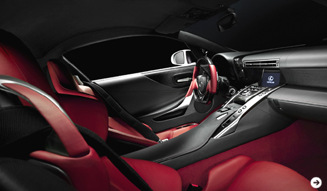
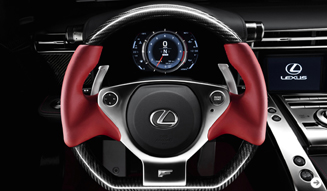
Additionally, it features independent electronic throttle control for each cylinder. In synergy with the 6-speed ASG (Automated Sequential Gearbox) transmission, which achieves a shift speed of 0.2 seconds, it delivers high responsiveness that quickly reacts to the driver's intentions.
The exterior, expressed based on Lexus's design philosophy "L-finesse," features proportions unique to FR vehicles due to its front-midship engine and rear transaxle layout. Combined with sculpted surfaces and dynamic air intakes, it exudes a presence befitting a supersports car.
Limited to 500 units worldwide, the price is approximately 37.5 million yen. Applications from interested buyers began on October 21st, with production scheduled from December 2010 to December 2012.
LEXUS LFA
Body | Length 4505 x Width 1895 x Height 1220mm Wheelbase 2605mm
Curb Weight | 1480kg
Engine | 4805cc V10
Max Output | 412kW [560ps] / 8700rpm
Max Torque | 480Nm [48.9kgm] / 6800rpm
Drivetrain | FR
Transmission | 6-speed ASG
Suspension | F: Double Wishbone R: Multi-link
Tires | F: 265/35ZR20 R: 305/30ZR20
Top Speed | 325km/h
0-100km/h Acceleration | 3.7 seconds
Price | Approx. 37.5 million yen
Official LFA Website
http://www.Lexus-LFA.com
BRAND HISTORY
Toyota launched its luxury car brand LEXUS in the American market in 1989. The aim was to offer a new value proposition distinct from American and German luxury cars, leveraging Toyota's advanced technological capabilities, superior quality, and exceptional customer service.
Upon the launch of the "LS400" (Celsior in Japan) and "ES250" (Camry in Japan) in the American market in September of the same year, the LS400 quickly earned the title of Best Import Car by February 1990. Lexus's reputation continued to grow, solidifying its position as a luxury brand with an expanding lineup.
Following its success in America, Lexus expanded into Europe in 2004 and announced its business development in Japan in May of the same year. In August 2005, it launched its luxury car business in its home market. Initially, the lineup lacked a flagship model like the "LS," featuring the "GS" (successor to the Toyota Aristo), "SC" (successor to the Toyota Soarer), and "IS" (successor to the Toyota Altezza). However, the introduction of the long-awaited new LS in September 2006, followed by its hybrid version, the "LS600h/LS600hL," in May 2007, met the expectations of the luxury sedan market.
Meanwhile, Lexus has focused on building a sports image, announcing the sports model "IS F" in October 2007 and entering the developing sports coupe "LF-A" in the Nürburgring 24 Hours race in May 2008, indicating expectations for further growth in popularity.