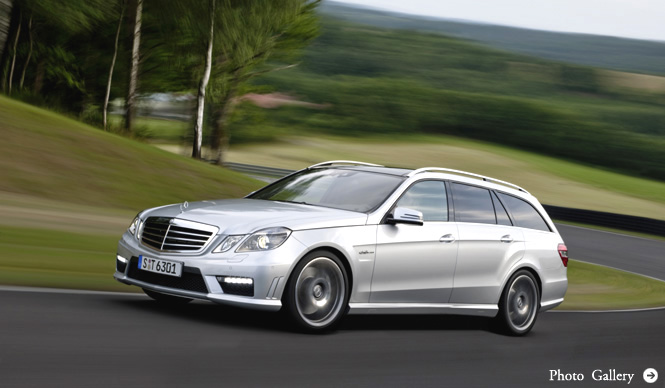
Mercedes-Benz E63 AMG Stationwagon | Mercedes-Benz E63 AMG Stationwagon
Mercedes-Benz E63 AMG Stationwagon
The Most Powerful E-Class Stationwagon
Daimler has announced the world premiere of the new Mercedes-Benz E-Class Stationwagon at the Frankfurt Motor Show, along with an overview of the "E63 AMG Stationwagon."
Text by Giraffe
Drivetrain Based on the E63 AMG Sedan
The engine and transmission installed in the E63 AMG Stationwagon are based on the "E63 AMG," the most powerful model of the new E-Class Sedan, which has just gone on sale in Japan.
The engine is a 6208cc V8 designed by AMG. Modifications to the intake and exhaust systems, along with the adoption of low-friction pistons, result in a maximum output of 525 ps at 5800 rpm and a maximum torque of 64.2 kgm at 5200 rpm. The transmission is the "AMG Speedshift MCT7" with paddle shifters.
The chassis features the newly developed "AMG Ride Control," which automatically controls vehicle height and damping force to achieve a high level of balance between handling and ride comfort. The "3-Stage ESP" is also standard, offering "On," "Off," and "Sport" modes for serious track driving.
The resulting performance from the combination of these various elements is a 0-100 km/h acceleration of 4.6 seconds and a top speed of 250 km/h (with limiter). With the optional limiter removal, the top speed can reach 300 km/h.
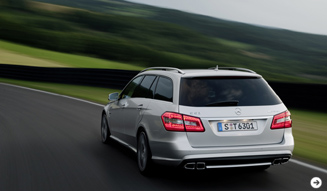
Price in Germany Starts from €108,409 (Approx. ¥14.5 Million)
Key exterior modifications include front fenders widened by 17mm compared to the base "E-Class Stationwagon," LED daytime running lights integrated into the front bumper, a diffuser added to the rear bumper, side skirts, and quad square chrome exhaust tips.
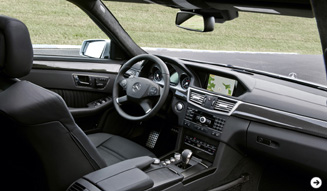
The interior also exudes a sporty yet refined atmosphere befitting AMG.
The luggage space, the stationwagon's biggest selling point, has a maximum capacity of 1950 liters (VDA measurement). Features to enhance usability include a tonneau cover that automatically retracts with the power tailgate, and "Quick Fold" for easy folding of the rear seats. A sub-trunk is also located beneath the luggage space.
Sales of this new model are scheduled to begin in Europe in February 2010. The price in Germany is expected to start from €108,409 (approximately ¥14.5 million).
BRAND HISTORY
When tracing the history of automobiles, we arrive at two Germans, Gottlieb Daimler and Karl Benz, as pioneers. It goes without saying that these two men independently created gasoline-powered automobiles between 1885 and 1886, laying the foundation for the automotive society. Although the automobile companies they founded were sometimes seen as rivals, they joined forces to overcome the post-World War I recession, leading to the establishment of Daimler-Benz AG through their merger in 1926.
The name "Mercedes," given to the products, originated when Emil Jellinek, a customer of Daimler's, named the cars after his eldest daughter in exchange for taking over sales outside of Germany. The trademark was registered by Daimler in 1902.
Thus born, Mercedes, and subsequently Mercedes-Benz, has continued to lead the times as a driving force in automotive development, consistently introducing cutting-edge technologies such as the safety passenger cell, airbags, ESP (Electronic Stability Program), and Night View.