Audi R8 SPYDER | A German Supercar Gets a Spider Variant
Audi R8 SPYDER | The German Supercar Gets a Spider
A Spider Variant Added to the German Supercar
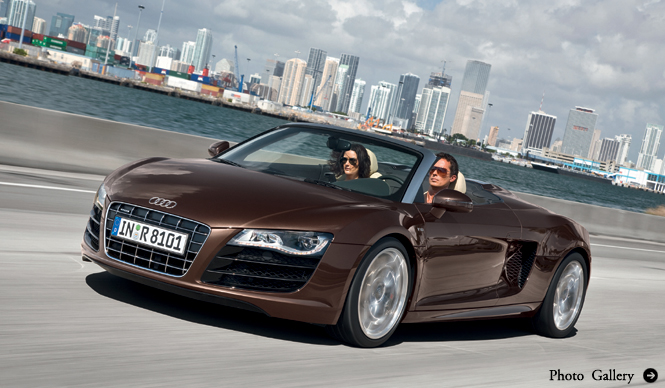
AudiAt the Frankfurt Motor Show, Audi announced details of the "R8 Spyder," the open-top version of its flagship supercar, the "R8."
By Giraffe
Soft top opens and closes in 19 seconds
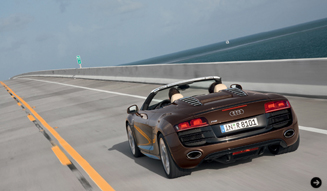
This new model is the open-top version of the coupe "R8." To avoid added weight from a metal roof, it features a soft top. This soft top retracts into the trunk in just 19 seconds with the push of a button and can be operated while driving at speeds up to 50 km/h.
The soft top has a three-layer construction, ensuring excellent weather resistance and sound insulation. When closed, it offers a quietness comparable to the coupe. The rear window is made of glass, preventing degradation of rearward visibility due to aging.
With three color options for the soft top, combined with the 11 available body colors, customers can create their own personalized spider. The aluminum-coated A-pillars are another distinctive feature of the spider.
The car is powered exclusively by a 5.2-liter V10 engine. This engine produces a maximum output of 525 ps at 8000 rpm and a peak torque of 54 kgm at 6500 rpm. Combined with the "quattro" full-time four-wheel-drive system, it achieves 0-100 km/h in 4.1 seconds and a top speed of 313 km/h.
Starting from €156,400 (approx. ¥20.8 million)
A 6-speed manual transmission is standard, but the optional 6-speed R tronic automated manual is also expected to be popular. The car comes standard with magnetic ride suspension, an adaptive damping system, and carbon-ceramic brakes are available as an option.
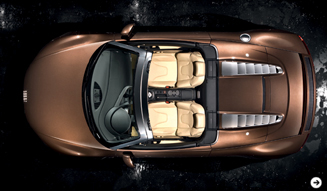
The interior features Nappa leather, creating a sporty yet luxurious space with effective use of aluminum accents. With six leather color options, coordinating with the body color when the top is down will be a highlight. Special dyes are used for the leather to reduce surface temperature buildup from direct sunlight.
An optional "seatbelt microphone," featuring three microphones integrated into the seatbelt, is available, enabling hands-free calls – a world first.
The R8 Spyder is scheduled to go on sale in early 2010, with prices announced to start from €156,400 (approximately ¥20.8 million).
BRAND HISTORY
Audi's emblem is the "Four Rings." As you may know, each ring represents one of the automotive manufacturers: Audi, DKW, Horch, and Wanderer. All were based in Saxony and were pioneers of the German automotive industry in the early 20th century. However, facing the fallout from the Great Depression after World War I, the four companies, in a bid for survival, formed Auto Union in 1932. DKW focused on motorcycles and small cars, Wanderer on mid-size cars, Audi on premium mid-size cars, and Horch on luxury cars.
However, following defeat in World War II, Saxony in East Germany fell under Soviet occupation, and Auto Union dissolved. Anticipating this, the new Auto Union was established in Ingolstadt, Bavaria, in West Germany. Unlike BMW and Mercedes-Benz, Auto Union faced a challenging start without existing factories, gradually building strength through the production of vehicles like the DKW delivery van.
In late 1964, Auto Union came under the umbrella of Volkswagen and soon introduced new models bearing the Audi name. In 1969, it merged with NSU (known for its development of the Wankel engine), based in Neckarsulm, becoming Audi NSU Auto Union. From 1985 onwards, it has continued as Audi to the present day. Technologies like quattro, dynamic performance backed by motorsport activities, elegant design, and high-quality finishes are driving Audi's popularity.