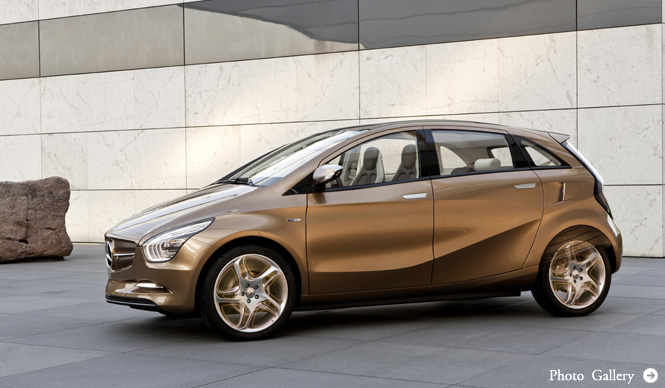
Mercedes-Benz BlueZero E-CELL PLUS
Mercedes-Benz Blue Zero E-CELL PLUS
Mercedes's Plug-in Hybrid Car
Daimler announced that it would exhibit a prototype of its new eco-car, the "BlueZero E-CELL PLUS," with an eye toward commercial production at the Frankfurt Motor Show.
By Giraffe
100km Range on a 1-Hour Charge
This plug-in hybrid model is based on the sandwich-style floor used in the A-Class and B-Class, with all mechanical components housed beneath the floor and within the engine bay.
The lithium-ion battery stored here can be charged from an external power source. Using a rapid charger, it can travel approximately 50km on a 30-minute charge, and about 100km on a 1-hour charge (full charge). When using a household power outlet, a full charge can be achieved in about 6 hours.
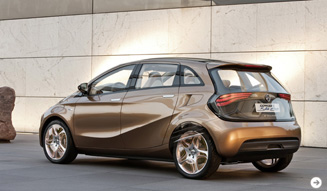
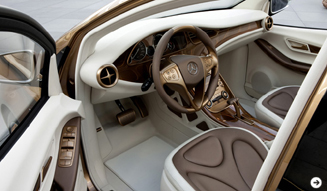
Equipped with a 1-Liter Engine for Power Generation
However, a 1-liter turbo engine is also installed for power generation, as a range of 100km may be insufficient for normal use. The electricity generated by this engine is stored in the battery, achieving a maximum range of 600km in that mode.
The system's output achieves a maximum of 136 hp and a peak torque of 32.6 kgm. It records 0-100km/h acceleration in under 11 seconds, with a top speed limited to 150 km/h.
Incidentally, CO2 emissions when generating electricity with the engine are 32g/km, a significantly lower figure than conventional gasoline cars.
BRAND HISTORY
When tracing the history of automobiles, we arrive at two Germans, Gottlieb Daimler and Karl Benz, as pioneers. It goes without saying that these two men independently created gasoline-powered automobiles between 1885 and 1886, laying the foundation for our car-centric society. The automotive companies they founded were at times seen as rivals, but to overcome the post-World War I recession, they joined forces, and the Daimler-Benz company was established through their merger in 1926.
The name "Mercedes," given to the products, originated when Emil Jellinek, a customer of Daimler's, had his eldest daughter's name used as the name for the cars in exchange for taking over sales outside of Germany. It was registered as a trademark by Daimler in 1902.
Thus, Mercedes and Mercedes-Benz have continued to lead the way in automotive development, actively introducing cutting-edge technologies such as the safety passenger cell, airbags, ESP (Electronic Stability Program), and Night View.