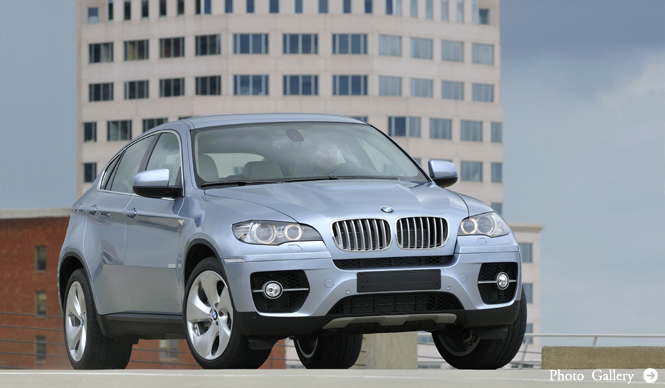
BMW ACTIVE HYBRID X6: The Hybrid Wave Reaches BMW Too
BMW ACTIVE HYBRID X6 | BMW ActiveHybrid X6
The Hybrid Wave Reaches BMW
BMW has unveiled the ActiveHybrid X6, its first full hybrid car.
Text by Giraffe
The Most Powerful Production Hybrid
The base vehicle is the X6's top-grade "xDrive50i." The hybrid system installed here is called a two-mode hybrid system, which adds two motors to the 50i's existing 4.4-liter direct-injection gasoline V8 twin-turbo engine (maximum output 400 ps, maximum torque 62.2 kgm). These two motors are divided into low-speed (91 ps, 26.6 kgm) and high-speed (86 ps, 28.5 kgm) applications, resulting in a total output of 480 ps and 79.5 kgm when combined with the engine – boasting the "most powerful output of any production hybrid vehicle."
The adoption of the "7-speed two-mode active transmission (ECVT)" and the "xDrive" 4WD system allows this power to be transmitted to the road without loss, realizing performance figures of 0-100 km/h in 5.6 seconds and a top speed of 250 km/h (governed by limiter).
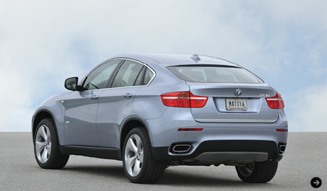
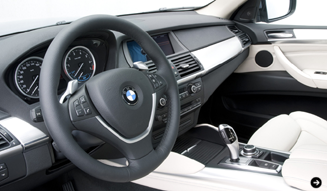
Zero-Emission Driving Possible at Speeds Up to 60 km/h
Instead of lithium-ion batteries, which are becoming mainstream for hybrid systems, it employs liquid-cooled, high-voltage nickel-metal hydride batteries. This allows the nearly 2.5-ton vehicle to travel up to approximately 2.6 km on zero emissions at speeds up to 60 km/h. Naturally, it also features idling stop and regenerative braking.
While official fuel economy figures have not been released, BMW has announced it to be "about 20% better than the 50i," suggesting an estimated European combined cycle fuel economy of around 9.6 km/l.
The ActiveHybrid X6 is scheduled to be officially announced at the Frankfurt Motor Show in September, with sales expected to begin between October and December.
BRAND HISTORY
Instantly recognizable by its "kidney grille" and four round headlights, BMW's front fascia is distinctive. While consistently popular in the Japanese imported car market, surprisingly few people can immediately explain what the name signifies.
Bayerische Motoren Werke. Literally translated, it means "Bavarian Motor Works." Its predecessor, Rapp Motorenwerke, was an aircraft engine manufacturer founded in Bavaria, Germany, in 1913 by Karl Friedrich Rapp. Rapp partnered with fellow Bavarian aircraft manufacturer Otto-Flugzeugwerke to achieve business success. In 1916, it was renamed Bayerische Motoren Werke GmbH. Two years later, it reorganized as a stock corporation and registered its propeller logo, inspired by Bavaria's blue skies and white clouds.
BMW continued to enhance its presence through innovative technology, but following Germany's defeat in World War I, it was forced to cease aircraft engine production. BMW then channeled its expertise into motorcycles, gaining attention in 1923 with the shaft-driven "BMW R32." Not content with this, the company acquired Dixi, which held a license to produce the Austin Seven. This provided a foothold in the automotive business, and in 1929, BMW launched the "BMW 3/15 PS," marking the start of its history as an automobile manufacturer.
Incidentally, Otto-Flugzeugwerke, which had a close relationship with BMW, was founded by Gustav Otto, the son of Nikolaus August Otto, who established the theory of the gasoline engine. This connection likely explains BMW's enduring focus on internal combustion engines.