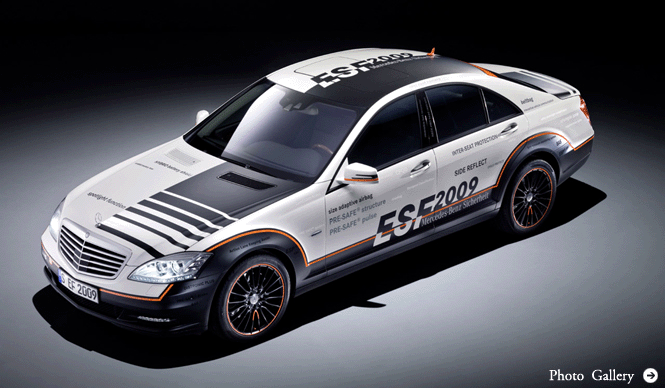
Mercedes-Benz ESF 2009
Mercedes-Benz ESF2009
The Ultimate in Safety Technology as of 2009
Daimler has unveiled the "ESF2009," developed based on the Mercedes-Benz S400 Hybrid.
Text by Giraffe
Equipped with Virtually All Latest Safety Devices
"ESF" stands for Experimental Safety Vehicle, and Mercedes refers to this abbreviation as ESF. Therefore, the model name "ESF2009" refers to a concept car that incorporates all the latest safety technologies that Mercedes-Benz could conceive of as of 2009.
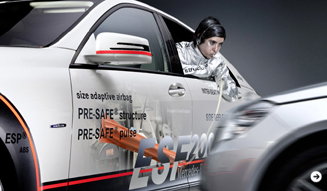
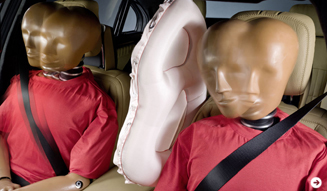
The "ESF2009" unveiled this time features the "PRE-SAFE Structure," an advanced side impact beam that inflates instantly; the "Braking Bag," which cushions impact by deploying an airbag between the front axle and underbody panel simultaneously with emergency braking if front bumper sensors detect an unavoidable collision; "Interactive Vehicle Communication" for receiving emergency information from road sensors; "PRE-SAFE Pulse" to maximize airbag effectiveness in side impacts; and the "Spotlight Lighting Function" for early detection of pedestrians during night driving.
To Be Adopted Sequentially in Production Models
Of course, in addition to these, it also incorporates "PRE-SAFE," "Beltbag," "Childcam," "Side Reflect," "Size Adaptive Airbag," and...Mercedes-Benz...it is no exaggeration to say that virtually all the latest safety devices that Mercedes-Benz possesses as of 2009 have been integrated.
Mercedes began its safety research in 1937.
Since then, with the release of the "180" in 1953 featuring the world's first crash-absorbent body, the start of crash testing in 1959, the development of the three-point seatbelt in 1968, ABS in 1970, and the practical application of the SRS airbag in 1980, the company's "latest safety technologies," which have led the automotive industry's safety advancements for many years, are scheduled to be sequentially adopted in production models from now on.
Mercedes-Benz Call
0120-190-610
BRAND HISTORY
When tracing the history of automobiles, two Germans, Gottlieb Daimler and Karl Benz, emerge as pioneers. It goes without saying that these two men independently created gasoline-powered automobiles between 1885 and 1886, laying the foundation for our car-centric society. Although the automobile companies they founded were sometimes seen as rivals, they joined forces to overcome the post-World War I recession, leading to the establishment of Daimler-Benz AG through a merger in 1926.
The name "Mercedes," given to products, originated when Emil Jellinek, a Daimler customer, had his eldest daughter's name used for the vehicles in exchange for taking over sales outside of Germany. It was trademarked by Daimler in 1902.
Thus born, Mercedes, and subsequently Mercedes-Benz, has consistently led the times as a driving force in automotive development, actively introducing cutting-edge technologies such as the safety passenger cell, airbags, ESP (Electronic Stability Program), and Night View.