Audi Q5 | On-Road and Off-Road (Part 1)
Audi Q5: On-Road and Off-Road (Part 1)
On-Road and Off-Road
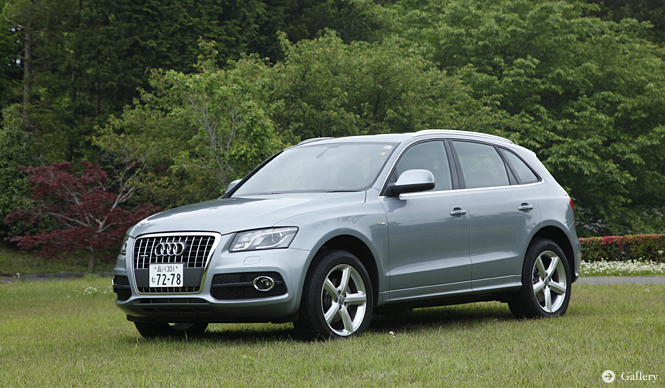
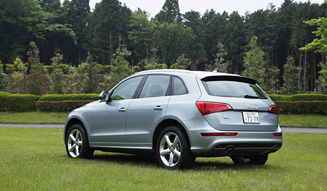
Audi Japan unveiled the new Q5, a vehicle in a category all its own, on May 21, 2009. While it's an SUV, its height is kept to a modest 1650mm, giving it the dynamism of a sedan and making it a car that can be used both on and off the road.
Text by Fumio OgawaPhotos by Atsuki Kono
An Aggressive, Agile Image That Sets It Apart from Rivals
The Q5, with its four doors and hatch gate, is available in two models. The "2.0 TFSI quattro" (¥5.69 million) is equipped with a 2-liter, four-cylinder direct-injection gasoline engine with a turbocharger, and the "3.2 FSI quattro" (¥6.60 million) features a 3.2-liter V6 engine. As the names suggest, both are paired with Audi's full-time four-wheel-drive system, "quattro."
What strongly impresses about the Q5 is its appearance. The single-frame grille, a hallmark of the Audi family, and the LED-infused headlights, designed differently from those of previous sedans, create an aggressive and agile image that Audi claims is "the sportiest in its segment," setting it apart from its rivals.
True to Audi's motto of "Vorsprung durch Technik" (Advancement through Technology), the Q5 achieves a high level of performance, fuel efficiency, and safety.
To improve fuel efficiency, the engine incorporates the "Audi valvelift system." This mechanism variably controls the lift of the intake valves in two stages, enabling more efficient combustion. Audi states this results in a 5% reduction in fuel consumption.
Audi Drive Select Available as an Option
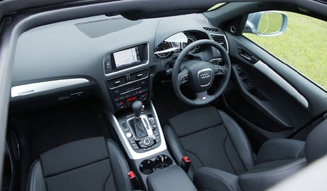
The adoption of the "S tronic" transmission—a 7-speed for the 211ps 2.0 TFSI quattro and a 6-speed for the 270hp 3.2 FSI quattro—eliminates power loss, even with gear changes occurring in fractions of a second, achieving fuel efficiency superior to manual transmissions.
Audi Drive Select is available as an option for both models. It offers three modes: "Comfort," "Normal," and "Dynamic," which adjust the engine's throttle response, shift points, steering power assistance, shock absorber damping, and steering response. Additionally, an "Individual" mode allows for custom combinations of these settings.
In terms of safety, the airbag system's technology for protecting occupants during a collision is noteworthy. By integrating sensors into the front seat rails, the car measures the distance to the occupant and calculates the force with which to tighten the seatbelt to restrain forward movement in the event of a collision, employing an integrated safety system.
Audi Communication Center
0120-598-106