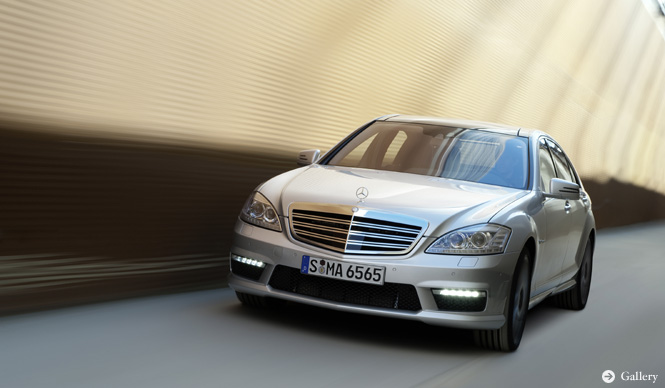
Mercedes-Benz | A Minor Change Model with Greater Environmental Consideration
The Evolved Mercedes-Benz S-Class AMG
Shifting Towards More Environmentally Considerate Models
Daimler has announced the minor change models of the 'S63 AMG' and 'S65 AMG'.
Text by Giraffe
This minor change follows the minor update to the Mercedes S-Class in early April. While the engines remain largely the same, the S63 AMG is equipped with a 6.2-liter V8 (525ps, 64.2kgm), and the S65 AMG features a 6.0-liter V12 twin-turbo (612ps, 102kgm). However, the key characteristic is the shift towards more environmentally considerate models, with improved fuel efficiency and reduced CO2 emissions.
The transmission for the S63 is the "SPEEDSHIFT 7G-TRONIC" 7-speed automatic, while the S65 is paired with the "SPEEDTRONIC" 5-speed automatic.
The performance is, of course, world-class. For the 0-100 km/h sprint, the S63 records 4.6 seconds, and the S65 achieves 4.4 seconds. The top speed for both models is electronically limited to 250 km/h, but with the limiter removed, speeds exceeding 300 km/h are possible.
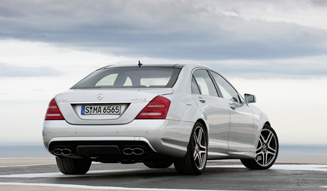
Mercedes-Benz S65 AMG
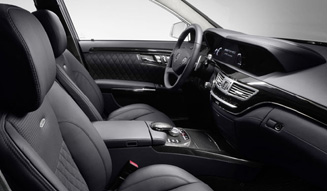
Mercedes-Benz S65 AMG
An AMG-Style, Sporty Luxury Finish
The front exterior features distinctive new aerodynamic parts, door mirrors, grille, and headlamps. New LED daytime running lights have also been adopted.
The rear has been updated with new taillights, incorporating 52 LEDs. The twin mufflers also feature a new design.
The interior boasts a sporty luxury finish, true to AMG's style. The newly designed AMG sports steering wheel includes paddle shifters, allowing for a more engaging driving experience.
Elements unique to this model abound, such as the standard burr walnut wood panels and the IWC-designed clock, offering a distinctive ambiance.
In terms of safety, similar to the base S-Class, features like ATTENTION ASSIST, Adaptive Highbeam Assist, and LANE KEEPING ASSIST are standard.
The European launch is scheduled for June.
BRAND HISTORY
When tracing the history of automobiles, two German pioneers emerge: Gottlieb Daimler and Karl Benz. It is widely known that these two men independently developed gasoline-powered cars between 1885 and 1886, laying the foundation for the automotive society. Although their respective automotive companies were once rivals, they joined forces to overcome the post-World War I recession, leading to the establishment of Daimler-Benz AG through a merger in 1926.
The name "Mercedes," given to the products, originated when Emil Jellinek, a customer of Daimler's, named the cars after his eldest daughter in exchange for taking over foreign sales. The trademark was registered by Daimler in 1902.
Thus born, Mercedes, and subsequently Mercedes-Benz, has consistently led the way in automotive development, actively introducing cutting-edge technologies such as the safety passenger cell, airbags, ESP (Electronic Stability Program), and NIGHT VIEW.