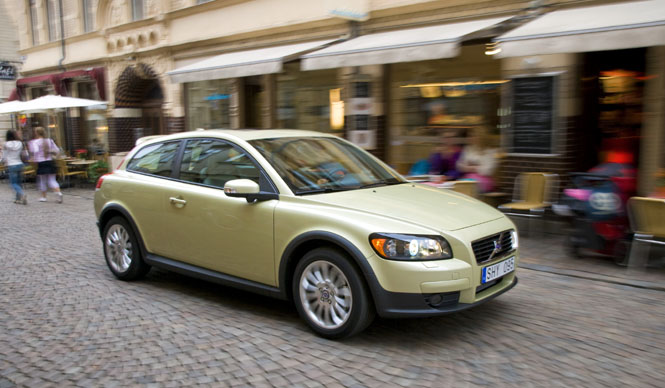
March 19, 2015
VOLVO | Volvo C30 | Part 10 (Conclusion) | "The Volvo I Recommend Most"
Part 10: Volvo C30 (Part 2)
The "Most Recommended Volvo"
Too stylish for a Volvo?
Too sporty?
No, no, the C30 is actually a very Volvo car, both historically and in terms of driving.
By Yasushi ShimonosonoPhoto by Volvo Cars
The Adult C30
Some might feel the C30 is too stylish for a Volvo, but looking back at its history, this design makes perfect sense.
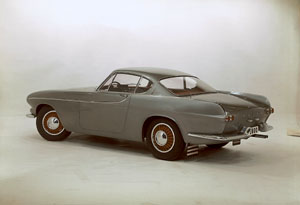
P1800 Prototype (1960)
The 3-door hatchback "480" introduced in 1986, and going further back, the "P1800" 2-door coupe that was popular in the 1960s.
The C30 perfectly follows this sporty Volvo lineage, known only to enthusiasts in Japan where the image of "Volvo = Wagon" is strong.
In its purest form, it's a "cool-style Volvo" that the Scandinavian manufacturer, which has always moved at a leisurely pace, occasionally felt inspired to create.
So, when I first saw this style, I actually felt a sense of nostalgia.
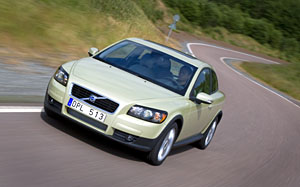
The target audience is envisioned as "single individuals or couples with active urban lifestyles, empty nesters with newfound free time, or as a second car for families."
But it's a remarkably stylish Volvo in the Golf class. When you start driving, expecting a certain ride quality, it feels like the usual Volvo.
And that's not a bad thing. The platform and powertrain are the same as the S40 sedan and V50 wagon. The driving feel is also akin to a slightly lower-riding S40.
Even the "T-5" with its 2.5-liter 5-cylinder turbo producing 230ps offers ample power, but it's never aggressive. If you're expecting the edginess of a hot hatch, you'll be disappointed.
However, that's the adult C30. Being free from childish speed and hurriedness is perhaps part of the Volvo way.
A Car to Be Driven Simply
The opening for the glass hatch is small, and the sill is high, so it's not a car for seriously hauling cargo. But anyone captivated by its shape likely knew that from the start.
They built a stylish car based on the S40/V50 platform, and it happened to turn out like a sporty wagon. It's a deliberate design, with the unspoken confidence of "Who said it had to be practical for carrying things?"
Meanwhile, the rear seats are surprisingly spacious and comfortable. Aside from the inconvenience of getting in and out of a 2-door, its capacity for carrying passengers is nearly equivalent to a 4-door sedan.
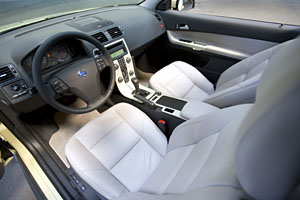
The Japanese model is primarily right-hand drive, with left-hand drive available only for the "T-5."
For those already on the verge of buying, the non-turbo 2.4-liter (170ps) engine is more than sufficient.
The optional 18-inch wheels offer no benefit to ride comfort and only detract from it. A "bring me the most expensive" power-elite mentality doesn't suit a Volvo. It's a car to be driven as simply as possible.
However, the optional "Body Kit" for the C30 is a must-have. This aero kit, consisting of a front spoiler and front and rear skirts, costs around 300,000 yen even for the top-tier T-5, but without it, the C30 doesn't achieve its stylish potential.
Many people I know who weren't previously interested in Volvos find themselves drawn to the C30. It's a testament to its design.
Furthermore, it's more compact than previous Volvos. For those who find the cargo space of the larger V70 wagon recently to be excessive, switching to the C30 still allows them to experience the same sense of security that comes with a Volvo.
As someone who appreciates smaller cars, it's currently my most recommended Volvo.
(End)
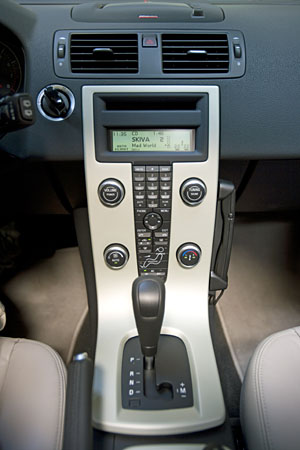
The distinctive "floating" center console, the "Free-floating Center Console," adopted from the S40/V50, is also present.
Vehicle Overview: Volvo C30
Debuting in the fall of 2006 and arriving in Japan in July of the following year, this is Volvo's 2-door premium compact coupe. It is Volvo's smallest model and an entry-level car aimed at attracting a new customer base.
Its most striking feature is its design. The rear view, in particular, with its glass tailgate, is sure to stand out even in the bustling city streets filled with a diverse array of vehicles.
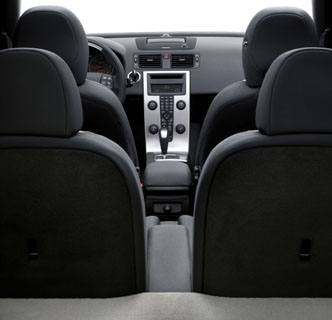
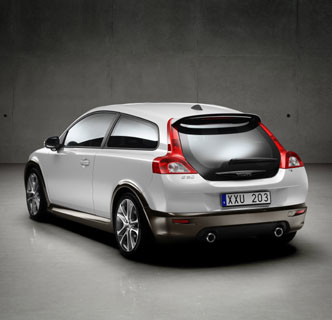
Built on the platform of the S40 sedan and V50 wagon, the body measures 4250mm in length, 1780mm in width, and 1430mm in height, with a wheelbase of 2640mm. It is 220mm shorter than the S40.
Two inline-5 engines are available. The 170ps 2.4-liter powers the "2.4i Aktiv" (¥2.85 million) and the core "2.4i SE" (¥3.48 million) grades, while the 230ps 2.5-liter turbo is found in the "T-5" (¥3.87 million). Both are paired with a 5-speed automatic transmission with a manual mode.
Volvo's signature safety features and premium qualities, exemplified by the DYNAUDIO premium sound audio system, are also key aspects of this car.
http://www.volvocars.co.jp/