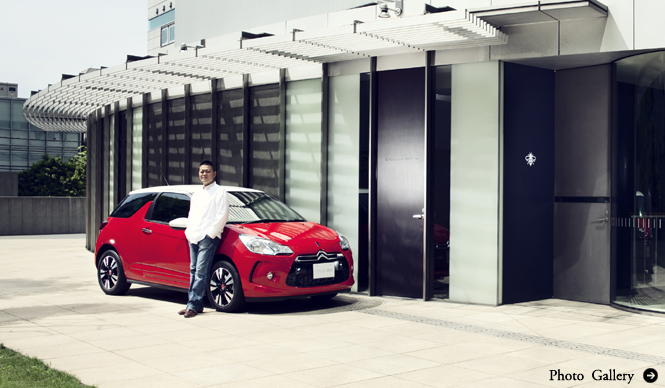
Chapter 5 | DS3 × Cuisine: An Interview with Yoshihiro Narisawa
CITROEN DS3 | CITROËN DS3
DS3 × Cuisine — Chef Yoshihiro Narisawa of 'Les Créations de NARISAWA'
Reflecting the Creator's Philosophy is the Expression of 'Now' (1)
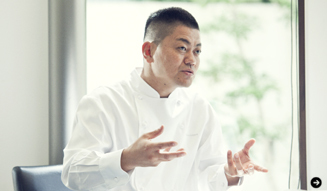
Chef Yoshihiro Narisawa of 'Les Créations de NARISAWA' offers cuisine that, while rooted in French classics, is constantly reimagined with a unique sensibility. His philosophy, transcending national boundaries of France and Japan and recognized globally, overlaps with that of the Citroën DS3.
Text by Fumio OgawaPhotos by Takahiro Igarashi
France Has a Unique Concept of Time in Craftsmanship
The charm of the French lies in their constant forward momentum. It's perhaps best exemplified by Citroën's car manufacturing, which challenges design conventions without looking back. Cuisine is no different.
French chefs emphasize the importance of expressing their originality. In contrast, established Japanese restaurants can sometimes be criticized as being 'like museums.' Yet, there is a restaurant in Tokyo's Aoyama district, 'Les Créations de NARISAWA,' that draws a constant stream of guests, including many French patrons. The creative cuisine served here can be described as the antithesis of retro.
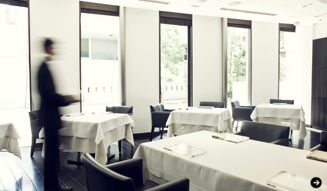
The cuisine led by Chef Yoshihiro Narisawa at 'Les Créations de NARISAWA' is both free-spirited and full of ingenuity. Since opening the restaurant in Aoyama in 2003, the chef has dedicated himself to perfecting his craft daily, creating dishes that stand apart in both preparation and presentation. Each time a plate is placed on the crisply pressed, thick tablecloth, guests gasp in surprise.
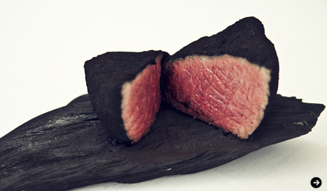
Consider the 'Assiette de Légumes' (vegetable platter), evoking Milton's vivid depiction of 'Paradise Lost' with its alluring aroma, or a steak that, upon cutting, reveals a deep red, juicy interior, mistaken at first glance for a black rock.
The presentation is original, and the taste is creative. The novel dishes are supported by cooking methods untried by predecessors. Chef Narisawa, renowned for his technical skill, does not rest on his laurels. His challenge for the new has forged his current global acclaim.
— When you think of 'new' and 'old,' what comes to mind?
Perhaps that some things change while the core remains. I feel this particularly in Europe, whether it's cars or fashion. They adapt to the times but cherish what is essential. And then there's time itself.

— Time?
In Europe, there's a unique unit of time, isn't there? Take wine, for example. French wines aren't meant to be drunk after just one or two years; they are aged for decades. They are perfected over a long period. I want to incorporate this concept of time in craftsmanship, which cannot be simply categorized as new or old.

— How does that apply to cuisine?
Everyday cuisine, which is affordable and satisfying for many, remains traditional – dishes that have been eaten in a region for generations. There's not much novelty here. On the other hand, for extraordinary occasions, for celebratory meals, novelty, including surprise, is often expected. Here, one could say, both the past and the present coexist.
CITROËN DS3 | CITROËN DS3
DS3 × Cuisine — Chef Yoshihiro Narisawa of 'Les Créations de NARISAWA'
Reflecting the Creator's Philosophy is the Expression of 'Now' (2)
The Courage of a Chef Who Advances Without Fear of Dislike
— In that context, what does 'now' mean?
It's not something that can be generalized, but for example, with cars, there are mass-market vehicles that anyone can drive, designed for broad accessibility. Then, at the higher end, there are models that are somewhat detached from ease of driving or general affordability. Sometimes, these models symbolize the brand's philosophy. In cuisine, too, though not in terms of 'high' or 'low,' there are dishes that reflect the creator's philosophy. Isn't that what 'now' in cuisine is?
— The creator's philosophy. What does that entail?
If I were to categorize the elements of cuisine that I consider important, they would be uniqueness, surprise, and discovery. Of course, deliciousness is crucial, but it doesn't have to be universally familiar.
— Is that the philosophy of French cuisine?
I believe French cuisine is not simply food eaten by the French, but rather an international cuisine that has passed through the filter of France in some form. What I'm referring to here is cuisine with a higher degree of originality from the creator.
— So, cuisine based on French foundations, but with greater originality?
If asked whether my cuisine is French, I would say no; it's Narisawa's cuisine. That's because I strive to incorporate my own originality. I believe not imitating anyone is paramount. That's precisely why diverse guests from around the world visit my restaurant in Aoyama.


— Your originality, something that can only be experienced here, is highly valued.
Immediately after returning from my training in France, I was focused on creating cuisine that mirrored French cuisine without any temporal difference. But one day, I considered it from the guest's perspective. If it's cuisine available in France, they can eat it in France. When they come to my restaurant, they must be seeking something they can only experience here.
— That's why culinary guidebooks exist, isn't it?
Hypothetically, if a chef in South Africa were creating French cuisine that was uniquely theirs, it would be worth a 30-hour flight to experience it. Of course, pursuing originality to its extreme can lead to polarizing opinions. But perhaps it's a bit arrogant to say, shouldn't one be unafraid of being disliked? I believe it's crucial for a chef to have the courage to create wholeheartedly for the guests who appreciate their work.
CITROËN DS3 | CITROËN DS3
DS3 × Cuisine — Chef Yoshihiro Narisawa of 'Les Créations de NARISAWA'
Reflecting the Creator's Philosophy is the Expression of 'Now' (3)
The Japanese Culture of Reflecting Scenery on a Plate
— Did your originality develop organically from within?
There are various levels of originality. Evoking a unique Japanese culture is also a form of originality. A dish titled 'Evolve with the Forest' expresses the Japanese worldview of coexisting with nature, symbolized by the forest. Using wood sourced from Hida as a plate, I constructed a pastoral landscape with various vegetables. Reflecting scenery on a plate is a culinary culture not found in France, so focusing on that was the starting point. If I had been born in another country, I would have expressed myself differently.
— Your cooking methods are also unique.
I slowly cook meat by pouring 80°C oil over it from a raw state, a method I believe is unique to me. I've been using this technique for over 10 years. I'm confident it's the best way to meticulously control both surface and internal temperatures, locking in delicious juices. The interior of meat contains various proteins, and the juices are part of them. This method cooks without damaging them. Only when you bite into it do the cylindrical proteins break down, releasing the juices into your mouth, which leads to deliciousness.
— And the charcoal cuisine.
I focused on the method of carbonizing vegetables with Binchotan charcoal and then dusting the ingredients with that charcoal in 2003. For example, with Hida beef, after soaking the Shimonita leeks in saltwater, I dust the beef with charcoal that has been slowly carbonized next to Binchotan charcoal until it turns pitch black. I believe I have discovered an unknown deliciousness. Even if there's initial unfamiliarity, the taste should overcome it. Cuisine must possess both flavor and avant-garde qualities.
— The Citroën DS3's message is 'Anti-Retro.' Does that resonate with you?
I think it's a great message. I've liked Citroën since my training days in France and found their hydropneumatic suspension fascinating. When I worked at a restaurant in the South of France, a large Citroën gliding into the yacht harbor looked remarkably cool. It left a strong impression. Although the DS3 is compact, I find its design quite unique. It's different from Japanese cars, of course, but also from German or Italian cars. I believe it's important to create such things, and equally important to appreciate them as a recipient.
Yoshihiro Narisawa
Born in 1969. Moved to France in 1988 at the age of 19, training at European restaurants for eight years. Upon returning to Japan in 1996, he opened 'La Napoule' as owner-chef. In 2003, he relocated to Minami-Aoyama, Tokyo, and renamed the restaurant 'Les Créations de NARISAWA.' In 2009, he received the 'Best Restaurant in the World 50' award for Best 20 and Best of Asia, hosted by the UK's Restaurant magazine, and in 2010, he achieved Best 24 and the same award.
www.narisawa-yoshihiro.com
Les Créations de NARISAWA
2-6-15 Minami-Aoyama, Minato-ku, Tokyo
Tel. 03-5785-0799
Opening Hours | 12:00–13:00 (LO), 18:30–21:00 (LO)
Closed | Sundays
Citroën Call
0120-55-4106