BMW i3 Domestic Test Drive | BMW
BMW i3 | BMW i3
An Epoch-Making Electric Car
Domestic Test Drive of the BMW i3
BMW has launched its electric car, the "i3." This vehicle, bearing the sub-brand "BMW i," is not merely an EV but is built from an entirely new perspective focused on constructing a sustainable automotive society, encompassing materials, manufacturing technology, and even its production plant. Tatsuya Otani, who previously summarized its philosophy in "The BMW i Incident," finally got behind the wheel of the i3 in Japan.
Text by OTANI TatsuyaPhotographs by ABE Masaya
The i3 I Finally Had a Chance to Drive
It's been nearly three years since I first interviewed the people in charge of BMW i back in 2011. Yet, even now, when I see one on the street, I can't help but exclaim, "Ah, an i3!" It still strikes me as so fresh. And rightly so; after interviewing the engineers and designers so extensively, I had convinced myself I had already driven it, but upon reflection, I realized I had never actually test-driven the "i3."
That chance finally came shortly after its release on April 5, 2014. Therefore, I visited the test drive venue with more anticipation than I'd felt for anything in years.
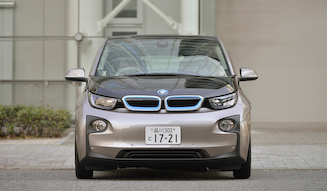
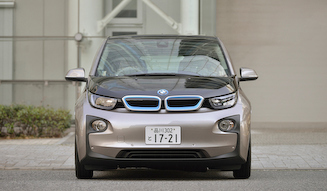
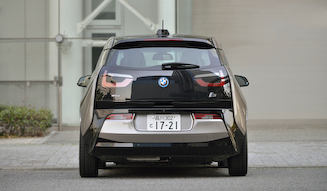
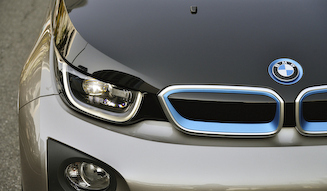
The exterior is the familiar i3, as expected. As I wrote in the article "The BMW i Incident", the organic design clearly communicates that this car is made not just of sheet metal but of plastic and carbon composite, which I find truly masterful. It also exudes a futuristic image, so even someone unfamiliar with it would intuitively sense that "this car is different." This is a significant departure from groups like Volkswagen and Audi, which give their EVs and PHEVs essentially the same exterior as conventional mass-produced cars (this is not a judgment of which approach is "better").
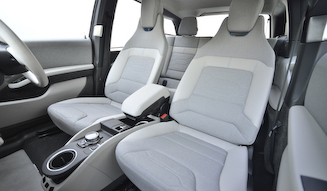
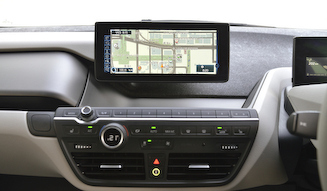
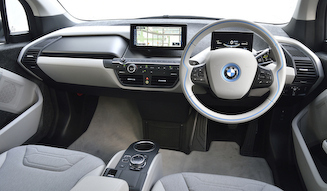
And the interior design is also superb. The dashboard, woven from plant fibers called kenaf, is lovely, and the "precision feel" of each individual component is impeccable. The design, which makes individual functional elements appear to float from the dashboard, is quite unique and effectively emphasizes the spaciousness of the cabin.
And above all, I appreciate how bright the interior is. Even with the issue of reflections on the windshield, an all-black interior can be rather dull. In contrast, the i3's interior is coordinated with generally light colors (though other color options are available), which I personally find very appealing.
BMW i3 | BMW i3
An Epoch-Making Electric Car
Domestic Test Drive of the BMW i3 (2)
Significant Feature in Accelerator Operation
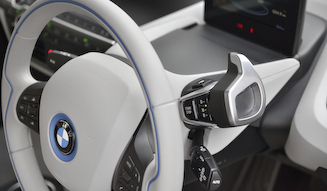
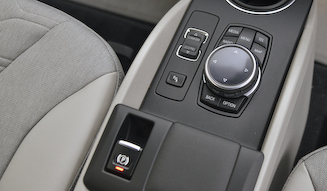
The controls also feature BMW i's original design. The "driving" functions are consolidated into a thick lever protruding to the right from the steering column, housing the start/stop button, a rotary drive selector (for D, N, R ranges), and the parking button. To start, first press the start button to enter ready mode, then simply twist the drive selector to choose D. The electric parking brake switch is located on the center console.
When you press the accelerator, the i3 begins to move effortlessly. The noise level is, of course, low. The sound from the inverter and motor is also relatively quiet. It might not quite match the "e-Golf", but at this level, it's hardly noticeable.
What's more characteristic is the throttle pedal, or rather, the accelerator's setting. Well, regarding acceleration, I don't feel anything particularly unusual. However, when you release the accelerator, a surprisingly strong deceleration G-force is generated.
It's natural for an EV to actively regenerate energy during deceleration. And it's understandable that this results in significant deceleration G-force. However, the i3 generates a deceleration G-force comparable to lightly applying the foot brake.
Whether you find this convenient or feel it's "not to your liking" will likely vary from person to person. In fact, the "MINI E", which BMW produced experimentally during the i3's development, generated a deceleration G-force of 0.3G when the accelerator was released. Considering that a full brake on a normal car is said to be 1G, this is about one-third, but it's likely a level that most people would perceive as "sudden braking."
Even so, I was able to adapt to the MINI E's driving operation in a surprisingly short time. And once accustomed to it, I even found it more convenient, as there was no need to switch to the brake pedal.
In the i3, however, the deceleration G-force feels reduced to about half that of the MINI E. Even so, first-time drivers will likely feel some unfamiliarity, but at this level, it might be within an acceptable range. On the other hand, for situations like seeing a red light ahead and gradually slowing down, you can still come to a complete stop using only the accelerator without touching the foot brake, so it could be considered a good compromise.
BMW i3 | BMW i3
An Epoch-Making Electric Car
Domestic Test Drive of the BMW i3 (3)
The Pros and Cons of Large-Diameter Tires
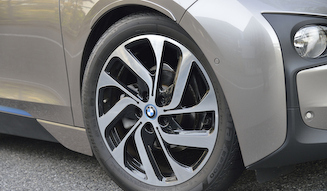
Looking at the i3's side profile, you notice it's equipped with tires of unusually large diameter. The test car was fitted with front 155/70R19 and rear 175/60R19 sizes. Fitting 19-inch wheels to the i3, which is essentially a C-segment car, is surprising enough, but combining them with "thick" aspect ratios of 60% and 70% results in a considerable overall tire diameter – about the size of a small motorcycle tire. On the other hand, the tire widths of 155 and 175 are sizes you'd expect for a kei car these days.
Why did BMW choose such an unusual tire size? The primary reason is to reduce air resistance. Wide tires have a larger frontal area, which directly increases air resistance. Conversely, narrowing the tires reduces their area and thus air resistance, but as you might imagine, the contact patch with the road also decreases, potentially leading to insufficient grip.
To prevent this, the adoption of large-diameter tires was considered. Tires with a larger outer diameter result in a contact patch that is elongated in the fore-aft direction. This compensates for the reduced width, aiming to achieve adequate grip.
Based on my test drive impression, I didn't feel a lack of lateral grip. In fact, the i3's cornering speed is quite brisk. If one finds this insufficient, they would likely need to drive a more dedicated sports car. That's how capable the i3's cornering performance is.
On the other hand, the ride comfort seemed to be where the downside of the large-diameter tires manifested. There's a tendency towards harshness, meaning that when the road surface is uneven, the shocks are transmitted directly into the cabin. This tendency is somewhat pronounced in the i3.
Some journalists might argue that this makes the "i3 a failure," but I don't think so. While it's true that less harshness is preferable, the perception of harshness varies from person to person, and those in our profession tend to have stricter evaluations. Therefore, I will report that the harshness was on the stiffer side, but I will leave the final judgment to the reader.
BMW i3 | BMW i3
An Epoch-Making Electric Car
Domestic Test Drive of the BMW i3 (4)
Aggressive Steering
Another aspect that I found disorienting in the i3 was its cornering form. Even with a slight turn of the steering wheel, it initiates a turn-in so quickly with almost no body roll. The steering gain, which is somewhat aggressive, was a point of concern for me.
"BMW excels at making sporty cars. Moreover, the i3 is marketed for its sporty handling, so such a tuning is natural, right?" You might be thinking that.
However, in BMW's latest models, excluding a very small number of sporty variants, steering response is more subdued, and body roll is properly controlled. The exception is the "MINI," but that's deliberately emphasizing a "go-kart" feel to convey a sense of playfulness, which could be considered a strategic tuning choice.
Incidentally, the third-generation MINI, which shares some platform components with BMW's compact models, had its go-kart feel significantly toned down. This suggests that BMW doesn't necessarily consider the go-kart feel essential. Personally, I think the MINI's character and the go-kart feel match well. However, I personally love the current BMWs' more subdued handling and natural body roll even more. Therefore, the i3's quick steering response leaves me with a slight sense of unease.
On the other hand, the power performance is quite lively. For example, in the 10-90 km/h range, the pickup is good, and you can experience responsive acceleration at all times. However, as is typical with electric cars, the momentum begins to wane somewhat at higher speeds. For the i3, around 100 km/h seems to be the upper limit for enjoyable driving. Still, considering Japan's speed limits and the i3's role as a city commuter, one could argue that more performance isn't necessary.
BMW i3 | BMW i3
An Epoch-Making Electric Car
Domestic Test Drive of the BMW i3 (5)
The Significance of BMW i
Articles about the i3 have been published on OPENERS numerous times before. However, there haven't been many impressions from test drives, so I focused on that for this piece, which has resulted in an emphasis on the harshness and handling aspects that I found somewhat jarring.
However, I would be deeply disappointed if this leads anyone to believe that I consider the "i3 to be a failure."
The i3 is a historically epoch-making car in that it achieved a carbon monocoque construction for under 5 million yen (5.46 million yen with the range extender). I believe that in about 20 years, when cars with carbon monocoque construction become more commonplace, the i3 will be remembered as the car that initiated this trend. Furthermore, I suspect it will take about another 10 years for rival manufacturers to catch up to BMW's mass-production technology for carbon monocoques.
Furthermore, BMW i has played a significant role in drastically reducing CO2 emissions during the car production process. This trend will undoubtedly ripple throughout the entire automotive industry.
I resonate with many aspects of the i3's concept and design. If I had more financial leeway and wanted to keep a city commuter car, the i3 would be a strong contender.
Nevertheless, I want to point out the aforementioned harshness and handling as areas for future improvement. However, given that BMW, which once struggled with the harshness of run-flat tires, has mastered them in just a few years and now significantly outpaces its rivals in this area, I am confident they will overcome the challenges associated with these large-diameter tires.
I eagerly await the day, perhaps two or three years from now, when I can encounter a more refined i3 with an improved chassis.

BMW i3 | BMW i3
Body Size | Length 4,010 × Width 1,775 × Height 1,550 mm
Wheelbase | 2,570 mm
Tread (Front/Rear) | 1,575 mm / 1,560 mm
Minimum Ground Clearance | 110 mm
Weight | 1,260 kg
Drive Battery | 1 Lithium-ion battery (96 cells)
Maximum Output | 125 kW (170 ps) / 5,200 rpm
Maximum Torque | 250 Nm (25.5 kgm) / 100-4,800 rpm
Drivetrain | RR
Suspension (Front/Rear) | Strut / Multi-link
Brakes (Front/Rear) | Ventilated discs
Tires (Front/Rear) | 155/70R19
0-100 km/h Acceleration | 7.2 seconds
Minimum Turning Radius | 4.6 meters
Trunk Capacity | 260-1,100 liters
Maximum Speed | 150 km/h
Driving Range per Charge (JC08) | 229 km
Price | 4,990,000 yen
BMW i3 | BMW i3 (with Range Extender)
Body Size | Length 4,010 × Width 1,775 × Height 1,550 mm
Wheelbase | 2,570 mm
Tread (Front/Rear) | 1,575 mm / 1,540 mm
Minimum Ground Clearance | 110 mm
Weight | 1,390 kg
Drive Battery | 1 Lithium-ion battery (96 cells)
Maximum Output (Electric Motor) | 125 kW (170 ps) / 5,200 rpm
Maximum Torque (Electric Motor) | 250 Nm (25.5 kgm) / 100-4,800 rpm
Generator Engine | Inline 2-cylinder DOHC 4-valve
Maximum Output (Generator Engine) | 28 kW (38 ps) / 5,000 rpm
Maximum Torque (Generator Engine) | 56 Nm (5.7 kgm) / 4,500 rpm
Drivetrain | RR
Suspension (Front/Rear) | Strut / Multi-link
Brakes (Front/Rear) | Ventilated discs
Tires (Front/Rear) | 155/70R19 / 175/60R19
0-100 km/h Acceleration | 7.9 seconds
Minimum Turning Radius | 4.6 meters
Trunk Capacity | 260-1,100 liters
Maximum Speed | 150 km/h
Hybrid Fuel Economy (JC08) | 27.4 km/l
Driving Range Using Charging Power | 196.1 km
Price | 5,460,000 yen