Audi's Baby Monster, the S1: A Test Drive
Audi S1 2.0 TFSI quattro
Audi S1 Sportback 2.0 TFSI quattro
A Spicy Hot Hatch
Test Drive: Audi S1 & S1 Sportback
In February this year, Audi’s most compact models, the A1 and its five-door sibling, theA1 Sportback, welcomed the sporty S1 andS1 Sportback. These cars boast specs befitting the "S" designation, featuring a four-cylinder engine producing 231ps and quattro all-wheel drive within a small body. Tatsuya Otani test drove these anticipated hot hatches in Sweden.
Text by OTANI Tatsuya
231ps of Power in a Compact Body
Don't underestimate these cars just because of their small size.
Indeed, the base model is the Audi A1, the brand's smallest offering. However, bearing the sporty "S" badge signifies the inclusion of Audi's renowned quattro all-wheel-drive system. Furthermore, by increasing the engine displacement from the standard 1.4-liter to 2.0 liters, a "baby monster" has been created, packing a 231ps power unit into a body just under four meters long.
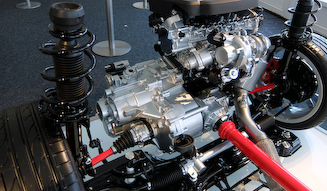
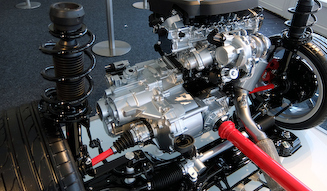
Front suspension
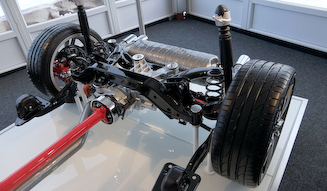
Rear suspension
However, without adjustments, the power-to-body ratio could result in a car that's difficult to handle. To prevent this, Audi upgraded the rear suspension from the standard torsion beam to a four-link setup. The substantial trailing arms are designed to effectively manage the longitudinal forces acting on the tires.
Moreover, as the cutaway model shows, the rear suspension, multi-plate clutch, and rear differential are all housed within a robust subframe. This suggests that the 231ps of power can be handled with ease.
The front suspension retains the A1's MacPherson strut design, but by lowering the pivot bearing position on the hub by 25mm compared to the standard specification, steering response has been improved, leading to more agile handling.
Audi S1 2.0 TFSI quattro
Audi S1 Sportback 2.0 TFSI quattro
A Spicy Hot Hatch
Test Drive: Audi S1 & S1 Sportback (Part 2)
Three-Door and Five-Door
While the suspension geometry has been revised and the springs and dampers re-tuned (not just stiffened, but equipped with a standard dual-stage damping control system), 231ps in a two-wheel-drive B-segment car would still be a significant challenge.
However, as mentioned, the S1 features quattro all-wheel drive. A full-time AWD system not only provides excellent traction on slippery surfaces but also distributes driving force to all four wheels during cornering, allowing for better utilization of lateral grip from each wheel. This results in superior cornering performance compared to two-wheel-drive vehicles.
In other words, the benefits of a full-time AWD system are particularly significant for compact sporty models like the S1.
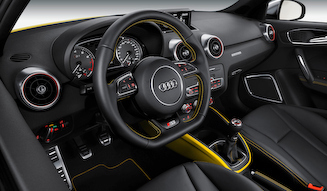
Another distinctive feature of the S1 is the absence of the S tronic dual-clutch automatic transmission; only a six-speed manual is offered. The reason for this is that equipping the S tronic would add 20kg to the front weight, making it more difficult to achieve agile handling. This decision can also be attributed to the car's compact dimensions.
Up to this point, I've referred to the S1 collectively, but this includes two types: the three-door "S1 2.0 TFSI quattro" and the five-door "S1 Sportback 2.0 TFSI quattro." However, similar to the relationship between the standard A1 and A1 Sportback, the overall length of the S1 and S1 Sportback is identical. The S1 Sportback is only 25kg heavier than the S1 (the weight difference for the Japanese-spec A1 and A1 Sportback is 20kg), a surprisingly small margin.
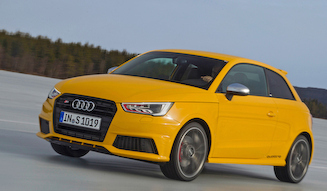
Audi S1 2.0 TFSI quattro
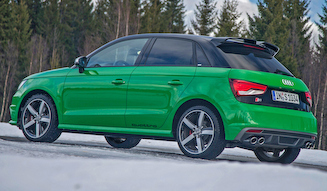
Audi S1 Sportback 2.0 TFSI quattro
The 0-100km/h acceleration figures are 5.8 seconds for the S1 and 5.9 seconds for the S1 Sportback. For European fuel economy (combined cycle), the S1 achieves 14.3km/L, while the S1 Sportback achieves 14.1km/L. The performance difference is negligible. Nevertheless, the actual driving experience reveals virtually no difference in performance.
However, there are subtle differences. The three-door model has a sportier exterior, and the seating position is slightly lower, which I personally find more comfortable. Of course, the practicality of the five-door is also appealing, making the choice a difficult one.
That said, unless otherwise specified, "S1" here refers to both the S1 and the S1 Sportback.
Audi S1 2.0 TFSI quattro
Audi S1 Sportback 2.0 TFSI quattro
A Spicy Hot Hatch
Test Drive: Audi S1 & S1 Sportback (Part 3)
A Perfectly Balanced Setup
So, what does this baby monster feel like on the road?
The test drive event took place in Östersund, Sweden, in early spring. As expected, the roads were still covered in snow in many places, making for slippery conditions – an ideal environment to test the quattro system.
Upon driving, the first impression is one of surprising stability. With a short wheelbase of 2,465mm (2,469mm officially in Europe) and a stiffened suspension to handle 231ps, some pitching over bumps in town would be understandable. However, the S1 maintains a remarkably flat posture while driving.
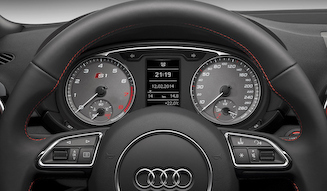
The ride quality is certainly not soft; road impacts are transmitted to the occupants with a distinct solidity. However, the harsh edges of the shocks are smoothed out, making it far from uncomfortable. Enthusiasts of sporty models will likely appreciate this setup.
The handling is agile, yet neither overly sensitive nor unstable. The S1 can be driven exactly as intended, almost as if the entire car fits in the palm of your hand.
Furthermore, the quattro system performs admirably during acceleration and cornering, preventing any single wheel from spinning uselessly or the car from sliding uncontrollably. It strikes an excellent balance between agility and stability, with agility perhaps having a slight edge.
Audi S1 2.0 TFSI quattro
Audi S1 Sportback 2.0 TFSI quattro
A Spicy Hot Hatch
Test Drive: Audi S1 & S1 Sportback (Part 4)
A Sport Hatch for Adults
While it may not possess the same level of stability as its larger sibling, theS3, the S1 offers superior agility. Therefore, the choice between the S1 and S3 likely depends on whether one prioritizes stability or nimbleness.
The 231ps power output is more than sufficient. Particularly pleasing is the punchy acceleration from low speeds, leveraging the 2.0-liter displacement.
The operation of the six-speed manual could be slightly lighter, but the overall linkage feels robust, and the shift gates are well-defined, eliminating any risk of missed shifts. It certainly won't detract from the enjoyment of sporty driving.
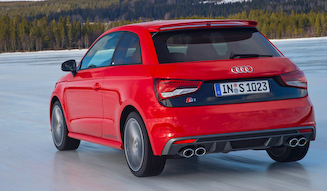
It's been a while since a hot hatch as spicy as the S1 has appeared. Moreover, it's not just a wild ride; the integration of high-quality technology ensures both ample stability and driving enjoyment. In this regard, it can be considered a sport hatch that satisfies even discerning adults.
Sales in Japan are expected to begin this autumn or later, with prices likely to be slightly over 4 million yen.

Audi S1 2.0TFSI quattro
Body Dimensions | Length 3,975 x Width 1,740 x Height 1,417 mm
Wheelbase | 2,469 mm
Tread Front/Rear | 1,474 / 1,452 mm
Weight | 1,390 kg
Engine | 1,984cc Inline 4-cylinder Direct Injection DOHC with Intercooler Turbo
Max. Output | 170 kW (231ps) / 6,000 rpm
Max. Torque | 370 Nm / 1,600-3,000 rpm
Transmission | 6-speed Manual
Drivetrain | 4WD
Front Suspension | MacPherson Strut
Rear Suspension | 4-Link
Tires Front/Rear | 215/40R17
Brakes Front/Rear | Ventilated Disc / Ventilated Disc
Trunk Capacity | 210 Liters
0-100km/h Acceleration | 5.8 seconds
Top Speed | 250 km/h
Fuel Economy (NEDC) | 7.0 L/100km (approx. 14.3km/L)
CO2 Emissions | 162 g/km
Audi S1 Sportback 2.0TFSI quattro
Body Dimensions | Length 3,975 x Width 1,746 x Height 1,423 mm
Wheelbase | 2,469 mm
Tread Front/Rear | 1,474 / 1,452 mm
Weight | 1,415 kg
Engine | 1,984cc Inline 4-cylinder Direct Injection DOHC with Intercooler Turbo
Max. Output | 170 kW (231ps) / 6,000 rpm
Max. Torque | 370 Nm / 1,600-3,000 rpm
Transmission | 6-speed Manual
Drivetrain | 4WD
Front Suspension | MacPherson Strut
Rear Suspension | 4-Link
Tires Front/Rear | 215/40R17
Brakes Front/Rear | Ventilated Disc / Ventilated Disc
Trunk Capacity | 210 Liters
0-100km/h Acceleration | 5.9 seconds
Top Speed | 250 km/h
Fuel Economy (NEDC) | 7.1 L/100km (approx. 14.1km/L)
CO2 Emissions | 166 g/km