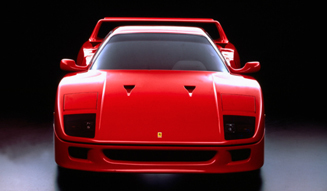
First Drive: The Ferrari California T | Ferrari
Ferrari California T
Considering Ferrari's Turbocharged Cars
First Drive: Ferrari California T
Debuting at theGeneva Motor Show in March 2014, the FerrariCalifornia Tdrew attention as the first Ferrari in a long time to feature turbocharging since the F40. Tatsuya Kushima, who had the opportunity to test drive the California T in the United States, was impressed by its engineering and reflected on what a turbocharged Ferrari means.—.
Text by KUSHIMA Tatsuya
Ferrari's Turbochargers
In Italian, it's called a 'compressore.' In English, it's a compressor, or more specifically, a supercharger. To put it simply, it's a turbocharger. It uses a portion of the exhaust gas to spin a turbine, which then forces compressed air into the engine.
Ferrari is said to have first implemented this in Formula 1 cars in the early 1980s. These cars, developed by Scuderia Ferrari, featured a 120-degree V6 engine with KKK turbochargers from Germany mounted on top. According to some accounts, they were quite wild machines with significant turbo lag.
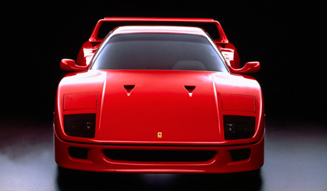
Ferrari F40
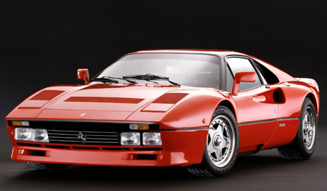
Ferrari 288 GTO
What about production cars?
The first that comes to mind is likely the 'F40.' Introduced in 1987 to commemorate Ferrari's 40th anniversary, this supercar was equipped with an intercooled twin-turbo engine supplied by IHI. Its claimed top speed was 320 km/h, which is astonishing. Even today, it remains a top-tier performance figure.
Besides the F40, there was also the '288 GTO.' Personally, I can't overlook the '208 GTB/GTS Turbo.' These models featured a Pininfarina-designed body, similar to the familiar '308,' with a 2-liter V8 engine mounted mid-ship. They bore a strong resemblance to the aforementioned Formula 1 cars, partly because they used KKK turbochargers, just like those F1 machines...
Ferrari California T
Considering Ferrari's Turbocharged Cars
First Drive: Ferrari California T (Part 2)
The "T" Represents a Significant Evolution
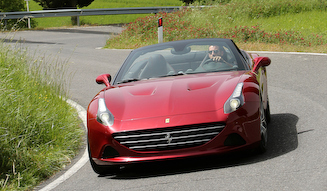
Ferrari's return to turbocharging for a production model is embodied in the "California T." The "T" in its name explicitly signifies its turbocharged nature.
It is based on theCalifornia 30, which was a further refined version of the previousCalifornia. The California 30 boasted a 30 horsepower increase and a 30 kg weight reduction, achieving a maximum output of 490 hp and a 0-100 km/h acceleration time of 3.8 seconds, compared to the previous 460 hp and 4.0 seconds.
What's remarkable is that the California T's advancements far surpass that level. Its maximum output is 560 hp, and it accelerates from 0 to 100 km/h in just 3.6 seconds. Furthermore, it achieves an impressive reduction in fuel consumption by approximately 15% and a decrease in CO2 emissions.
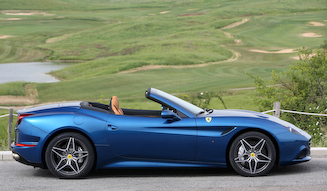
The engine displacement is downsized from 4.3 liters to 3.9 liters. While engine downsizing is a trend, achieving these figures highlights the effective contribution of the turbocharger. The twin-scroll turbocharger operates from low RPMs, with the twin-scroll design minimizing response time. The supplier, like for the F40, is IHI. Their collaborative development has yielded such remarkable performance.
Incidentally, Ferrari has been strengthening its ties with IHI recently. This is because the V6 parallel twin-turbo engine used in the Maserati is also a collaboration with them. While this engine was developed by Maserati and is produced at Ferrari's Maranello factory, Ferrari's development team mentioned that their engineers were seconded to Maserati for the turbo engine's development.
Ferrari California T
Considering Ferrari's Turbocharged Cars
First Drive: Ferrari California T (Part 3)
The Ferrari Sound Remains
So, what is the driving feel of the California T's turbocharged engine like? Frankly, the sensation of turbocharging is subtle. This is because the acceleration in response to throttle input is exceptionally smooth, with no noticeable turbo lag. It truly feels like a naturally aspirated unit.
Of course, if you test the seven gears across various speed ranges during driving, some lag might occur, but otherwise, it's not a concern.
However, the engineers mentioned that the high-rpm range was particularly challenging. They spoke with confidence about overcoming this hurdle.
They also stated that they put great effort into ensuring this engine delivers Ferrari's traditional powerful and racing-inspired sound.
Indeed, even with turbocharging, the characteristic Ferrari 'らしさ' (its essence) remains, and you can enjoy that distinct, high-pitched, crisp sound. Its presence, capable of transforming ordinary roads into a racetrack in an instant, is undeniable. Moreover, the low-end volume has been enhanced this time, with a notable presence of lower frequencies, which is unusual. The press release explains this by mentioning, "Equal-length exhaust headers optimize exhaust pulse dynamics..."
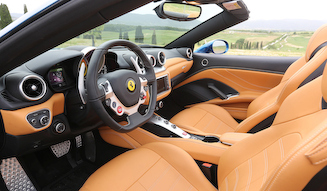
In addition to the sound, what I found particularly unique was the Variable Boost Management system. This system alters the torque delivery depending on the gear position, with the engine supplying different torque levels from 3rd to 7th gear. This might contribute to the natural-aspirated-like feel.
Considering all these aspects, there's much to discuss regarding the engine alone. It's a testament to the engineers' dedication. Ultimately, they pursued the advantages and disadvantages of turbocharging from every angle to create this optimal solution.
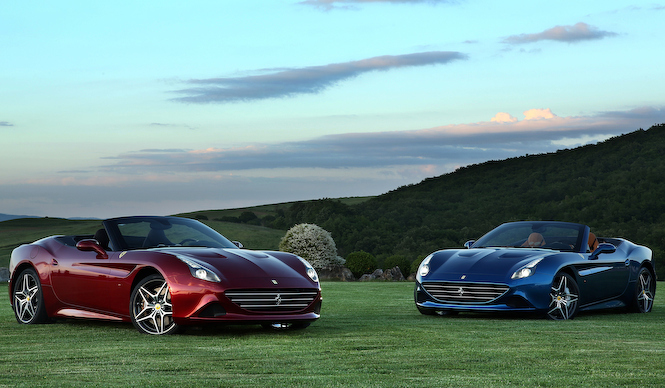

Ferrari California T
Body Dimensions: Length 4,570 x Width 1,910 x Height 1,322 mm
Wheelbase: 2,670 mm
Tread Front/Rear: 1,630 / 1,605 mm
Dry Weight: 1,625 kg
Weight Distribution Front/Rear: 47% / 53%
Engine: 3,855 cc 90-degree V8 direct-injection turbo
Maximum Output: 412 kW (560 hp) / 7,500 rpm
Maximum Torque: 755 Nm (77.0 kgm) / 4,750 rpm
Transmission: 7-speed dual-clutch
Drivetrain: FR
Tires Front/Rear: 245/40ZR19 / 285/35ZR19
Brakes: Carbon-ceramic (CCM3)
Top Speed: 316 km/h
0-100 km/h Acceleration: 3.6 seconds
0-200 km/h Acceleration: 11.2 seconds
Fuel Consumption (NEDC): 10.5 L/100km (9.5 km/L)
CO2 Emissions: 250 g/km
Fuel Tank Capacity: 78 liters
Trunk Capacity: 340 liters (with roof stowed)
Price: 24,500,000 yen