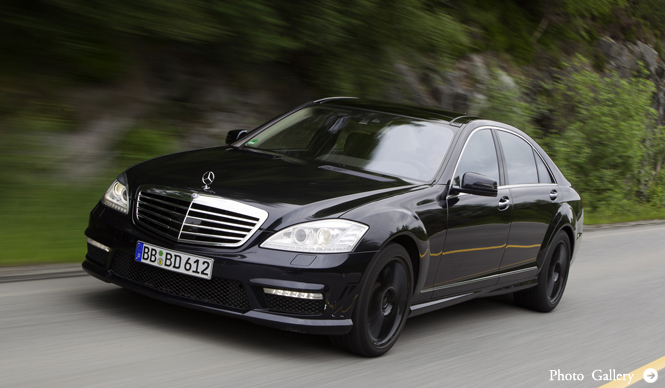
Mercedes-Benz S 63 AMG Report
Mercedes-Benz S 63 AMG
AMG Becomes Eco-Conscious (1)
The flagship saloon, "Mercedes-Benz S63 AMG," has been redesigned to be more environmentally conscious, improving fuel efficiency by 25 percent while retaining its distinctive exhaust sound and unchanged appearance.Mercedes-BenzMotor journalist Yasuhiko Kawamura test-drove the new S63 AMG.
Text by Yasuhiko KawamuraPhotos by Mercedes-Benz Japan
Successor to the M156, the M157 engine: 5461cc, V8 DOHC
When AMG completed its 6.2-liter, high-revving sporty engine capable of exceeding 7,000 rpm in 2005, its development team proudly declared, "This is our first engine designed and developed from scratch, not merely a tuned Mercedes unit."
However, in just about five years, the times seem to have changed dramatically. AMG has now introduced a new heart to replace its high-revving, high-output, large-displacement engine, even for AMG, which boasts a lineup of powerful models. They are now touting "a 25 percent improvement in fuel efficiency." It seems that environmental consideration is now indispensable in today's world.
Actually, AMG itself does not introduce this new unit as a replacement version of the previous one. However, given that the new engine is the M157 and the previous 6.2-liter engine was the M156, anyone would naturally infer that the former is the successor to the latter.
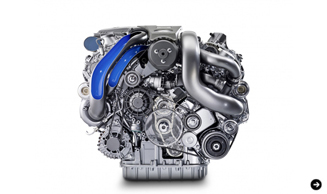
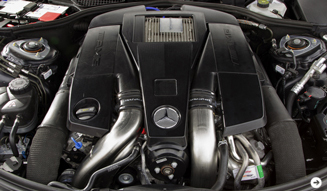
There is a decisive reason to believe these two engines are related as old and new: the engine in the V8 model of the flagship S-Class saloon has been replaced from the M156 to the M157. Despite this, both vehicles are named "S63 AMG." This means the S63 AMG model has undergone an exceptional refinement mid-lifecycle, with only the engine being completely redesigned.
The basic specifications of the engine, officially unveiled this September, are a 5,461cc twin-turbocharged V8 DOHC with a 90-degree V-bank. The maximum output is 544 ps, an increase of 19 ps from the M156. Meanwhile, the maximum torque of 800 Nm represents a substantial increase of 170 Nm, a significant boost typical of turbocharged engines.
Twin Turbochargers Boasting 185,000 RPM
Incidentally, an optional tuning package called "Performance Package" is available. With this option, the maximum boost pressure is increased from 1.0 bar to 1.3 bar, raising the maximum output and torque to 571 ps and 900 Nm, respectively.
Nevertheless, CO2 emissions have been significantly reduced from 347g in the M156 era to 246g (the same figure for the Performance Package car) under the European "NEDC" test cycle. This is likely the primary reason for the engine swap.
"More power, better fuel economy" is the current trend for premium models originating from Europe. The new unit, incorporating direct injection and an idling stop mechanism, along with thorough friction reduction in various parts, is developed based on the principle of reducing fuel consumption in the normal operating range by decreasing displacement, while utilizing supercharging to increase output when needed.
The displacement reduction from the M156 6.2-liter engine is 747cc. The spray-guided direct injection system uses highly precise piezo injectors, and the two turbochargers, welded to the exhaust manifold and capable of reaching 185,000 rpm, are efficiently driven by the high-energy exhaust gases immediately after they are discharged.
The driving performance of the S63 AMG, equipped with this new heart, remains as robust as ever.
Mercedes-Benz S 63 AMG
AMG Becomes Eco-Conscious (2)
The Serenity of a Flagship Saloon and Inherited Acceleration Power
Of course, it also delivers the refined driving experience befitting a chauffeur-driven flagship saloon like the S-Class. The combination of a highly efficient and responsive wet multi-plate start clutch and a 7-speed automatic transmission provides acceleration as smooth as a torque converter automatic.
However, when you press the accelerator pedal deeply, the world transforms! The true nature of this model lies in its ability to deliver exhilarating performance that can outpace even top-tier sports cars.
Despite the reduced displacement, the powerful acceleration from low RPMs is in no way inferior to the "6.2-liter era." Furthermore, as mentioned earlier, pressing the accelerator pedal deeply provides a warp-like acceleration sensation, as if being sucked into a black hole, maintaining the essence of the previous S63 AMG.
In fact, the 0-100 km/h acceleration time for the new model is 4.5 seconds. For the Performance Package specification, it's 4.4 seconds, which is truly "uncontrollable speed" that even the Porsche 911 Carrera cannot match.
For reference, the previous model's time was 4.6 seconds. Here again, the promise of improved efficiency while surpassing past performance has been fulfilled.
What was particularly interesting was the exhaust sound, which is so powerful that it's almost indistinguishable from the 6.2-liter model. Typically, turbocharged engines, which also function as "exhaust energy recovery devices," tend to have a quieter sound than naturally aspirated versions. However, this is not the case with the S63 AMG. AMG has a long and inseparable history with V8 engines.
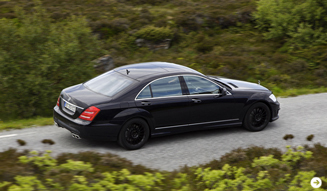
Historically, the distinctive identity of AMG V8 cars has included their spectacular exhaust sound during acceleration. Therefore, it is likely that the development team deliberately tuned this S63 AMG to possess that signature AMG sound.
In fact, another V8 model from the same company, equipped with a similar concept new engine, is scheduled for release soon. Comparing its exhaust note with this one should reveal how much emphasis AMG places on its V8 engine sound.
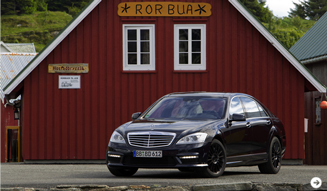
A More Valuable Heart Befitting Its Class
By the way, the high-revving, high-output characteristics of the M156 unit, now considered the "old engine" in the S63 AMG, are still appealing in terms of sportiness. Even though the new M157 achieves "a balance of power and fuel efficiency," it cannot match the M156 in its ability to rev freely past 7,000 rpm with the sharp response of a 1.6-liter sports engine.
Therefore, it appears that AMG will continue to explore a division of roles between the two for the time being. The SLS AMG, a super sports model, is equipped with an engine derived from the M156, and the comment that the new M157 will "be adopted first in large, heavy models" suggests such a strategy.
Indeed, while the S63 AMG is the flagship model of sports saloons, it's unlikely that many people desire an engine that revs past 7,000 rpm for a car of this class. For "mass-produced AMG cars," the aim is a significant improvement in fuel efficiency, while the unit with high-revving, high-output characteristics is elevated to a more exclusive and valuable heart. This strategy behind the introduction of the downsized new M157 engine can be sensed.