TOYOTA iQ | The 25th Installment (Part 1) | A Car That Shatters Automotive Hierarchy
The 25th: TOYOTA iQ (Part 1)
A Car That Shatters Automotive Hierarchy
In an era of "moving beyond oil" and "divorcing oil," Toyota released the microcar iQ. What is the true value of this new generation of premium car that challenges the hierarchy of the automotive world based on body and engine size?
By Yasushi ShimonosonoPhotos by Toyota Motor Corporation
A Body 40cm Shorter Than a Kei Car
Rich people drive big cars. This is, perhaps, common sense. Rich people drive cars with poor fuel economy. This too can be considered common sense, as big cars are inherently less fuel-efficient. After all, if one has the wealth to afford a large car, they likely wouldn't fuss over fuel costs. The proof? There are no luxury sedans that can travel 100 kilometers on a single liter of gasoline, despite costing ¥30 million. It's not that it couldn't be done; it's simply that there was no demand.
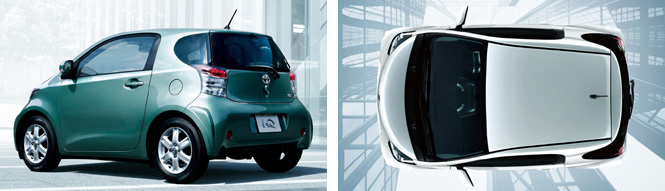
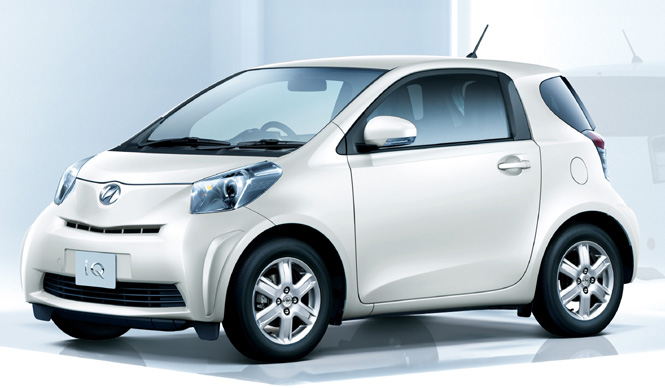
With its sculpted body lines and sharp waistline, the iQ's excellent design creates a presence that belies its body, which is 40cm shorter than a kei car.
However, these notions belong to the old century. The 21st century is the era of "moving beyond oil" and "divorcing oil." Hollywood stars are flocking to the Toyota Prius. A certain celebrity madam, who drives a clean diesel Mercedes E320 CDI capable of traveling about 800 kilometers on a full tank, smugly remarks, "I only have to visit the gas station three times a year." The era when only those with tight budgets sought compactness and fuel efficiency is drawing to a close.
It is in this climate that the Toyota iQ has arrived. While a 1-liter displacement is not uncommon, this car, despite not being a kei car, is 40cm shorter than a kei car. Its weight is even lighter than many kei cars. Yet, its price is higher than the Vitz. Its tagline is "Micro Premium Car."
An Innovative Package for Three Adults
At its unveiling press event, the chief engineer described it as "a car that shatters automotive hierarchy." I was surprised that Toyota, which boasts a lineup as diverse as an automotive department store, would say such a thing. "Why not release it under the Lexus brand then?" I asked the developers, who admitted that such discussions had indeed taken place.
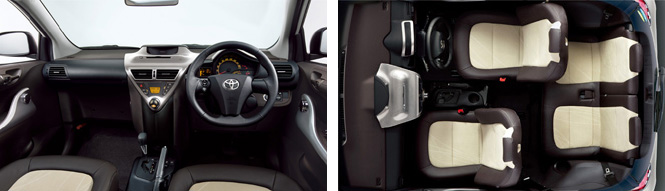
By positioning the passenger seat ahead of the driver's seat and employing a compact powertrain, it achieves a 4-seater configuration within a body less than 3 meters long. This is truly a triumph of packaging.
At 2985mm, the iQ is the second shortest production car currently available, after the Smart ForTwo. Its 30cm advantage over the Smart allows for rear seats. Sitting in them, they are more than just 'occasional seats.' Through various efforts, such as slightly moving the passenger seat forward, thinning the front seatbacks, and cleverly arranging the power unit, they have achieved this. As a result, while the space behind a large driver is understandably tight, an adult can comfortably sit behind the passenger seat. In essence, it's a full 3-seater.
As a Smart owner, I often find myself wishing for just one more seat during daily use. Furthermore, if it could accommodate three adults plus one child, it could even serve as a minimalist family car for a household. The reason I've been able to own three two-seaters (two of which were Smart cars) is that we have another car at home with rear seats. In this regard, the iQ truly lives up to Toyota's reputation. Even with its innovative packaging, it understands the key to marketing.