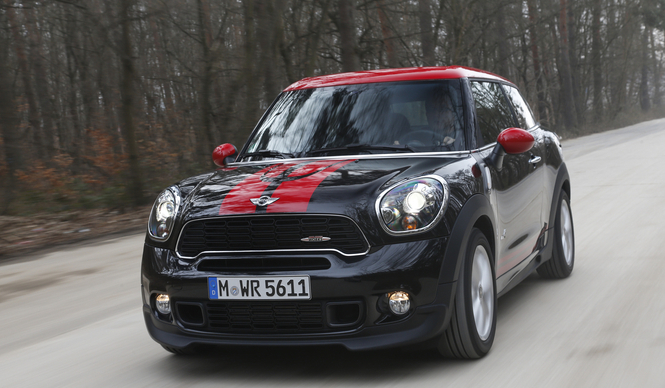
Test Drive: The MINI JCW Paceman | Mini
MINI John Cooper Works Paceman |
MINI John Cooper Works Paceman
The Hottest Paceman
Test Drive: MINI JCW Paceman
Having recently landed in Japan,MINI Pacemanwhich we also featured on OPENERS,Overseas Test DriveandDomestic Test Drivewe have now seen the addition of the JCW to the Paceman lineup.John Cooper Works AppearsMr. Toshifumi Watanabe took the wheel in Frankfurt.
Text by WATANABE Toshifumi
Gracefully Adorning the Cityscape
We drove the "John Cooper Works (JCW)" version of the newest MINI, the "Paceman," for approximately 500km from Frankfurt to Munich.
A MINI for those who want to drive and be driven more──This car deliberately breaks the crossover concept with its slash-cut roof to emphasize its personal character.──Understanding the origins of the Paceman is difficult. Or, it's easy to dismiss it as putting the cart before the horse.
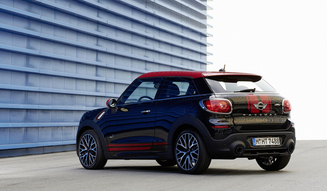
However, in a world full of convenient cars, the role of a two-door coupé is precisely that. By choosing inconvenience, it highlights the driver's individuality and gracefully adorns the cityscape. In other words, MINI is a brand that has aggressively applied new ideas to such areas.
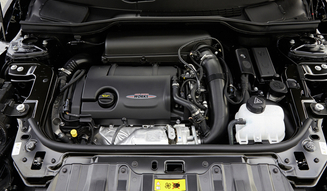
The specifications for the JCW Paceman are nearly identical to those of theJCW Crossoverwhich was released earlier. The 1.6-liter direct-injection turbo produces 218ps, with a torque of 280Nm at 1,900rpm under normal conditions, and temporarily increases boost pressure under high load, such as full throttle, to a maximum of 300Nm.
MINI John Cooper Works Paceman |
MINI John Cooper Works Paceman
The Hottest Paceman
Test Drive: MINI JCW Paceman (2)
A Refined Ride Feel That Defies Preconceptions
In terms of power, the acceleration from 0-100 km/h in 6.9 seconds is also the same as the JCW Crossover. The top speed, possibly due to aerodynamics, is 224 km/h for the AT version, just 1 km/h faster than the JCW Paceman. The main differences in size are that the overall height is 25mm lower than the JCW Crossover, and while the Crossover series offers an optional 5-seater configuration, the Paceman series is exclusively a 4-seater.
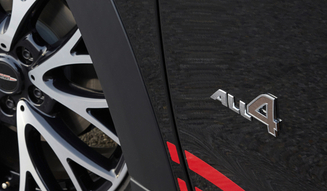
The JCW Paceman features the "ALL4" all-wheel-drive system, inherited from the base model. The mechanism and control, utilizing an electronically controlled hydraulic differential, remain the same as before, providing full-time 50:50 power distribution that can linearly shift up to nearly 100 percent to either the front or rear wheels depending on slip conditions.
The suspension, with struts at the front and a multi-link setup at the rear, is also unchanged, but the brake and suspension settings are, of course, different. The ground clearance is not significantly different from the base model, so the settings are not so extremely on-road biased as to limit its range of use.
The combination of the 1.6-liter direct-injection turbo unit, which pioneered the downsizing trend with its excellent balance of power and efficiency, and the 6-speed AT still feels remarkably current. Despite being over 1.4 tons and equipped with all-wheel drive, the JCW Paceman pulls away effortlessly and smoothly, quickly reaching cruising speeds of 200 km/h.
Even more impressive is the chassis. Compared to the base model, the ride is noticeably smoother and flatter. This refined ride feel, which defies preconceptions of a MINI, is also evident in cornering. Rather than forcibly suppressing body roll, it clears corners with natural grip, utilizing the significant unsprung weight effectively. It might be more accurately described as neutral steering rather than the typical go-kart feel.
MINI John Cooper Works Paceman |
MINI John Cooper Works Paceman
The Hottest Paceman
Test Drive: MINI JCW Paceman (3)
The Goal of Crossover-Series JCW Models
For MINI, agility remains a dynamically crucial identity that defines the brand.
On the other hand, among the JCW-badged models, there is theicon, aptly named the "GP."It is a pure sports hatch born to satisfy extreme preferences, with its rear seats removed and a brace installed between the rear strut towers.
MINI John Cooper Works Paceman | MINI John Cooper Works Paceman
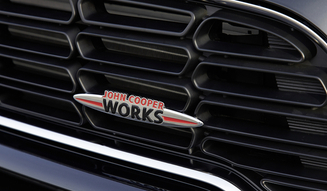
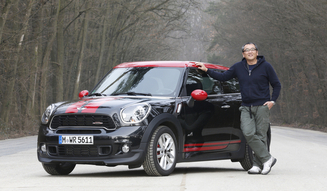
In contrast, the JCW crossover models, including the Paceman, seem to aim for a depth that allows them to function as all-weather grand tourers, with agility built upon that foundation. For users who prioritize sportiness, they appear to be exploring tuning that feels more refined than the ride of the base grade. Perhaps this is the direction they are pursuing.
How much added value can be delivered to the user without compromising the brand's core 'go-kart feel'? The JCW models' aspirations might reflect what MINI has been experimenting with in its current generation. While the JCW Paceman could be considered a niche offering, it's a gap that MINI, with its premium compact cars selling in volumes of 300,000 units, might be uniquely positioned to fill.

MINI John Cooper Works Paceman
Body Dimensions | Length 4,124 x Width 1,786 x Height 1,527mm
Wheelbase | 2,596 mm
Tread Front/Rear | 1,527 / 1,554 mm
Minimum Turning Radius | 5.8 meters
Trunk Capacity (VDA value) | 330-1,080 liters
Weight |
(6-speed AT) | 1,420 kg
(6-speed MT) | 1,400 kg
Engine | 1,598cc Inline 4-cylinder Direct Injection DOHC Turbo
Maximum Output | 160kW (218ps) / 6,000 rpm
Maximum Torque | 280Nm (28.5kgm) / 1,900-5,000 rpm
Maximum Torque (Scramble Control) | 300Nm (30.6kgm) / 2,100-4,500 rpm
Transmission | 6-speed Automatic / 6-speed Manual
Drivetrain | 4WD
Front Suspension | MacPherson Strut
Rear Suspension | Multi-link
Tires | 225/45R18
Brakes Front/Rear | Ventilated Disc / Disc
Top Speed |
(6-speed AT) | 224 km/h
(6-speed MT) | 226 km/h
0-100km/h Acceleration | 6.9 seconds
0-1,000m Acceleration | 27.4 seconds
Fuel Consumption (NEDC value) |
(6-speed AT) | 7.9 ℓ/100km
(6-speed MT) | 7.4 ℓ/100km
CO2 Emissions |
(6-speed AT) | 174 g/km
(6-speed MT) | 172 g/km
Fuel Tank Capacity | 47 ℓ