Test Drive: The BMW 7 Series | BMW
BMW 7 Series | BMW 7 Series
BMW 523d BluePerformance | BMW 523d BluePerformance
BMW Flagship
Test Drive the New 7 Series
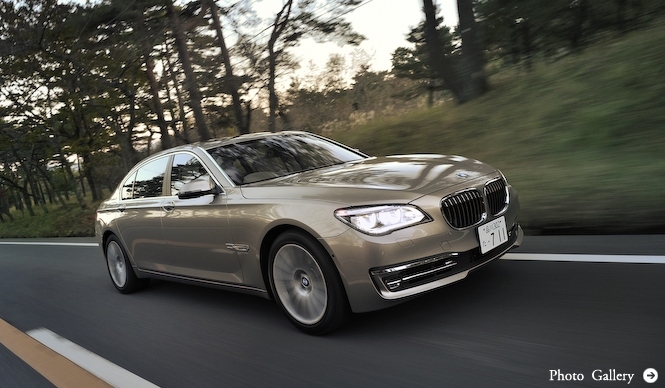
BMW's ultimate luxury sedan.7 SeriesThe 7 Series has undergone a minor change, including an update to its engine lineup. Notably, the "ActiveHybrid 7," which saw a reduction in power compared to its predecessor based on specifications alone, is among these changes. How has the new 7 Series evolved in character? Tatsuya Otani shares his insights.
Text by OTANI Tatsuya
Photographs by ABE Masaya
What is a Luxury Car?
What are the requirements for a luxury car?
The term "luxury car" might not be fashionable these days, and while "luxury sedan" could be used as a substitute, it carries a slightly different nuance.
Let's stick with "luxury car" after all.
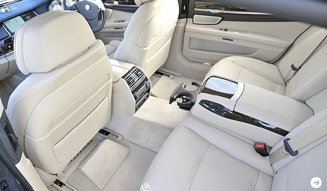
There seem to be two main criteria for a luxury car. First, the car itself must be worthy of the "luxury" designation. This means it should have a refined interior and exterior design, ample interior space, be quiet, offer a comfortable ride, and possess ample power. In recent years, environmental performance has also become a key criterion.
The second criterion seems to be less about the car itself and more related to the social message and position it conveys. In other words, whether we like it or not, cars are visible to others and play a role in communicating the owner's or driver's preferences and social standing.
Whether that message is appropriate is another matter, but it can elicit negative reactions like "Wow, they're driving that?" or positive resonance like "As expected, that's the car they would choose." More pragmatically, the way hotel staff treat you when you arrive can differ depending on whether you're in a truly luxurious car or not.
In other words, driving a universally recognized luxury car can potentially enhance your luxurious lifestyle.
BMW 7 Series | BMW 7 Series
BMW 523d BluePerformance | BMW 523d BluePerformance
BMW Flagship
Test Drive the New 7 Series (2)
The Benefits of "TwinPower Turbo"
BMW's flagship sedan, the "7 Series," its representative luxury car, has received a minor facelift.
The main focus this time is the powertrain update. For example, the 3.0-liter inline six-cylinder engine in the "740i" has been replaced with the latest generation TwinPower Turbo engine, featuring a twin-scroll turbocharger, high-precision direct injection, and Valvetronic, achieving a 48% improvement in fuel efficiency and a JC08 mode rating of 12.1 km/l compared to the previous model.
By the way, is there a misunderstanding about BMW's "TwinPower Turbo engine" designation? TwinPower Turbo refers to a turbo engine that combines direct injection technology with Valvetronic or VANOS (variable valve timing technology); it does not indicate the number of turbochargers, unlike "single turbo" or "twin turbo."
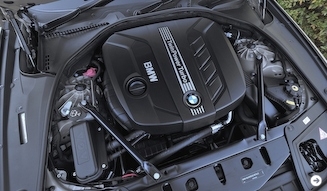
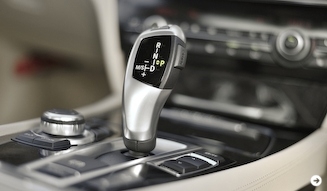
In contrast to the new 3.0-liter inline six-cylinder engine, the turbocharger count for the new 4.4-liter V8 turbo engine has been reduced from two to one. Whether this is a contributing factor or not, the maximum output has slightly decreased from 326 ps/5,800 rpm to 320 ps/5,800 rpm.
Meanwhile, the maximum torque has been adjusted from 450 Nm/4,500 rpm to 450 Nm/1,300-4,500 rpm, allowing it to deliver its peak torque of 450 Nm across a wider rev range.
The 4.4-liter V8 turbo engine in the "750i" has now joined the TwinPower Turbo family by newly incorporating Valvetronic (this version also features two turbochargers).
As a result, unlike the 3.0-liter inline six-cylinder engine, the maximum output has clearly increased from 407 ps/5,500 rpm to 450 ps/5,500 rpm. Maximum torque has also been boosted from 600 Nm/4,500 rpm to 650 Nm/2,000-4,500 rpm.
BMW 7 Series | BMW 7 Series
BMW 523d BluePerformance | BMW 523d BluePerformance
BMW Flagship
Test Drive the New 7 Series (3)
From Engine to Motor
The "ActiveHybrid 7" has undergone more significant changes than the two models mentioned above.
Launched almost simultaneously with the full model change of the 7 Series two years ago,the "first-generation" ActiveHybrid 7was equipped with a 4.4-liter V8 twin-turbo engine producing 449 ps/5,500-6,000 rpm and 650 Nm/2,000-4,500 rpm. However, the newly released "new-generation" ActiveHybrid 7 is powered by a 3.0-liter inline six-cylinder twin Power Turbo engine, basically the same as the one in the 740i. Consequently, the engine's maximum output is 320 ps, and even the system output including hybrid performance is 354 ps, significantly lower than the first-generation ActiveHybrid 7.
However, focusing solely on the reduction in maximum output and torque would lead to a misunderstanding of the true significance of the "new-generation" ActiveHybrid 7. While the engine's performance has been reduced, the motor's maximum output and torque have been significantly enhanced, from 20 ps to 54 ps and from 160 Nm to 210 Nm, respectively.
Calculating the "power relationship" between the engine and motor reveals that while the motor accounted for 4.5% of the maximum output and 25% of the maximum torque in the previous generation, in the new generation, it accounts for 17% of the maximum output and 46.7% of the maximum torque, indicating a substantial increase in the motor's role.
In other words, the new ActiveHybrid 7 aims to more clearly emphasize the fuel efficiency improvement effect of the hybrid system by increasing the proportion of the motor's contribution to the total system power.
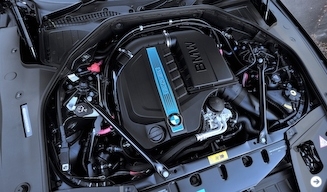
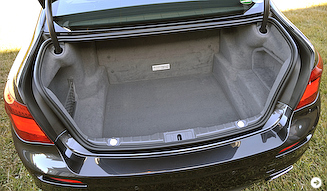
When test driving the "new-generation ActiveHybrid 7," the impact of electrification is clearly noticeable. In fact, the combination of the 3.0-liter inline six-cylinder engine and the hybrid system, including the 8-speed automatic transmission, is exactly the same as that found in BMW'sActiveHybrid 5andActiveHybrid 3.However, when you ease off the accelerator during cruising, the engine instantly shuts off, and the car seamlessly switches to "coasting" or "EV mode" powered by the motor. This is a distinct difference from the ActiveHybrid 5 and 3.
The frequency of engine shut-off varies significantly depending on the "Driving Dynamics Control" mode. The "ECO PRO mode," which prioritizes fuel efficiency, shuts off the engine most frequently, followed by "Comfort," "Comfort Plus," "Sport," and "Sport Plus" in descending order. It goes without saying that shutting off the engine more often leads to greater fuel efficiency improvements.
However, frequent engine on/off cycles can increase the likelihood of experiencing jolts and place a burden on the mechanical components. Nevertheless, the advancements in hybrid system control technology and the confirmed reliability of the system, likely gained through the development of the ActiveHybrid 5 and ActiveHybrid 3, have made this possible.
In any case, it was surprising that the driving experience differed so much despite using the same hybrid system.
BMW 7 Series | BMW 7 Series
BMW 523d BluePerformance | BMW 523d BluePerformance
BMW Flagship
Test Drive the New 7 Series (4)
The Conditions of a Luxury Car, Unchanged for 100 Years
The setting that frequently shuts off the engine created another benefit besides fuel efficiency.
The silence that descends the moment the engine stops creates an indescribable comfort in the ActiveHybrid 7's cabin. The superior quietness has been a hallmark of luxury cars for over 100 years, ever since the Rolls-RoyceSilver Ghostwas born. Of course, this is not to say that the ActiveHybrid 7 is noisy when the engine is running. Far from it.
However, the difference between when the engine is running and when it is off is clearly noticeable. Moreover, the silence when the engine is off seems to be addictive; once you experience this comfort, you even start to feel a slight disappointment each time the engine starts. As a result, the "ECO PRO mode," where the engine stops most frequently, has become the driving mode that feels most luxurious to me.
The new ActiveHybrid 7 achieves a fuel economy of 14.2 km/l in JC08 mode, and its drivability is also satisfactory. Not only does the motor provide strong support at very low speeds right after starting, but when you floor the accelerator, the boost mode engages, allowing the engine and motor to unleash their full power and deliver impressive acceleration.
While it may not match the "750i" with its 450 ps output, the ActiveHybrid 7 possesses more than enough performance for a luxury car.
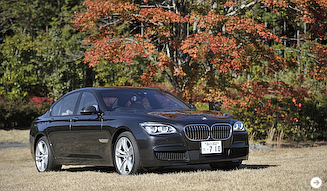
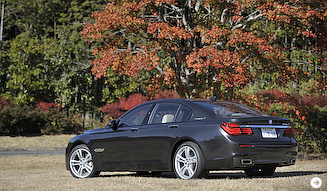
Furthermore, the ride comfort, which is gentle yet composed, and the handling that, while slightly acknowledging its 2-ton weight, never loses sight of its essence as a driver's car, are truly impressive, as expected from BMW.
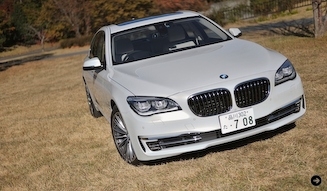
The exterior boasts the best proportions among the new generation of BMW designs. It skillfully expresses intelligence and high quality in a subtle manner. With this design, you wouldn't feel out of place arriving at any luxury hotel.
The BMW 7 Series not only offers high-quality hardware befitting a luxury car but also incorporates innovative features to ensure owners can fully enjoy a luxurious lifestyle. This is achieved through the "BMW Club Concierge" service.
This is a membership-based concierge service that handles reservations at hard-to-book restaurants, play at prestigious domestic golf courses, arrangements for top chefs to cook at your home, and bookings for luxury cruises. Membership is generally exclusive to 7 Series owners, with the initiation fee and first year's annual fee waived (until the end of 2012, "6 Series Gran Coupé" owners were also eligible. The annual fee from the second year onwards is 126,000 yen).
The creation of such services might be considered unique to luxury cars.
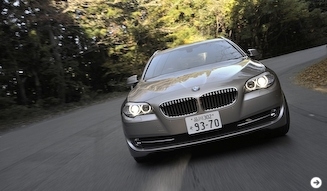
This time, we also had the opportunity to test drive the "523d," which is equipped with the same 2.0-liter inline four-cylinder direct-injection diesel turbo engine as the320d.
Despite weighing 200 kg more than the 320d, its maximum torque of 380 Nm allows the 5 Series to accelerate briskly. There are no complaints about its quietness either.
Furthermore, its price is 6.33 million yen. This model accurately embodies BMW's philosophy ofEfficient Dynamics.

BMW ActiveHybrid 7 | BMW ActiveHybrid 7
Body Size | Length 5,080 x Width 1,900 x Height 1,475 mm [Length 5,220 x Width 1,900 x Height 1,485 mm]
Wheelbase | 3,070 mm [3,210 mm]
Tread Front/Rear | 1,620 / 1,630 mm
Minimum Ground Clearance | 150 mm
Trunk Capacity | 360 liters
Weight | 2,080 kg [2,140 kg]
Engine | 2,979cc Inline 6-cylinder Direct Injection DOHC Twin-scroll Turbo
Maximum Output | 235kW (320ps) / 5,800 rpm
Maximum Torque | 450Nm (45.9kgm) / 1,300-4,500 rpm
Motor Maximum Output | 40kW (54ps)
Motor Maximum Torque | 210Nm (21.4kgm)
System Maximum Output | 260kW (354ps)
System Maximum Torque | 500Nm (51.0kgm)
Transmission | 8-speed Automatic
Drivetrain | FR
Suspension Front | Double Wishbone, Coil Spring, with Stabilizer
Suspension Rear | Integral Arm Type Air Spring, with Stabilizer (with self-leveling function)
Tires Front/Rear | 245/45R19 / 275/40R19
Fuel Economy (JC08 Mode) | 14.2 km/ℓ
Price | 11.98 million yen [13.38 million yen]
* Figures in brackets [] are for the ActiveHybrid 7 L
BMW 523d BluePerformance | BMW 523d BluePerformance
Body Size | Length 4,910 x Width 1,860 x Height 1,475 mm
Wheelbase | 2,970 mm [3,210 mm]
Tread Front/Rear | 1,600 / 1,625 mm
Minimum Ground Clearance | 140 mm
Trunk Capacity | 520 liters
Weight | 1,760 kg
Engine | 1,995cc Inline 4-cylinder DOHC Diesel Turbo
Maximum Output | 135kW (184ps) / 4,000 rpm
Maximum Torque | 380Nm (38.7kgm) / 1,750-2,750 rpm
Transmission | 8-speed Automatic
Drivetrain | FR
Suspension Front | Double Wishbone, Coil Spring, with Stabilizer
Suspension Rear | Integral Arm Type Coil Spring, with Stabilizer
Tires | 225/55R17
Fuel Economy (JC08 Mode) | 16.6 km/ℓ
Price | 6.33 million yen