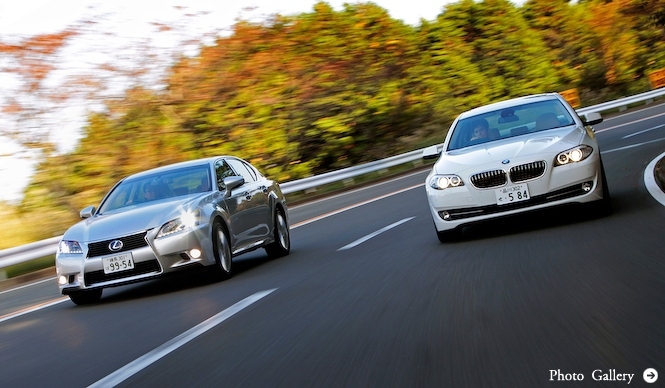
The World of the Japanese-German Premium Hybrid Saloon | LEXUS & BMW
BMW ActiveHybrid 5
Lexus GS450h
Japan-Germany Hybrid Saloon Comparison
BMW ActiveHybrid 5 vs. Lexus GS450h
It has been 15 years since the Toyota Prius first appeared. "Hybrid cars" have long ceased to be a rarity. And to simply say "hybrid car" today barely touches upon the essence of each vehicle. For instance, the two cars that Tatsuya Otani is comparing here, theLexusGS450h and theBMWActiveHybrid 5, are both hybrid cars in the same segment, but they are not similar vehicles.Toyota and BMWWe will likely hear more about the results of their cooperation in the future. What are the differences in the current car manufacturing philosophies of these two companies? OPENERS takes another look at these premium brands from Japan and Germany through their hybrid saloons.
Text by OTANI TatsuyaPhotographs by MOCHIZUKI Hirohiko
Are Hybrid Cars Easy to Drive?
The other day, in the waiting room of the sports therapy clinic I attend, a woman who appeared to be in her 50s was talking to the man next to her. "Yes, the car I just bought isn't a hybrid, so it's not that easy to drive..." Hearing this, I thought, "Wow!" So, hybrids are easy to drive...
It's true that the electric motor assists the engine, increasing torque in the low-RPM range, which might make hybrid cars more drivable, i.e., easier to drive. However, I hadn't really thought of it as "easy to drive" until now.
But now that I think about it, she's absolutely right. As I listened to her, I reflected on my own narrow-mindedness and pondered how differently people perceive hybrids.
Hybrid cars initially appeared as fuel-efficient vehicles, but as various manufacturers began producing them, they evolved beyond mere eco-cars.
For example, some manufacturers utilize the power of electric motors to enhance performance, while others use them to create a sense of luxury through quietness. There are even cases where they are employed for a certain kind of image strategy, emphasizing a futuristic feel or a message of environmental friendliness.
Therefore, it's no longer accurate to directly equate "hybrid car" with "fuel-efficient car."
Fifteen years have passed since the Toyota Prius debuted. The era of hybrid cars has entered a phase of individualization.

BMW ActiveHybrid 5
Lexus GS450h
Japan-Germany Hybrid Saloon Comparison
BMW ActiveHybrid 5 vs. Lexus GS450h (2)
Different Hybrids, Different Core Technologies
To experience this evolving world of hybrid cars, we've chosen two mid-size saloons for this comparison. One is theLexusGS450h, crafted by Toyota, the originator of hybrid technology. The other is theBMWActiveHybrid 5, from a company that has been releasing hybrid models at a rapid pace recently.
As mentioned earlier, hybrid cars have entered an era of individualization, and these two models differ significantly in their fundamental hybrid system architectures.
The GS450h employs Toyota's THS (Toyota Hybrid System), the same system used in other Toyota hybrids.
Its key features include a highly powerful electric motor (200ps compared to the engine's 295ps), nearly matching the engine's output, and a unique mechanism that functions as both a gearbox and a power-blending unit for the engine and motor (referred to by Toyota as an "electronically controlled continuously variable transmission" or "power split device"). This combination achieves smooth gear changes and versatile driving modes.
A significant advantage of the THS is its ability to keep the engine operating within its most efficient RPM range regardless of vehicle speed, greatly enhancing engine efficiency. Potential drawbacks might include the tendency for larger motors and batteries, and less optimal efficiency during high-speed cruising.
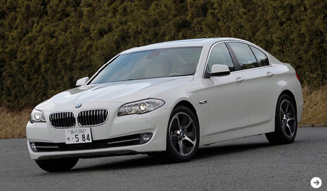
BMW ActiveHybrid 5
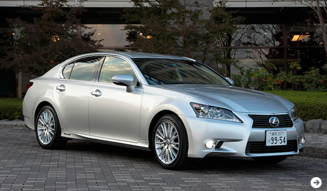
LEXUS GS450h
The ActiveHybrid 5's mechanism is remarkably simple. It essentially integrates a motor and clutch between the engine and the gearbox. This setup alone suggests that the engine is the primary power source, with the motor playing a supporting role. Incidentally, this hybrid system was developed by ZF, a German gearbox manufacturer.
They have developed a product that packages a motor, clutch, and an 8-speed automatic transmission into a unit of the exact same dimensions as their existing 8-speed AT, and supply it to automakers.
The three hybrid models BMW has introduced this year, namely the "ActiveHybrid 5,"ActiveHybrid 3", and "ActiveHybrid 7," all utilize this same unit. Furthermore, the system in Audi'sAudiA6 Hybrid, including its motor's maximum output (54ps), is identical to that of the ActiveHybrid 5.
The advantage of this system lies in its compactness, light weight, and cost-effectiveness.
Beyond that, it also features regenerative braking (converting deceleration energy into electrical energy to charge the battery), a crucial function for hybrid systems. Additionally, it can cleverly charge the battery by having the engine work harder when the driver is not accelerating much, thereby improving the engine's thermal efficiency.
Another benefit is the smooth engine restart after idling stop, as the powerful hybrid motor serves as the starter.
However, the benefits beyond compactness, light weight, and low cost are all achievable with the THS as well. Therefore, while opinions may differ on which is superior overall, the THS can be said to offer superior fuel efficiency due to its larger and more complex system.
BMW ActiveHybrid 5
Lexus GS450h
Japan-Germany Hybrid Saloon Comparison
BMW ActiveHybrid 5 vs. Lexus GS450h (3)
Lexus or BMW?
The preamble has been lengthy. Let's begin discussing the actual driving experience.
While still rooted in Toyota's design philosophy,Lexushas truly forged its own identity, particularly with the current generation GS. Its distinctiveness extends beyond the spindle grille exterior. The interior design, with its horizontally elongated dashboard, is uniquely Lexus. The meticulously stitched leather seats also exude a quality befitting a premium saloon.
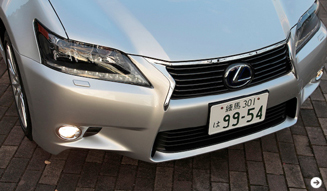
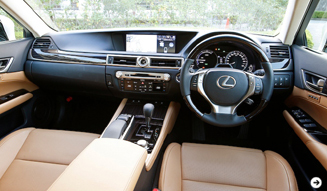
The evolution of the GS is not limited to its design. In fact, the improvements in driving performance, including the chassis, are what deserve the highest praise in the current GS. Firstly, the body rigidity is firmly established. The suspension components are meticulously engineered without compromise and have undergone thorough tuning, evident in their design.
As a result, it achieves a robust feel that resists losing grip even when pushed hard through corners, while simultaneously balancing a taut yet comfortable ride. The steering feel is also excellent, and the ability to accurately sense road conditions is another commendable aspect.
In essence, these advancements bring it up to par with European premium brands. The 3.5-liter V6 engine maintains its smoothness even at high RPMs, free from any harsh or unpleasant noise. Furthermore, with the motor's assistance in the low to mid-speed range, it offers ample power. Just as the woman at the sports therapy clinic mentioned, the GS450h is indeed an "easy-to-drive" hybrid car.
Expecting the ActiveHybrid 5 to face a significant challenge, I switched cars. However, I must admit that the body rigidity and the solid feel of the suspension are, regrettably, superior in this vehicle. When driven spiritedly on winding roads, the sense of security provided byBMWis still a step ahead. While I praised the GS450h's steering feel earlier, the ActiveHybrid 5 provides a more tangible connection to the road surface.
This sensation extends beyond the steering to the tires' contact with the road, perceived through all senses. This doesn't imply crude construction; rather, it feels like essential information is being transmitted through a high-precision filter.
In comparison, while the GS450h can be considered more refined, it also carries a certain sense of detachment or aloofness.
Therefore, the BMW is the more fitting choice for a "driver's car."
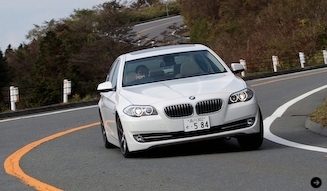
To reiterate, the gap in driving quality between BMW and Lexus has undeniably narrowed. Ultimately, it wouldn't be surprising if the choice between them comes down to personal preference in design, or practical considerations like price and fuel efficiency. However, if asked about my personal design preference, I would immediately choose the ActiveHybrid 5.
For instance, consider the hybrid system's operating mode display on the large central screen; the ActiveHybrid 5's presentation is more refined and stylish. You might think, "Is such a minor detail important?" However, isn't the meticulous attention to detail, even in the smallest aspects, precisely what buyers of premium cars expect?
The Lexus is also very good. However, there is no doubt that BMW's long history of building premium cars lends it a deeper sense of refinement.

BMW ActiveHybrid 5
Body Dimensions: Length 4,910 x Width 1,860 x Height 1,475 mm
Wheelbase: 2,970 mm
Tread Front/Rear: 1,600 / 1,625 mm
Minimum Ground Clearance: 140 mm
Trunk Capacity: 375 liters
Weight: 1,960 kg
Engine: 2,979 cc Inline 6-cylinder DOHC Turbo
Compression Ratio: 10.2:1
Maximum Engine Output: 225 kW (306 ps) / 5,800 rpm
Maximum Engine Torque: 400 Nm (40.8 kgm) / 1,200-5,000 rpm
Fuel System: Digital Motor Electronics (DME / Electronic Fuel Injection)
Maximum Motor Output: 40 kW (54 ps)
Maximum Motor Torque: 210 Nm (21.4 kgm)
System Maximum Output: 250 kW (340 ps)
System Maximum Torque: 450 Nm (45.9 kgm)
Transmission: 8-speed AT
Battery: Lithium-ion battery
Drivetrain: FR
Tires: 245/45R18
Fuel Economy: 13.6 km/ℓ (JC08 mode) 14.6 km/ℓ (10-15 mode)
Price: 8,500,000 yen
LEXUS GS450h
Body Dimensions: Length 4,850 x Width 1,840 x Height 1,455 mm
Wheelbase: 2,850 mm
Tread Front/Rear: 1,575 / 1,590 mm
Minimum Ground Clearance: 130 mm
Trunk Capacity: 482 liters
Weight: 1,860 kg (I package 1,820kg)
Engine: 3,456 cc V6 DOHC
Compression Ratio: 13.0:1
Maximum Engine Output: 217 kW (295 ps) / 6,000 rpm
Maximum Engine Torque: 356 Nm / 4,500 rpm
Fuel System: Direct Injection + Port Fuel Injection (D-4S)
Maximum Motor Output: 147 kW (200 ps)
Maximum Motor Torque: 275 Nm
System Maximum Output: 256 kW (348 ps)
Transmission: Electronically controlled continuously variable
Battery: Nickel-metal hydride battery
Drivetrain: FR
Tires: 235/45R18
Fuel Economy: 18.2 km/ℓ (JC08 mode) 20.5 km/ℓ (10-15 mode)
Price: 7,000,000 yen (Test car "version L" was 7,900,000 yen)