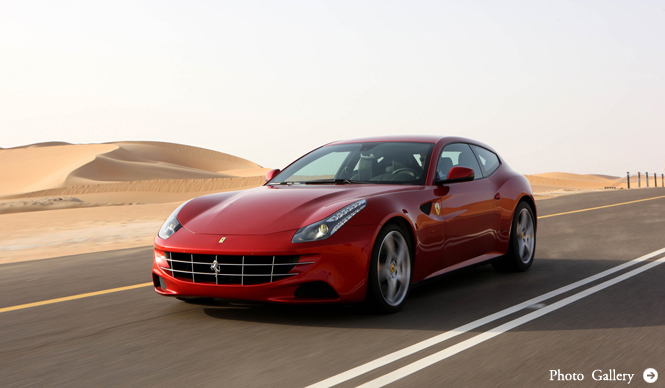
Ferrari Four (FF) Unveiled in Geneva
Ferrari Four (FF) Unveiled in Geneva
FF and 458 Italia Exhibited
FERRARIFerrari unveiled its first four-wheel-drive model, the FF, and the 458 Italia equipped with the HELE system at the Geneva Motor Show.
By Dai Matsuo
Fuel Economy 6.5 km/L, CO2 Emissions 360 g/km
The Ferrari FF, Ferrari's first four-wheel-drive vehicle, is an ambitious GT car featuring a shooting brake-inspired design. It is powered by a 65° V12 engine. The 6,262cc direct-injection engine, with a bore increased by 2mm over the unit found in the 599, produces a maximum output of 485kW (660ps) at 8,000 rpm and a peak torque of 683Nm (69.6kgm) at 6,000 rpm. Delivering 500 Nm of torque from just 1,000 rpm and paired with a 7-speed F1 dual-clutch transmission, it achieves 0–100 km/h in 3.7 seconds and a top speed of 335 km/h, performance befitting the Ferrari name.
Meanwhile, its fuel economy is 15.4 L/100 km (6.5 km/L). CO2 emissions are 360 g/km, a reduction of approximately 25 percent compared to previous V12 engines. Ferrari explains this is achieved through the HELE (High Emotion/Low Emission) system, which incorporates stop-start technology. Considering the Lamborghini Aventador, announced the same day, has figures of 17.2 L/100 km (5.8 km/L) and 398 g/km, these numbers are quite favorable.
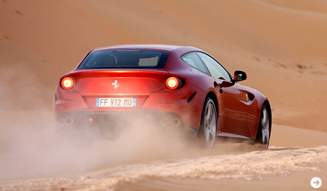
The adoption of four-wheel drive means this performance can be delivered even on low-grip surfaces. This is thanks to Ferrari's proprietary 4RM system, where the PTU (Power Transfer Unit) distributes the necessary torque to the front wheels while maintaining torque to the rear, depending on road conditions. By integrating vehicle control systems such as E-Diff, F1-Trac, and PTU into a single CPU, optimal torque distribution to individual tires is achieved.
With the engine positioned in the front-mid layout and the gearbox over the rear axle, the weight distribution is 53 percent to the rear. While not as light as the Aventador, as Ferrari traditionally avoids extensive use of carbon fiber in its production cars, the FF has been made lighter through the use of the latest casting techniques for the engine, advanced aluminum alloys and manufacturing processes for the body, and detailed refinements to many other key components. This results in a dry weight of 1,790 kg and a gross vehicle weight of 1,880 kg.
A Ferrari for Four Adults
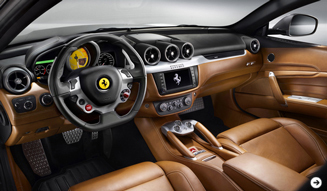
The interior features magnesium for the seat frames and various high-tech materials. The brakes are Brembo's third-generation carbon-ceramic brakes (CCM), which are lightweight and durable, exhibiting minimal wear under normal road use.
The body design, naturally, is by Pininfarina, pursuing sportiness and versatility to the fullest.
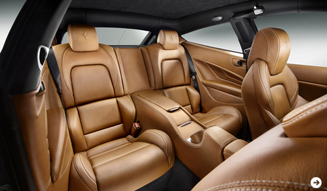
Despite being a Ferrari, it offers ample seating and cabin space for four adults, with a trunk capacity of 450 liters. Furthermore, by folding down the independently reclining rear seats, the capacity can be expanded to a maximum of 800 liters.
Six exterior colors are available. The interior is finished in Poltrona Frau aniline leather. The cabin is equipped with a new rear-seat infotainment system, featuring two screens for rear passengers, allowing them to enjoy television, DVDs, and a 1,280-watt, 16-channel Dolby surround sound system.
458 Italia Records 275 g/km CO2 Emissions
Another model generating buzz is the 458 Italia equipped with the HELE system. While there are no particular visual distinctions from the previous 458 Italia, its CO2 emissions have been reduced from 307 g/km to 275 g/km. This represents a reduction of approximately 15 percent compared to the previous model, making it the sports car in its class with the lowest CO2 emissions.
Ferrari Four (FF)
Body Dimensions | Length 4,907 x Width 1,953 x Height 1,379 mm
Wheelbase | 2,990 mm
Vehicle Weight | 1,790 kg (Dry Weight)
Engine | 6.2-liter V12
Maximum Output | 485 kW (660ps) / 8,000 rpm
Maximum Torque | 683 Nm (69.6kgm) / 6,000 rpm
European Combined Fuel Economy | 15.4 L/100 km
CO2 Emissions | 360 g/km
Drivetrain | Four-wheel drive
Transmission | 7-speed dual-clutch transmission