Twiggy | Vol. 11: Miho Matsuura's Choice of Lodgings (Part 2)
Twiggy
Vol.11 Miho Matsuura's Inn Selection (Part 2)
Miho Matsuura, a popular hairstylist, has been proposing cutting-edge fashion trends at her salon "Twiggy," which she has led since 1990. Last year, a project she had been nurturing for years finally came to fruition: her own line of "organic shampoos and treatments." In an era of remarkable scientific leaps in the cosmetics industry, why has someone at the forefront of fashion consistently focused on "organic"? This series unravels the secrets behind it.
Narration/Photos: Miho MatsuuraEditing: Yuka Kobayashi

A free-thinking, unconstrained approach is indispensable for an artist. This also requires the sensibility to constantly experience and digest new discoveries. Matsuura says she gains much of this from her travels. Her curiosity, once piqued, compels her to open doors. This not only satisfies intellectual curiosity but also profoundly influences her life's work upon returning from a trip. Matsuura's style of travel, with its clear purpose of satisfying her quest for knowledge rather than being a "vacation" or "escape from reality," is indeed captivating.
—You mentioned having a different experience in Senegal than the "inns that reflect the owner's taste" you introduced last time.
Most of my trips are like "Solo 'Uru-run' Travelogue" (laughs). Immersing myself in places with different cultures and customs is truly enjoyable. About 12 years ago, I had the opportunity to go to Senegal in West Africa for a hair and makeup job for a TV show called 'Uru-run Taizaiki.' When the program production first began, it hadn't even aired yet, and the director was still exploring the direction. It was a truly unscripted, on-the-spot challenge, with the staff constantly asking, 'What do we do from here?' But the director was very receptive to the staff's opinions, and I myself was able to voice my thoughts, like 'I think this is good' or 'I don't think they would do that.' It felt like we were all truly traveling together. It was chaotic, but it was a truly fascinating trip.
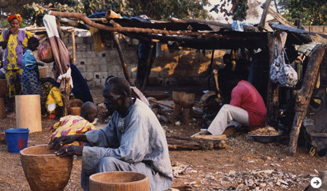
The scene of stretching the skin on a djembe (traditional drum)
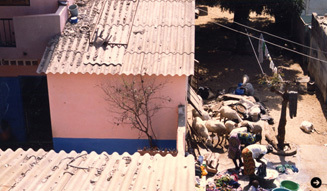
Stretching and drying goat skin on roofs and walls after washing
—However, the environment there is quite different from Ibiza or Jamaica... it's right in the middle of nature.
It was full of challenges. First, it was a battle with flies (laughs). For example, flies would land so densely on the rim of a cup of café au lait that there was no space left. Even if I shooed them away, they'd come right back. I'd think, 'Ugh, I want to drink my café au lait...' (laughs). But on the first day, I couldn't drink it and just stared at the cup, agonizing. On the second day, I'd be thinking, 'Oh dear, what should I do?' And by the third day, I'd just drink it, thinking, 'I've already drunk it!' (laughs). I was surprised at myself, thinking, 'Humans really are like this, aren't they? Humans are so interesting.'
I was also shocked when I was invited to someone's home for a meal. When I went to the restroom, a goat's head was just placed next to the hole for the toilet. Of course, at first, I'd be like, 'Eek!' (laughs). But even while feeling scared, I'd accept it, thinking, 'Ah, this is how it is here,' and finish using the toilet. Then, when I came out, they'd say something like, 'Here's today's dish: goat meat!' (laughs). It was delicious, but the afterimage of the goat's head lingered in my mind. What's more, that goat might have been a pet with a name. I'd break out in a cold sweat. Then, the next day, the skin of the goat I ate yesterday was hanging on the wall. 'Oh, the goat I ate yesterday...' (laughs). They said it would be used as skin for a djembe (percussion instrument) once it dried. In other words, nothing was wasted. When I received a keychain made from that skin, I somehow felt, 'This is the kind of travel I'll be doing from now on.'
Another thing I noticed in Senegal was that women seem surprisingly more resilient than men. All the male staff members got stomach problems, but the two women remained energetic throughout. The women in the family were also fine when I went to Morocco. Women carry good bacteria in a good way. That's why I believe we should eat more organic foods. Supermarket vegetables are almost always sterilized and germ-free, meaning they lack beneficial bacteria. When we consume only foods lacking these bacteria, we become vulnerable to damage in environments rich in microbes. We might get an upset stomach just from using a cup that a fly landed on (laughs).
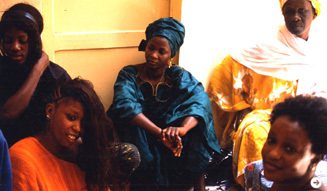
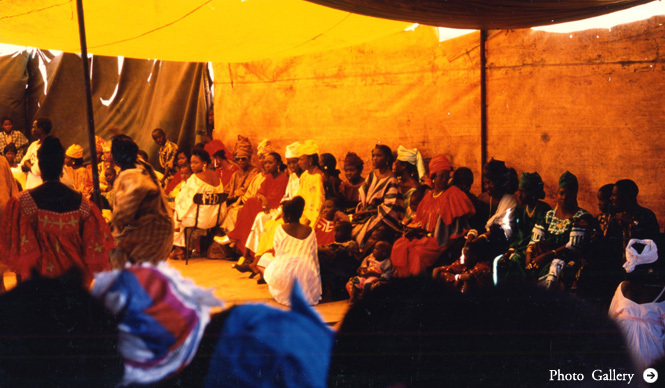
Women gathering and doing each other's hair and makeup before going to a drum party (creating hairstyles for each other without going to a salon)
Twiggy
Vol.11 Miho Matsuura's Inn Selection (Part 2) 2
—So, is the culture shock experienced at your accommodation the biggest source of stimulation?
Yes, culture shock can be significant. It's something I hadn't experienced despite living for decades. But this isn't unique to special places like Senegal; it happened even when I lived in London. When I lived in London and the gas went out, I called the gas company, and they said they couldn't come for a week. That was a culture shock! A week without gas means no baths for a week (laughs). But it's during these culture shocks that I can maintain my sense of excitement and curiosity. That feeling definitely connects to my work.
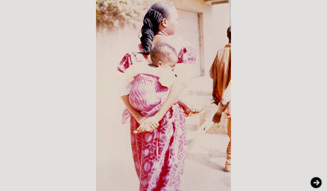
Stylish Hairstyle 2

Stylish Hairstyle 3
I'm certain that the experiences I have while traveling and the interactions I have with people at my accommodations lead to what I can offer my clients. Excitement, curiosity, pleasure – don't we all want to repeat these throughout life? Culture shock encountered during travel might be the easiest way to maintain these feelings. The more I hear about people who are drawn to interact with those they wouldn't normally meet, or places that are considered strange, the more interested I become. It's a curiosity that I've always held onto, and I feel it's reflected in all my travels. Of course, at first, I might think, 'That looks scary,' or 'Oh, to a place like that?' But I can't suppress the urge to push that door open. And the discoveries, like 'Wow! I saw it, I saw it!' are incredibly enjoyable.
Twiggy
Vol.11 Miho Matsuura's Inn Selection (Part 2) 3
—I heard you're planning a trip to Bhutan at the end of this year.
I had originally planned it for early this year, but a client who is knowledgeable about Ki-gaku (a type of Japanese geomancy) advised me that 'December would be better.' There's no reason to force it against such advice, and things change in various ways due to such triggers. So, I postponed the plan to the end of the year. Then, another acquaintance introduced me to a Bhutanese friend, which has given me more time to gather information before departure and allows me to carefully consider what to do and whom to meet once I arrive.
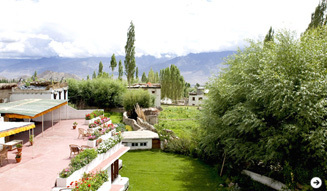
The view from the room at the hotel "omasila" in Ladakh overlooks the Himalayas!
In Bhutan, there's a village where they don't erect utility poles and don't run electricity so that cranes can land. The only hotel there is an Aman, but if a high-end luxury hotel offers genuine value, I'm interested. Of course, I'll also be looking for high-end guesthouses in Bhutan during my time before departure (laughs). I believe travel can be transformed in various ways depending on the choice of accommodation. If you want to observe a country from a slight distance, staying in a luxury hotel is suitable. If you want to delve deeper, you can choose a smaller hotel with a self-catering kitchen. Isn't the moment of deeply analyzing your current self, starting from the stage of selecting accommodation in your destination, the beginning of travel?
—I've heard that experiences in Bhutan and Ladakh, which you visited previously, offer valuable insights into foreign cultures.
The keyword that concerns me most in my life in Japan is "national happiness index." No matter how much we focus on organic food or health, it's meaningless if Japan's national happiness index isn't high. If 'high national happiness index' refers to the genuine well-being of a nation's citizens, rather than resource availability or economic conditions compared to global standards, then I believe I experienced a model of such a life during my stay in Ladakh. Furthermore, I understand that the Bhutanese Prime Minister's philosophy is to consciously integrate foreign cultures and the latest technologies without being overwhelmed or driven by them, focusing on 'what to enrich and what to cut.' I would really like to meet him.
Wouldn't it be wonderful if our children could say, 'We were born and raised in Japan, the country with the highest national happiness index'? I would be even happier if that were true for us now (laughs). By doing our best, by making an effort, and ultimately passing it on to the next generation, I want them to say that Japan is a good country. For that, we try a little harder... I feel that the ultimate purpose of life lies there. As I mentioned before... a country where, despite lacking so many things from Japan's perspective, people live with contentment, using only the bare minimum and without any waste... that landscape was like a world where that had been realized. I don't think I'll travel just to eat delicious food, wear nice clothes, or stay in good hotels anymore. Instead, encountering an ideal environment at my destination that seems truly livable and reconsidering the state of my own country through travel enriches the soul.
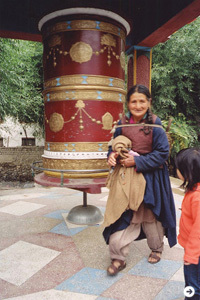
In front of the hotel "omasila" in Ladakh is a prayer wheel (called 'mani khorlo' in Tibetan). I heard that one rotation is equivalent to reciting the Heart Sutra once.
