Twiggy | Vol. 9: What Artists Gain from Travel (Part 2) 2
Twiggy
Vol.9 What Artists Gain from Travel (Part 2) 2
Miho Matsuura, a popular hairstylist who has been proposing cutting-edge fashion trends in various magazines through her salon "Twiggy," which she has led since 1990. A project she had been nurturing for several years was finally realized last year: her own line of "organic shampoos and treatments." In the cosmetics industry, where scientific advancements are remarkable, why has a leading figure in fashion continued to focus on "organic"? This series will unravel the secrets behind it.
Narration by Miho MatsuuraCompiled by Yuka KobayashiPhotos by Koji Sato

Matsuura says she had her fill of luxurious travel, the kind you see in fashion magazines, in her thirties. Following her previous trip to Baja California, her next destinations seem to be regions with unique and highly ethnic cultures. "I often draw inspiration from ethnic cultures," Matsuura says, but it was more than just ideas for hairstyles; it was a power that spoke directly to Matsuura's very way of life.
—Her experience in Ladakh further deepened Matsuura's interest in agriculture.
"Ladakh, where I went next, was also completely self-sufficient, with a minimal lifestyle, yet everyone looked genuinely happy. They looked so happy, I was almost envious."As I mentioned before (Vol. 7, Part 1),"Ladakh was where I first witnessed a 'zero-waste lifestyle,' which became the biggest catalyst for me to start farming. Even if it's difficult to achieve this lifestyle in Japan, I thought I should at least consider what I can do in my daily life... I learned the essence of living a 'zero-sum' life."
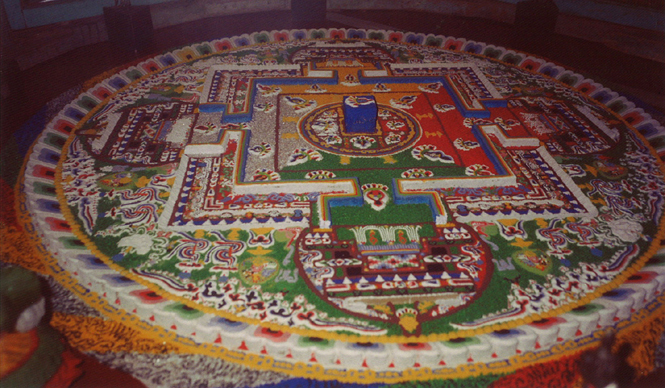
Another memorable experience in Ladakh was seeing the sand mandala at a temple. Although Ladakh is in Northern India, it is strongly influenced by Tibetan Buddhism. The sand mandala was incredibly vast, and in a living environment with little greenery, the mandala, drawn with vibrant colored sand, was truly magnificent.
This sand mandala, created with meticulous skill over a long period, is taken to the windiest spot three days after its creation and blown away entirely. This is a ritual based on the teaching of "letting go of attachment," and witnessing it made me feel a profound sense of understanding. Tears just streamed down my face. I had thought I wasn't particularly attached to things, but I realized then that I was incredibly attached to so much. It was through these experiences, gained one by one through travel, that I felt I was truly growing into an adult.
—You felt something more than just the richness of ethnic culture in Ladakh, didn't you?
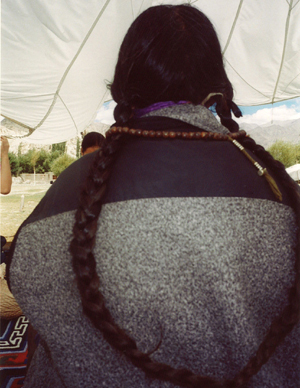
"Yes. The hairstyles of the women in Ladakh (photo on the right) were very simple and strong. My creative ideas often draw inspiration from ethnic cultures. And it was in Ladakh that I first felt a connection to our roots, a sense of 'Japan used to be like this too,' in these scenes. Knowing this way of life, I realized that unlike them, we have fully embraced Western culture, especially American culture. As a result, I feel we have lost the spirit of preserving our traditions—the foundation of our ancient culture. The most important part has somehow become distorted. Ladakh also has computers and mobile phones. They have a strong sense of economics. The roofs of the temples are all solar-powered. Even though temples use only a small amount of light at night, they still consider energy. Seeing them do these things properly was truly moving. What they understand as 'no waste' is 'knowing the present moment.' They are people who balance the desire to return to the good old days with the will to carry on traditions while discerning the present. They possess both.
—After these meaningful journeys, how did your mindset as a hair artist change?
"It had a significant impact. It wasn't directly related to the hairstyles I create, but more to my attitude as a hairdresser. My travels from my teens to my thirties were about refining my external self. But going to places like Morocco and Ladakh, and realizing that living honestly with my soul, that this journey was about refining my inner self, I felt 'It's okay to be me, it was okay to be this way,' and I think I became more confident in expressing myself. Being able to say 'I love this,' and finding something wonderful in it, has definitely led to my current confidence.
"I can say, 'This is how this person's hair should be cut.' It's not that I'm imitating a model, but a conviction arises: 'Ah, this is how this person should be cut.' Before, I thought I couldn't cut hair without some reason, like following a trend or fashion. But while there are definitely reasons, before that, I would see someone's face or hear them speak, and suddenly, it would just come to me. Then, I'd want to give it form. In the past, if I said something like that, I thought people would find it creepy, like 'Are you a psychic?' I myself didn't like being told that, so I didn't want to rely on hunches... But hunches definitely exist, and they are not wrong. However, to theorize them, one must refine oneself; otherwise, theory and hunch won't align. Therefore, I believe these journeys were necessary as a means to complete the theory of my intuition and my sensibility."
