Twiggy|Vol. 6 Hair and Detox (Part 1)
Twiggy | Twiggy
Vol. 6 Hair & Detox (Part 1)
Miho Matsuura, a popular hairstylist who has consistently proposed cutting-edge fashion at her salon 'Twiggy,' which she has led since 1990, is always at the forefront of mode. Now, a project she has nurtured for years has come to fruition: her own line of "organic shampoos and treatments." In an era of remarkable scientific leaps in the cosmetics industry, why has a leader in mode continued to focus on "organic"? This series will unravel the secrets behind it.
Narration by Miho MatsuuraCompiled by Yuka KobayashiPhotos by Koji Sato

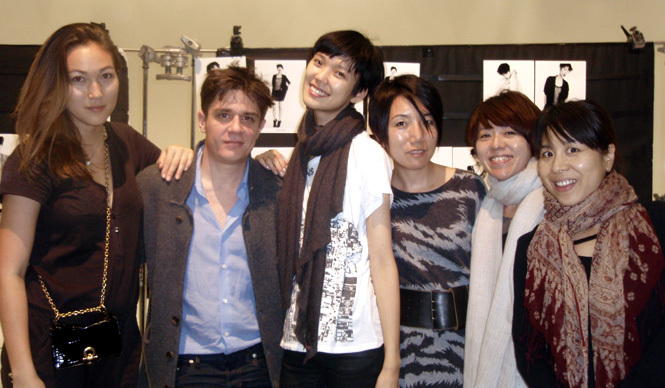
Matsuura believes that enjoying rice cultivation and gardening for "self-cultivation" also heightens the awareness of "creating" the clients who visit the salon. And Matsuura, who "creates" models backstage at numerous fashion shows, found this year's most striking event to be the hair transformations of the models gracing the runway. Tao's sensational appearance with a short haircut seemed to resonate with a certain feeling the models were experiencing...
Q. Your rice cultivation often comes up in conversations with salon clients, doesn't it?
The previous installment of this series received a lot of feedback. Of course, for a beauty feature, the photos of rural landscapes and rice harvesting were quite impactful (laughs). But "eating" is fundamental to "self-creation." It's indispensable for balancing mind and body. I've spoken about this extensively, stemming from my experiences in London and childbirth. However, I feel I'm truly "creating myself" when I'm at the salon. I feel I gain more from the time spent realistically engaging with clients than from attending parties. My venture into rice cultivation also began with conversations with clients, and once realized, it became a way to deepen the connection with them.
The connection between rice and hair might seem obscure, but the conversations we have about hair are akin to discussions about nurturing the mind and body. When I speak with clients, I find that the topics often veer towards the various things surrounding us, rather than hair itself.
Q. Women, in particular, tend to have strong feelings about their hair, don't they?
From a stylist's perspective, the moments when people decide "I want to cut my hair" are particularly memorable. The instant someone—especially a woman—wants to cut their hair is special. For example, women entering Buddhist orders shave their heads. This is an act of shedding their "femininity" and entering a world that signifies being neither male nor female. Furthermore, I once heard from an acupuncturist and herbalist that if the external body is likened to the five internal organs, then hair is the "qi of the kidneys"—related to the kidneys. The function of the kidneys is vital for maintaining the human body. Learning this made me acutely aware of the responsibility in my work. Until then, I had a rather casual view, thinking of myself as just a "haircutter," but I realized, "I am cutting my clients' 'kidneys.'"
Changing to a trendy hairstyle, as a matter of fashion... it's more than that, it's about something deeper within. Of course, we are always in a position to be creative, to shape culture and fashion, but before that, the awareness of "creating each individual" is paramount. Since learning that hair is the "qi of the kidneys," I've approached cutting hair with genuine sincerity, and that feeling has connected to everything around me. The kidneys have a function that promotes detoxification within the body, and detoxification has gained attention with the term "detox." Could it be that hair, as an external manifestation of the kidneys, is what allows for true detoxification and personal transformation, more so than makeup or clothing...? The reflection in the mirror undeniably changes.
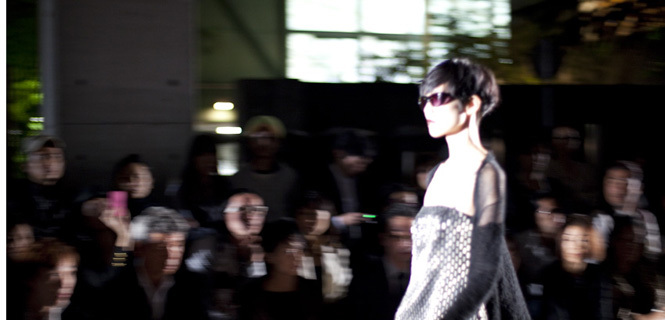
Q. You mentioned that cutting model Tao's hair short was a symbolic act of detox.
I believe Tao is a model with an avant-garde sensibility capable of expressing "Japan" to the world. It was when she was considering a fresh start and relocating her base to New York that I cut her hair short. And in New York, where Japanese models were traditionally known for their long, "oriental beauty" black hair, Tao, with her short cut, was suddenly chosen as the muse for Philip Lim's collection. Before heading to New York, Tao, whom I met ten years prior, was at a crossroads after a decade in modeling. Anyone who has dedicated themselves to something for a long time experiences a "hesitation" around the ten-year mark. By changing her appearance through her hair and transforming herself visually, she challenged the New York collections as a new kind of model. Although she had her doubts before her departure, she blossomed rapidly in New York. Seeing that, I was convinced, "Ah, Tao's detox this time was a success."
Furthermore, after Tao's significant selection as a muse, short hairstyles rapidly increased in the modeling industry. I don't think everyone was simply imitating Tao; rather, they felt that "the definition of a model no longer fits the current era" and wanted to detox. So, seeing models who had drastically cut their hair being recognized by Philip Lim upon arriving in the global arena of New York, I believe many models thought, "This is a good approach." "It's okay to do this." These models, who traditionally maintained a stance as "materials"—unassertive, capable of embodying both elegance and avant-garde—began to adopt short cuts one after another... This was a truly fascinating development.
Q. Was this indicative of a new trend emerging in the fashion industry?
No, it's more likely that the models themselves felt the need to change. This year alone, I've cut the hair of over ten models from long to short, and in my nearly 30 years as a hairstylist, this is an unprecedented experience (laughs). Such a movement has never occurred in the modeling industry before. These individuals, who are meant to be neutral, began to value their individuality and cut their hair. If this were a profession where they competed based on personality, like actresses or artists, it would be one thing, but the fact that models, whose images are shaped externally, are doing this is a significant departure from the past. The phenomenon of many prominent models, including Tao, Sachi, and Ai Tominaga, asserting and expressing their "individuality" is something rarely seen in Japan since the era of Sayoko Yamaguchi, perhaps.
The current era, where models who shape and reflect the times feel the urge to "cut their hair," is not merely a new trend. I believe it stems from their need to detoxify, trusting in their own power to create something new. None of the models whose hair I cut did so because their agencies told them to. Even those who called their managers just before the cut were not told "no." This suggests that the environment surrounding models was also permeated by a sense that "things can't go on like this." They are all demonstrating boldness through their short haircuts and successfully achieving their detox. And for me personally, cutting Tao's hair and witnessing her significant transformation up close was an invaluable experience.
