March 13, 2015
ORGANICAL on Twiggy Vol.2: A "Waking" in London (Part 2)
Twiggy
Vol.2 Awakening in London (Part 2)
Miho Matsuura is a popular hairstylist who has been at the forefront of fashion trends for various magazines at her salon, 'Twiggy,' which she has led since the 1980s. Now, a project she has been nurturing for several years is set to come to fruition this autumn. It's her own line of 'organic-based hair care products.' In an era of remarkable scientific leaps in the cosmetics industry, why has someone at the cutting edge of fashion consistently focused on 'organic'? This series will unravel the secrets behind it.
Narration by Miho MatsuuraCompiled by Yuka KobayashiPhotos by Koji Sato

“I became interested in organic when, in the 80s, wonderful people I met in the UK and the US started their ‘organic lives.’ I began a vegetable-focused diet due to financial reasons while traveling, concerns about mad cow disease and salmonella in chicken at the time, and also because a friend working at Neal's Yard would often bring me products from the store.” Matsuura, who in the previous installment shared that ‘what’s needed to maintain a healthy diet isn’t asceticism in selecting food, but pleasure,’ explained the meaning behind this.
Q. You became a vegetarian after becoming pregnant while staying in the UK. What was a vegetable-only diet like at first?
Initially, while I gained intellectual pleasure from knowing I was eating healthy food, I didn't feel the ‘mental pleasure’ of satisfaction. Because it just didn't taste good. At the time, I thought, ‘Why are people drinking this awful-tasting soy milk?’ (laughs). However, because I was in a new situation with my pregnancy, it was certainly easier to adopt a new diet...
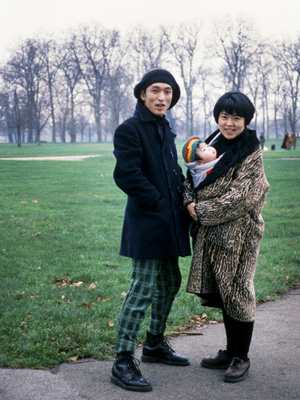
September 1989, I gave birth to my eldest son (Raku) in the UK. My first walk after giving birth.
Q. How did you achieve that ‘mental pleasure’?
It was more of a gradual process. It’s about finding ways to enjoy what you understand intellectually. For example, I learned that echinacea herbal tea helps with a sore throat or cough, and I tried it, but when I thought, ‘This is awful!,’ I realized, ‘It might be delicious with honey.’ So, I added Manuka honey, which is also very effective for sore throats. It was delicious with a synergistic effect!!
Knowledge and wisdom are built upon each other; wisdom doesn't grow without knowledge, but if you become complacent with your wisdom and stop studying, you won't gain more knowledge, and that wisdom will just become outdated. I enjoyed the ‘mental pleasure’ that comes when you have an epiphany, like ‘Ah, I see,’ and feel convinced by your own actions. The period when I transitioned to an organic lifestyle coincided with my age, a time for accumulating knowledge.
Q. When you returned to Japan, the health-conscious trend hadn't yet emerged.
Yes. When I returned to Japan after two years in London, the concept of ‘healthy’ was not yet widely recognized. So, I had no choice but to gather ingredients from the few organic supermarkets available and make an effort to cook at home as much as possible, including preparing baby food for my child. At that time in Japan, it was barely enough to call it ‘vegetarian’; there was no recognition of ‘organic.’ So, when eating out, I ate whatever was available.
Q. Despite that, were you eventually able to become a complete vegetarian?
No, not completely. But as I continued my organic lifestyle in my own way, at my own pace, one day I started to find that soy milk, which I used to find so unpleasant, tasted ‘delicious.’ Now I can drink soy milk by the gallon, but I can't drink cow's milk (laughs). You really can't ‘force’ yourself. You have to find those moments when you genuinely find organic food delicious, otherwise, you can never truly ‘enjoy’ it. After all, life isn't enjoyable without pleasure, is it? And when I thought, ‘So where does that pleasure come from?,’ I realized it's all about my own mindset. Letting go of preconceptions and attachments is important (laughs).
Q. So, a turning point or a trigger is important, isn't it?
No, it's different. It's not about forcing yourself to change your angle on pleasure, but about creating an environment where you can instinctively move in that direction, while maintaining your own pace. You just have to skillfully create a stance that isn't troublesome for you. I didn't become a vegetarian through force or effort; I think I internalized and slowly digested this lifestyle at my own speed. It wasn't a clear discovery that served as a ‘trigger,’ but rather my body seemed to remember it, and I naturally became that way.
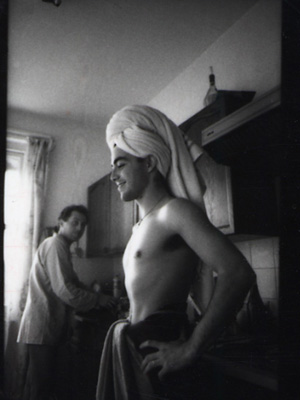
Pietro. At the time, he was the staff member in charge of ‘Peanut Butter’ at Neal's Yard. He eats strawberries every morning. ‘See, my sweat smells like strawberries?’ he said…
Q. In Japan, organic and vegetarianism are also a ‘trend.’
If you approach it as a trend, it eventually feels restrictive and becomes a hassle. Just because it's trendy, do you really enjoy going to organic restaurants every day, living in organic cotton, drinking herbal tea, and going to bed? Is it bringing you pleasure? I want to ask (laughs). Everyone probably wants to wear completely chemical-laden clothes sometimes, or let loose completely. However, I think it's important to maintain a stance that allows you to return to yourself the day after you've let loose. While you're incorporating it into your life as a trend and having fun, you might be satisfied with yourself fitting into that mold, but when the trend passes, the ‘satisfied self’ also ends. ‘Continuing’ is the most important thing!! ... Yes, the reason I wanted to create organic products for my own company is not because it's a trend, but fundamentally to gain my own pleasure.
Q. Pleasure as a hairstylist?
Yes. Simply put, it's because I want to cut hair the way I envision. When I cut the hair of people who use poor-quality hair care products, have irregular diets, or are under a lot of stress, I often find myself inwardly screaming, ‘Stop that habit!’ or noticing that ‘this part is stiff while this part is soft.’ The stylist's desire to cut in a certain way clashes with the hair's texture and how it wants to be cut. This results in frustration for the stylist, and also leads to frustration for the client, who might then switch salons. I believe ‘salon hopping’ often stems from this kind of frustration. That's why, just as a dentist cherishes the gums, we want to convey, in various ways, the message that we cherish the hair until the very end, driven by our desire to remain professionals in our work.
