ORGANICAL on Twiggy Vol.1: A London “Awakening” (Part 1)
Twiggy
Vol.1 Awakening in London (Part 1)
Miho Matsuura, a popular hair stylist who has been proposing cutting-edge fashion at various fashion magazines through her hair salon "Twiggy," which she has run since the 1990s. A project she has nurtured for years is about to come to fruition this autumn. It's her own line of "organic shampoos & treatments." In the cosmetics industry, where scientific leaps are remarkable daily, why has someone at the forefront of fashion continued to focus on "organic"? This series will unravel the secrets behind it.
Narration by Miho MatsuuraPhotos by Koji SatoSummary by Yuka Kobayashi

"Organic" and "eco" are familiar phrases now. However, Matsuura has been interested in these since the 80s, regardless of trends. The major catalyst was her two-year stay in London. London, where she went to learn her craft, was a hub of trends at the time, attracting various artists. What experiences did she gain here...?
Q. First, could you tell us about your background leading up to your move to London?
I was born and raised in the Kitakyushu industrial zone in the 60s. It's one of Japan's three major industrial areas, where I studied as a student. Factories thrived alongside shopping streets, and it was an era when everyone looked only to the future, not at their feet. In the 70s and 80s, as a teenager and young adult, I thought drinking, smoking, and dancing until morning... in short, being unhealthy was cool (laughs). How long could I stand while being unhealthy... Tanning my skin dark and walking braless wasn't about bodywork for health, but a punk spirit expressing spiritual liberation.
Q. You were greatly influenced by the generation you admired, weren't you?
I think that was largely influenced by the fact that the generation above us was into the hippie era of the 70s. While people ten or twenty years older were active in their careers, what they did was interesting. They were people who created what didn't exist and once destroyed what did, so they were mentally strong, and I was greatly influenced by them. That's why I wanted to be like the cool older generation and thought that breaking down things like health was cool. Even though my parents raised me healthily in an industrial area, I started to think even that was uncool.
Q. During that time, you traveled to London to study your craft. Was there already an organic boom in London?
Not at all. London in the 80s was still in the world of "in Drug," and London itself was all chemicals. Compared to NY, London had a more grounded feel, but unlike NY, which was always moving forward, London still had a tradition of loving old things. I think that was incredibly concentrated in Vivienne Westwood and Paul Smith. Because they loved old things, they created new things – that "spiritual punk" took shape... That was the start of the 80s, and the punk spirit, which was a matter of philosophy, began to take shape as fashion in 80s London.
In Kensington, there was a select shop called "Hyper Hyper," which is what we'd call a select shop today. It was a place for young designers to showcase their work, and it was incredibly exciting. Even though people gathered from all over the world, that energy was what "London" was all about. I was so drawn to it, feeling like nothing would start unless I went to "Hyper Hyper"...
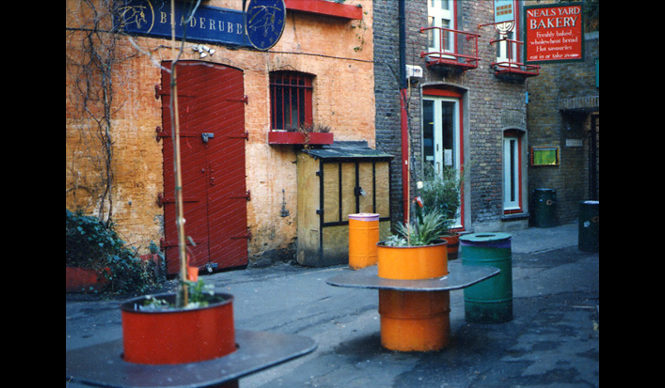
Neal's Yard in 1989. Entering a narrow alley in a corner of Covent Garden
led to "YARD," where salad bars and
bakeries lined the streets. People would have lunch or tea in this space,
a wonderful atmosphere.
Around that time in NY, people would bring their own Evian water and go to the office in sneakers, then change into high heels... In that sense, NY was more sensitive to "health" at the time. London, conversely, was in a period where it wanted to be more chemical. Health and nature were considered uncool. Nevertheless, I believe that the intellectual people of the 70s, who didn't drift to San Francisco (the birthplace of New Age at the time) but stayed in London, are the ones who created "Neal's Yard."
Q. So, there was a "healthy lifestyle" in London at the time, different from NY?
Even if the NY sensibility was edgy, the British pride of the "United Kingdom" meant they couldn't say NY was cool. However, it was around this time that British people started to flock to NY. But it wasn't that NY was good; it was just that people who wanted to turn art into business moved to NY. Others stayed in London, and those with a stronger New Age inclination headed not to NY, but to San Francisco. San Francisco seemed to have a stronger healthy lifestyle orientation than NY. But as a child, I didn't understand these things yet.
My encounter with Neal's Yard in London was my first return to my roots, though I didn't realize it at the time. I thought a chemical punk spirit was cool, but perhaps I found healthy things like Neal's Yard appealing because I experienced an "intelligence that could be felt through the air," even without speaking English fluently.
For me, who naturally lived a life of drinking until morning in Tokyo, I started to feel disgusted by "disco until morning" as my friends, who were British, Italian, and French, began frequenting jazz cafes and theaters instead of punk and rock clubs. I began to think, "Wait, are we... uncool?"
Like New Yorkers, people in London who stopped by organic cafes on their way to work in the early morning looked smart.
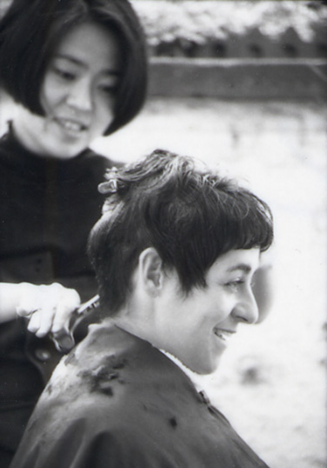

Nadia. I met her at Neal's Yard (she was in charge of the salad bar at the time) and we've been friends for 20 years. She was the first person to teach me about "herbs," "natural remedies," and "traditional Eastern medicine."
Then, when I went to NY and became an assistant to a makeup artist, the shoots were with the famous Steven Meisel, and all the staff were famous people. I remember them all being health-conscious. They all brought their own water, and the catering was hot meals. They served warm food and genuinely enjoyed their meal times. Even after returning to London, when I worked with renowned photographers like Johnny Ross and Cindy Palmano, who were active in "ITALIAN VOGUE" and "BRITISH VOGUE" at the time, the catering on set was magnificent. In Japan, meals on set weren't considered that important back then, but there, it was a lunchtime for conversation. The day would start with a meeting over tea.
Q. ...Did you touch upon their mindset through your work?
Yes. Furthermore, during Johnny Ross's shoots, most people were vegetarian, and at that time, there was only soy milk in the morning. Going to places that were challenging for me always meant they were ascetic places... that was a striking impression. That was NY and London for me. Rather than becoming popular in the 80s, I think the people who were successful in business after the hippie movement of the 70s continued that trend into the 80s with a health-conscious approach.
It was then that I realized, "I wasn't grounded in Tokyo." At first, I thought, "Why are they eating such bland food?" but seeing the people I admired frequenting Neal's Yard looked wonderful to me, who used to do the "all-night Tsubaki course" in Tokyo. People from the 70s lived an organic lifestyle. It was their way of life.
Q. What was the trigger for you to adopt an "organic lifestyle"?
For me, my relationship with organic began when I became pregnant in London. As the number of people I loved grew, I began to want to cherish the people I loved and my position among them. To do that, I wanted to stay healthy, and when I realized I wasn't living just for myself, I started to question, "Why am I eating like this?" "Why am I drinking until late at night?"
When I thought, "Where is my important place?" I was fortunate to be able to work in a field I loved, but if I found a love that was comparable, it's natural to want to be healthier in mind and body. When I want to move forward, I want to have the physical strength to do so. If my body fails, I can't make the effort. So, I naturally started to think, "I have to be well."
Of course, life in London was tough then, and due to financial reasons, I was eating mostly vegetables (laughs). Coincidentally, I had a friend working at Neal's Yard, and she often brought me products from the store. I didn't become strict about organic because I was pregnant, nor is there any need to be strict. I happened to become vegetarian then because of pregnancy, but fundamentally, humans need an element of "absolute pleasure" to continue anything.
