March 11, 2015
The History of the World's Oldest Barbershop (Part 1: The 19th Century)
THE STORY OF TRUEFITT&HILL
The History of the World's Oldest Barbershop (Part 1: The 19th Century)
The Prosperity and Glory of Truefitt & Hill, with 100 Staff Members
The history of Truefitt & Hill, the world's oldest barbershop, began in 1805. Over three installments, we introduce the illustrious history of Truefitt & Hill as it makes its official debut in Japan.
October 21, 1805, Mayfair, London
Decades ago, there was only one hairdresser on London's prominent Old Bond Street. That was H.P. Truefitt, the predecessor of today's Truefitt & Hill.
Its history dates back to October 21, 1805, when a barbershop opened in Long Acre, Mayfair, London. On that day, over 200 years ago, a barber established a hair salon. His name was Francis William Truefitt, opening as a Royal Warrant holder for hairdressing, head dressing, and wig making.
Francis Truefitt possessed not only exceptional barbering skills but also a remarkable talent for blending and developing fragrances, hair products, and hair tonics. His reputation spread rapidly, leading to a truly brilliant start, including being appointed as a Royal Warrant holder by King George III.
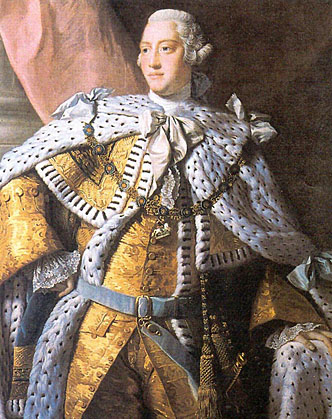
King George III
The early days, cherished by the privileged classes such as the British Royal Family and aristocracy, have been passed down to the present day through media and contemporary literature.
In his book 'George IV,' the author Thackeray writes about Truefitt being the wig maker to George IV. In 'Rebecca and Rowena,' he issues this warning to the young men of the time:
'Mature men and women, that is, gentlemen and ladies, have the right to improve themselves and become attractive individuals. Ladies must not forget kindness, and more importantly, must become stronger than they were in their school days. Gentlemen must not only possess spirit but also acquire the proper grooming of a Truefitt.' Beyond this, numerous media outlets have featured Truefitt and his clientele, with the contemporary magazine 'Punch' even dedicating an issue to Truefitt's philosophy.
The writer Charles Dickens, a client of Truefitt, touches upon the barbershop's excellent reputation in his book 'The Uncommercial Traveller,' quoting:
'Salons with excellent hairdressers like Mr. Truefitt are filled with gentlemen learning French to pass the time.'
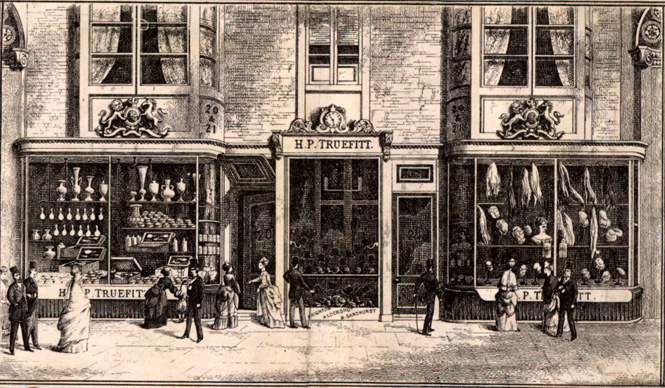
Soon, Francis Truefitt invited his brother Peter, opening branches in multiple locations. Between 1811 and 1850, he energetically expanded, opening successful establishments in Old Bond Street, New Bond Street, Hanover Street, Long Acre, and Burlington Arcade.
Notably, the 'Toiletry Club' started at the Burlington Arcade branch later became widely known as 'The Club' among patrons and continued until 1936. Engravings documenting the period depict gentlemen in formal attire having their beards lathered by brushes, operated by a Heath Robinson-designed intricate device suspended from the ceiling. A fixed brush rotates as an operator in a frock coat moves around the customer.
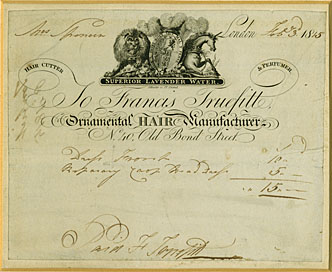
A 1815 Invoice
Many 'Toiletry Club' membership tickets, punched to indicate services like shaving and haircuts, have been discovered as mementos upon the passing of long-time customers and donated to Truefitt as historical materials.
Royal Warrant Holder by King George IV
In that era, visiting a barber was an even more indispensable habit for gentlemen than it is today. Gentlemen needed to keep their hair short to ensure their wigs fit perfectly. Subsequently, Peter's son, Henry-Paul, changed the company name to 'H.P. Truefitt' and solidified his reputation as a haircutter, hairdresser, and wig maker. H.P. Truefitt established an era as a Royal Warrant holder by King George IV.
According to posters and documents from the time, H.P. Truefitt also opened a branch in Brighton. In an era when only a select few had country residences, spending holidays in the suburbs via train, like in towns such as Aldershot and Sandhurst, became a status symbol for the privileged class, and this suburban branch catered to that demand.
A popular item in hair salons at the time was the scratcher (back scratcher). Some were works of art with elegant curves, others telescopic, and they came in a wide variety of styles. 'If you scratch my back, I'll scratch yours.'
While this phrase can sometimes be suggestive, it also arose from necessity. These stylish scratchers remained popular until the mid-19th century, typically measuring 15-20 cm in length. Many featured intricate designs on the scratching end, with miniature hands being particularly popular.
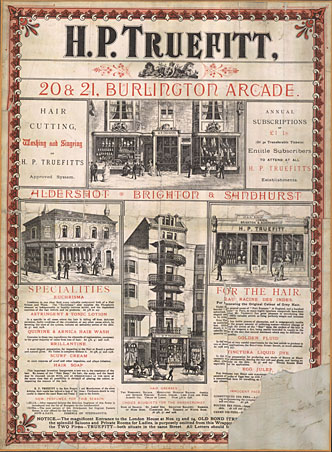
An 1820 Advertisement
A gentleman, impeccably groomed with perfectly blended cologne and pomade-slicked hair, would tuck his favorite items into the waistcoat of his tailor-made suit. Meanwhile, ladies of the Royal court and fashion-conscious aristocrats carried intricately crafted scratchers as fashion accessories. These were later replaced by pocket watches with chains and fountain pens. Truefitt's product catalog from that era showcases a wide array of high-quality scratchers alongside fine combs, offering a glimpse into that glamorous period.
H.P. Truefitt & Co. was also a company with a strong sense of social responsibility. The third generation, Henry-Paul Truefitt, established a charitable foundation. The British Benevolent and Provident Institution was founded in 1831, making it the 18th historically recognized charity in the UK. Henry Truefitt was appointed its first chairman, dedicating himself to the role for 25 years until his retirement in 1883 at the age of 84. The hairdressers' charity 'The Caring Hand of the Industry,' still known today, continues to extend its helping hand across the UK.
The Content of the World's Oldest Contract
Between 1860 and 1861, Henry Truefitt appointed John B. Daniel as his manager. Believing Daniel's diligence made him suitable for the role, H.P. Truefitt entered into a contract with him and placed him in a position of responsibility. According to archives held by the City of Westminster, this contract is believed to be the oldest ever issued in the field of barbering, and the original document is still preserved today.
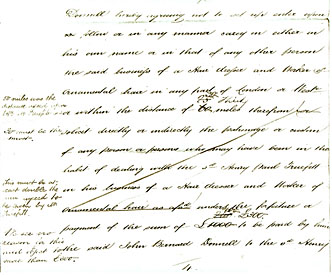
The Contract with Daniel, Written in 1860
The contract states that Daniel was to dedicate himself to the barbering business or be employed as a site supervisor. It further stipulated that Daniel himself would work diligently and honestly, understand H.P. Truefitt's philosophy and vision, and exert his utmost effort for the company's continued prosperity.
This contract stipulated that Daniel would dedicate himself exclusively to his work at H.P. Truefitt, earning a weekly salary of £4.1, which increased to £6 after three years. The contract included a three-month mutual reporting obligation. If Truefitt were to terminate the contract, for instance, due to Henry Truefitt's death and business closure, a penalty of £300 and compensation equivalent to three months' notice would be promised. Should Daniel resign voluntarily, he would be prohibited from working within a 30-mile radius of Old Bond Street for the following three years. The contract specified that if Daniel violated this, he would be fined £600 and be subject to agreement to new restrictive clauses.
If Truefitt decided to sell the company, Daniel was granted the first right of purchase, with a decision required within ten days. If Daniel declined, he was also obligated to act as a liaison, conveying all information and rules regarding Truefitt's management and operations to the new owner.
Opening a Groundbreaking Ladies' Hair Salon
In the early 19th century, hair salons primarily served gentlemen, and services for ladies were not offered. However, by the latter half of the century, Bond Street had become a fashionable thoroughfare, with increased foot traffic and horse-drawn carriages, heralding the dawn of a new era.
Consequently, Truefitt decided to open a hair salon targeting women. At that time, establishing a salon for women was unprecedented and a highly risky, avant-garde endeavor. This was because women's hairdressing and wig maintenance were considered private matters, typically handled at home. Ladies' hairdressing was usually done by a dedicated maid at home, and professional hairdressers were only invited to the residence for special events to enhance beauty.
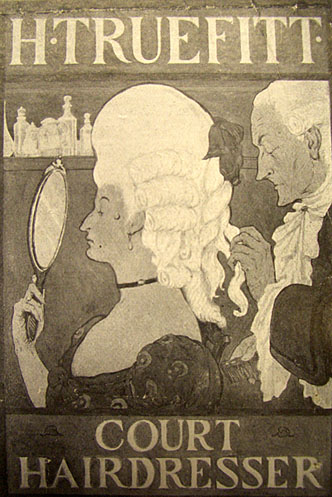
Court Hairdresser
Today, women visiting hair salons is considered a feminine activity worldwide. Truefitt was the pioneer who broke down the rigid prejudices that existed before. The world's first women's hair salon by Truefitt opened in 1870 at 23 Old Bond Street. At that time, Old Bond Street began to feature forward-thinking shops and soon became a fashionable thoroughfare where elegantly dressed gentlemen and ladies enjoyed shopping.
Undoubtedly, Truefitt's ladies' hair salon became one of the most fashionable establishments for ladies. In G. Allen's 1900 book 'Wolverden Tower,' there is the following passage:
A report by an Oxford University student investigating a group of fashionable ladies attending a reception party stated: 'I do not favor hairstyles like theirs. Dressing up is fine, but it's completely overdone. However, among them, there was a woman who was elegantly dressed with a very natural and beautiful hairstyle. That sophisticated styling must be the work of Truefitt.'
Maintaining a strong relationship with the British Royal Family, H.P. Truefitt & Co. launched its original fragrances and cosmetics in 1875 in response to growing demand, achieving great success. Records from Truefitt dating back to 1878 indicate the launch of what was likely the first lipstick in Bond Street, and possibly the world. Developed by Truefitt's dedicated pharmaceutical staff, it contained cochineal, not only preventing lip dryness but also coming with a two-year quality guarantee.
Perfume Cherished by Queen Victoria
Truefitt's fragrances, soaps, pomades, hair products, and beard styling products became immensely popular. Among them, a perfume cherished by Queen Victoria was named 'Imperial Bouquet.' Truefitt's fragrances became inextricably linked with the gentlemen and ladies of the British Royal Family.
Truefitt's perfumes included 'Choice of Rifle Brigade,' 'Favorite of Royal Artillery,' 'Imperial Bouquet,' 'Guards Own Bouquet,' 'Palmerston Bouquet,' 'Jockey Club Bouquet,' 'Royal London Yacht Club Bouquet,' 'Aldershot Bouquet,' 'Brighton Bouquet,' and 'Orleans Club.' The perfume 'Knickerbocker Nosegay,' patronized by the Knickerbocker Hunts Club, exuded an essence of grace and intellect and, like 'Exhibition Bouquet,' was specially blended for events. These perfumes, along with wigs, were showcased at the 1851 Great Exhibition as successful products.
The label of the fragrance named 'Kubaya,' characterized by its rich aroma, reads: 'This fragrance is known only to the indigenous people of Talai, a town in northern India.'
This fragrance, brought to Britain, was later favored by the Prince of Wales, who would become King Edward VII. Perfumes based on exotic flowers from Japan, India, South Africa, Syria, and Australia, such as Moropoh, Ixia, Opoponax, Frangipani, and Stephanotis, also gained popularity. Furthermore, sophisticated perfumes with modern interpretations like 'For Her' and 'Old Bond Street Scent,' created for other companies, became bestsellers.
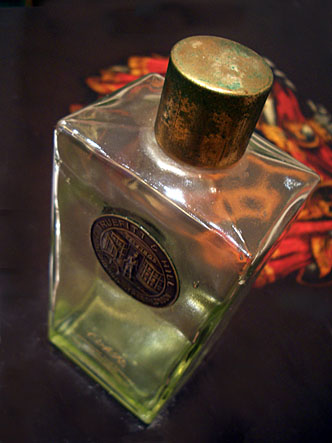
Old Bottles from Truefitt & Hill
Innovative Ideas Born from Consideration
Truefitt's spirit of innovation was once again evident with the installation of marble washbasins. Despite the absence of a developed water supply network, the basins featured faucets with running water, and a basin was placed underneath. A painting from 1880 depicts the scene before this bold invention was in use. The predecessor supporting the services of this cutting-edge hairdresser was a large maidservant, wearing a white hat and black attire. The painting shows her struggling to rinse a customer's hair with hot water while holding a heavy basin. The essential qualities for service providers were, above all, compassion, efficiency, and exceptional skill.
Another invention by Truefitt was the opening of a shop specializing in manicures and foot treatments. The interior was adorned with numerous gold-framed pictures and many potted plants. To launch this business, Truefitt recruited a manicurist from America. Ms. Amelia West arrived in Britain in 1880 and dedicated the next 60 years to Truefitt. She combined the American method, patented by Dr. Paul, with delicate French finishing techniques. She generously passed on her skills to aspiring professionals who came to her from all over Britain and Europe. It is an undeniable fact that through her long career at Truefitt, she passed down her techniques to the next generation, training hundreds of students and thus laying the foundation for today's beauty industry.
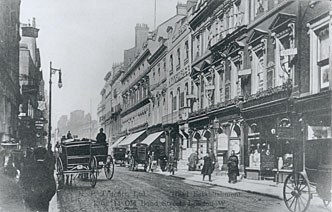
Old Bond Street in 1880
On May 9, 1882, Henry Paul Truefitt founded a guild for hairdressers, wig makers, and perfumers, becoming its first president. This guild ensures all its members maintain the highest standards of skill and elegance and continues to operate today with 28 branches across the UK.
Discussion on Sunday Opening Hours
A meeting was held in January 1883 to discuss Sunday opening hours. The members widely condemned it, citing psychological, social, and economic disadvantages. However, a bill prohibiting Sunday operation of barbershops was not introduced until 1930. While some view the inability to open on Sundays as a double-edged sword, many staff still believe it is the best approach for the barbering profession.
An interesting article appears in the annual directory of the Barbers' Guild. This exact same discussion took place nearly 500 years ago, in 1413. The letter was addressed to Thomas Arundel, Archbishop of Canterbury, stating: 'Barbers shall not open their shops on the Sabbath without a spirit of devotion to God. Those who violate this shall be fined.'
This decree was immediately enforced, applying without exception to all barbers, apprentices, and other staff and their families within the City of London. The fine was set at 6 shillings and 8 pence, with a fine of 5 shillings for supervisors and guilds.
There was a period when an increasing number of gentlemen visiting Truefitt sported mustaches and beards. In response, Truefitt developed a product called 'Cosmetic Stick.' It was a record-breaking hit product, not only for conditioning and shaping mustaches but also for elegantly styling beards and eyebrows. This product continued to be manufactured for about 50 years, making it a long-seller. That 50-year mark coincides with the retirement of Ms. Joyce, mentioned later, and it is believed that the decrease in men growing beards, due to her activities, was the reason.