March 18, 2015
5th Installment: Discussing the film "Perfume" with the Editor-in-Chief of "Kinema Junpo" 1
Part 5: Discussing the Film "Perfume" with the Editor-in-Chief of "Kinema Junpo" - 1
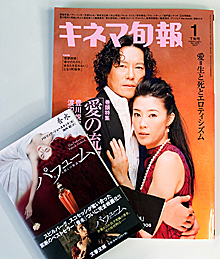
This year marks my 25th anniversary, a quarter-century, of writing columns for magazines. In my twenties, I primarily wrote about films. For nearly four years, until the year before last, I had a column in "Kinema Junpo," the queen of serious film magazines, though I sometimes felt out of place. It was partly for this reason that I wanted to discuss the perfume-centric film "Perfume" with this particular person.
She is Yuko Sekiguchi, the editor-in-chief of "Kinema Junpo."
text by NAKANO Kaoriphoto by TATSUNO RinSPECIAL THANKS: GAGA COMMUNICATIONS INC.
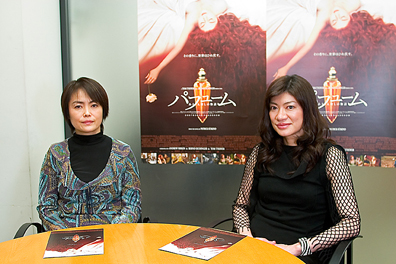
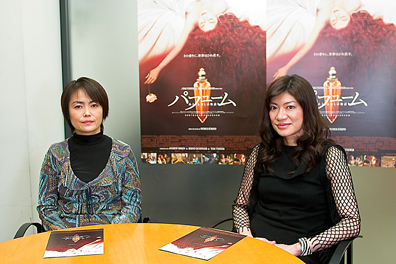
At GAGA Headquarters
The Internet of Curiosity, The Magazine of Deep Reading
NAKANO KaoriEditor-in-Chief Sekiguchi, it's a pleasure to see you again.
Yuko SekiguchiThank you, it's been a while. Thank you for the serialization.
NakanoThe pleasure was all mine. When I started my serialization in "Kinema Junpo" and when I finished, the meaning of writing about films felt like it had completely changed. People could easily get film information online without having to buy a magazine. I myself found myself buying fewer film magazines and pamphlets than I did in the 80s, and I felt that writing about films in print media now required considerable resolve.
SekiguchiI believe the needs of readers for online content and magazines are different. I use the internet to look up immediate information like cast, directors, and showtimes, or to check blogs of people writing about films, but I don't have any particular sites I always visit. It's more for satisfying curiosity. However, with magazines, people expect more in-depth information and unique content that goes a step further.
NakanoIn terms of being a film magazine that one can read thoroughly, "Kinema Junpo" is really doing its best.
Editor MakotoI agree. I bought "Kinema Junpo" again after a long time, if I may say so (laughs), and the articles, like the director interviews, were all very substantial. It made me realize anew, 'This is what a magazine should be, this is what a magazine is.'
SekiguchiThank you. I believe the internet and magazines occupy different fields. Rather than competing, they coexist.
NakanoI'm aiming for both satisfying curiosity and providing a deep reading experience with this web magazine serialization (laughs). But I sometimes feel guilty, wondering if I'm not achieving either and just falling somewhere in between...
Editor MakotoYou should be prepared for that (laughs).
God? Genius? Devil? Angel?
NakanoI believe the issue of competition isn't relevant to the relationship between a film and its source material either. What are your thoughts on "Perfume," Editor Sekiguchi? How did you first encounter it?
SekiguchiI haven't read the novel. I was drawn to the fact that the director was the same person who made "Run Lola Run." Director Tom Tykwer also made a film called "Heaven," which was my best film of that year. So, I was very curious to see what he would do with his new film.
Nakano"Heaven"... I'm sorry, but I missed the chance to see it. What kind of film is it?
SekiguchiKrzysztof Kieślowski wrote the screenplay.
NakanoThe Kieślowski of "Blue" (The Three Colors Trilogy)! I loved that film so much I listened to the soundtrack endlessly.
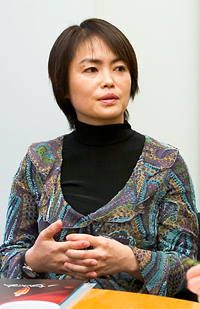
Editor Yuko Sekiguchi
SekiguchiKieślowski based "Heaven" on Dante's "Divine Comedy" and reportedly conceived it as a trilogy of "Inferno," "Purgatorio," and "Paradiso." He only made the "Paradiso" part into a film. The interpretation of heaven is poignant, or rather, it delves into the fundamental aspects of human nature. In that sense, doesn't "Perfume" also have a religious dimension?
NakanoReligious... or rather, it certainly had a sense of delving into the fundamental. I encountered it through the novel. I think the translation by Tadashi Ikeuchi was superb, and reading the novel deeply affected me. I was left stunned, unsure if it was a horror story, a tale of beautiful perfume, a story of genius, a story of a devil, or a story of an angel adorned with perfume. I was completely captivated, and when I heard it was being made into a film, I couldn't wait.
SekiguchiIt's not sad, nor is it moving; you really don't know what the story is about, do you?
NakanoSome movie sites classify it as horror (laughs).
SekiguchiThey tend to categorize it more as fantasy, don't they?
NakanoIt's also a story filled with absurd, nonsensical silliness.
SekiguchiThe story begins at the fish market, with his birth, doesn't it? That must be shocking for someone who hasn't read the novel.
NakanoA baby, dropped right into the slimy innards of fish that seem to reek (laughs).
SekiguchiI found myself wondering what the intention was here. I do enjoy reading between the lines (laughs). Jesus was also born in a stable, wasn't he? Perhaps he's depicted as a human with divine elements?
NakanoAnd he's a person who doesn't have a scent. Not having a scent is said to be a characteristic of the devil. So, the protagonist is both a god and a devil.
SekiguchiAnd by wearing the ultimate perfume, he becomes an angel.
NakanoA genius, a god, a devil, an angel... He's tenacious because he's 'chosen.' His vitality is immense.
SekiguchiHis vitality leads to his mother's death when he cries.
NakanoExactly, everyone who gets involved with him dies after they part ways with him (laughs).
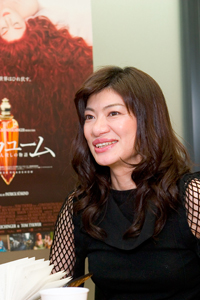
Kaori Nakano
SekiguchiHe brings death to his benefactors one after another... so perhaps he is the child of the devil after all?
NakanoThe fact that his benefactors die so easily brings each episode to a close, and the story moves swiftly to the next. It's the height of absurdity. Isn't it funny from a cinematic perspective?
SekiguchiRight, the scene where Dustin Hoffman's house collapses – that's something that would never happen in reality. It's a row house, but only that one collapses (laughs).
NakanoIn the novel, it catches fire.
SekiguchiRather than a fire, the way it instantly turns to ash with a clatter is more cinematic.
NakanoExactly, it's filmed in a way that lacks a sense of tragedy, so you don't have to empathize with the deceased. It's a stylishly deformed adaptation of the novel. In that sense, this film, far from being faithful to the original, seemed to reproduce the essence of the novel more intensely and effectively.
[profile]
Yuko Sekiguchi
Editor-in-Chief, "Kinema Junpo"
Graduated from Tokyo Gakugei University in 1987. After working at a design company, she joined Kinema Junpo Co., Ltd. in 1990. She became editor-in-chief in 2000 and executive editor-in-chief in 2001.