
March 18, 2015
Part 1: Words to Describe Scents
Part 1: Warm-up
Words That Express Scent

I used the word "fragrance" in the title, but that was simply to follow the convention (as it appeared to me) of how people in the perfume business use language.
When you visit a perfume counter, you'll find all sorts of products with pleasant scents, from "parfum" and "eau de toilette" to solid perfumes and creamy body lotions. When buyers talk about these collectively, they tend to call them "fragrances" in a general sense.

photo by IDEGUCHI Keiko
The term "perfume" carries a strong image of being for women, but it seems "fragrance" is more palatable for men. I respect that as a term currently in circulation.
Perfume, Fragrance, and Aroma
Nevertheless, in this forum, it seems best to first confirm the distinct original meanings of several words that express "pleasant scents." This is about solidifying the linguistic foundation that will serve as the bedrock for our thinking as we aim for higher ground.
To limit our discussion to English, it goes something like this. While the meanings can differ slightly from their specialized use in perfumery, here we are simply reviewing the nuances of commonly used terms.
Perfumerefers to a strong, rich scent, whether natural or artificial.
Fragrancerefers to a fresh, pleasant scent, particularly one emitted by trees, flowers, or grass.
Aromarefers to a somewhat stimulating, fragrant aroma (like the aroma of coffee).
Odor, Smell, Scent, Stench, and Stink
While we're at it, let's also distinguish between the words that mean "scent" itself.
Odorrefers to a characteristic "smell," with emphasis on the source of the scent. For example, body odor. "Deodorant" is something that eliminates body odor.
Smellis a general term for "scent," but when used without an adjective, it typically refers to an unpleasant odor. Even when an adjective is added to make it sound pleasant, it somehow feels a bit dubious. For example, the "sweet smell of success."
Scentrefers to a faint, subtle scent. "Scent of a Woman," the film that showcased Al Pacino's blind performance, uses this word.
Stenchrefers to an unpleasant, nauseating, and offensive odor. For example, the "stench of death" uses this word.
Stinkalso refers to an unbearable stench. For instance, a "stinking summer" might be called a "stink."
The Lingering Scent of Roses in the Hand, the Tearful Scent of Violets on the Heel
Oops, we've strayed into unpleasant odors, but I'd like to return to fragrances to conclude this section.
There are some wonderful words surrounding "fragrance." (Apologies if this sounds preachy!)
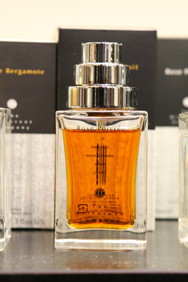
"Rose Poivrée" by The Different Company photo by IDEGUCHI Keiko
The fragrance always remains in the hand that gives the rose.
The hand that gives a rose to someone always retains the rose's fragrance.
Forgiveness is the fragrance the violet sheds on the heel that has crushed it.
The scent of violets that lingers on the heel of the shoe that crushed them is the violet's forgiveness.
There can be various interpretations, but this is how I received it.
Is it not good to generously give away spoils of war, symbolized by the rose, to others? For the hand retains the rose's fragrance, which is more valuable than the spoils themselves.
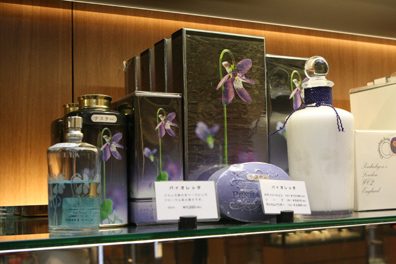
Violet perfume "Violetta" (Photos of both perfumes taken at Isetan Men's Building 1st Floor Fragrance Counter) photo by IDEGUCHI Keiko
As I pictured the violets releasing their fragrance even when trampled, I was reminded of the attitude the Amish people took towards the families of the perpetrators after their children were senselessly massacred at school the other day.
Suppressing their own pain, the Amish offered quiet forgiveness to the perpetrators' families. I detected the scent of violets in their actions and could not help but shed tears.
End of this section