Watches & Wonders 2021 new release. The Reverso Hybris Mechanica Calibre 185, featuring the world's first ultra-complicated mechanism and four dials | JAEGER-LECOULTRE
JAEGER-LECOULTRE
Limited to 10 pieces. The Reverso Hybris Mechanica Calibre 185, expressing the time of the cosmos and Earth.
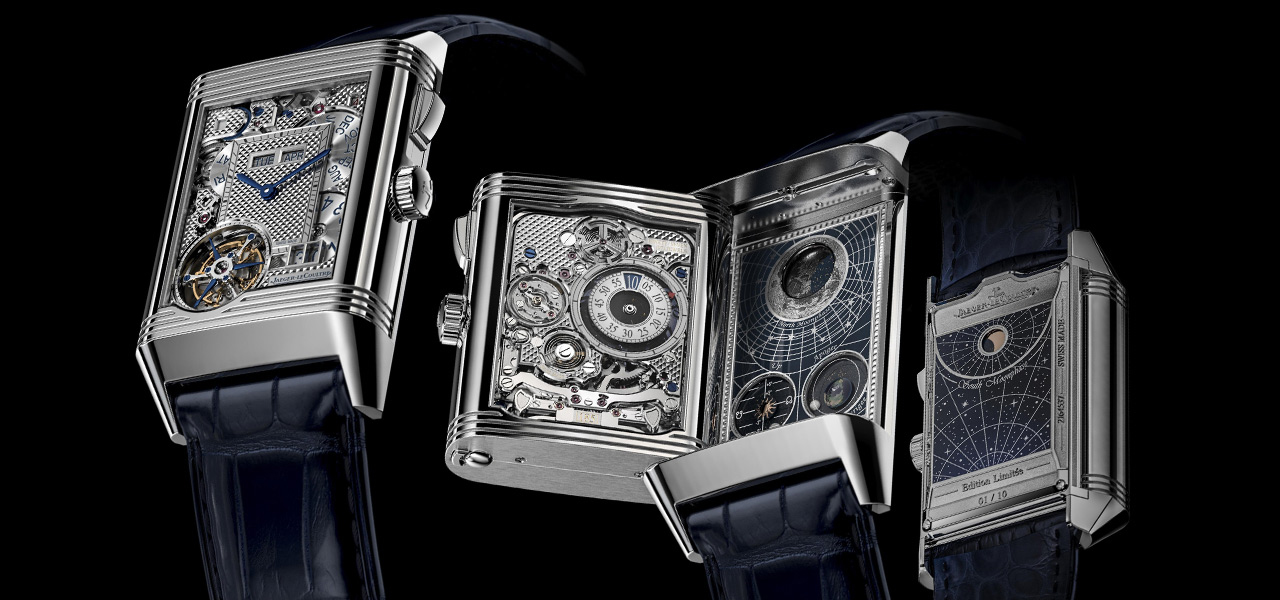
From Jaeger-LeCoultre, the esteemed Grand Maison, comes the Reverso Hybris Mechanica Calibre 185, a world-first wristwatch released in a limited edition of 10 pieces. It fuses unparalleled mastery in ultra-miniaturized watchmaking with a highly complicated mechanism featuring four dials, celestial indications, and chiming complications. This timepiece, the most complex Reverso ever created, expresses the time of the cosmos and Earth through its functional design, a truly rare creation.
Text by OZAKI Sayaka | Edit by TSUCHIDA Takashi
Expressing the Cosmos Through Unparalleled Mechanical Watchmaking and Innovation
The Reverso Hybris Mechanica Calibre 185 is a highly complicated watch that combines key elements of Jaeger-LeCoultre's savoir-faire, developed over more than six years, with innovative new astronomical displays. This piece is the world's first timepiece to feature four functional dials, merging 11 complications—including perpetual calendar, minute repeater, and synodic, nodal, and anomalistic month indications—with unparalleled mastery in ultra-miniaturized watchmaking. The cradle integrates three lunar information displays (synodic, nodal, and anomalistic months), enabling prediction of astronomical phenomena such as the next supermoon, solar eclipses, and lunar eclipses occurring globally.
The 18K white gold case, measuring 51.2 x 31 x 15 mm, is a testament to the Manufacture's nearly two centuries of expertise and a thoroughly modern approach to technical innovation. Housed within this case is the in-house Calibre 185, nicknamed the Quadriptyque, developed over six years specifically for this watch. It drives the world's first double-faced case and double-faced cradle, featuring an ingenious patented mechanical system by Jaeger-LeCoultre that synchronizes and updates the displays every midnight with an audible chime.
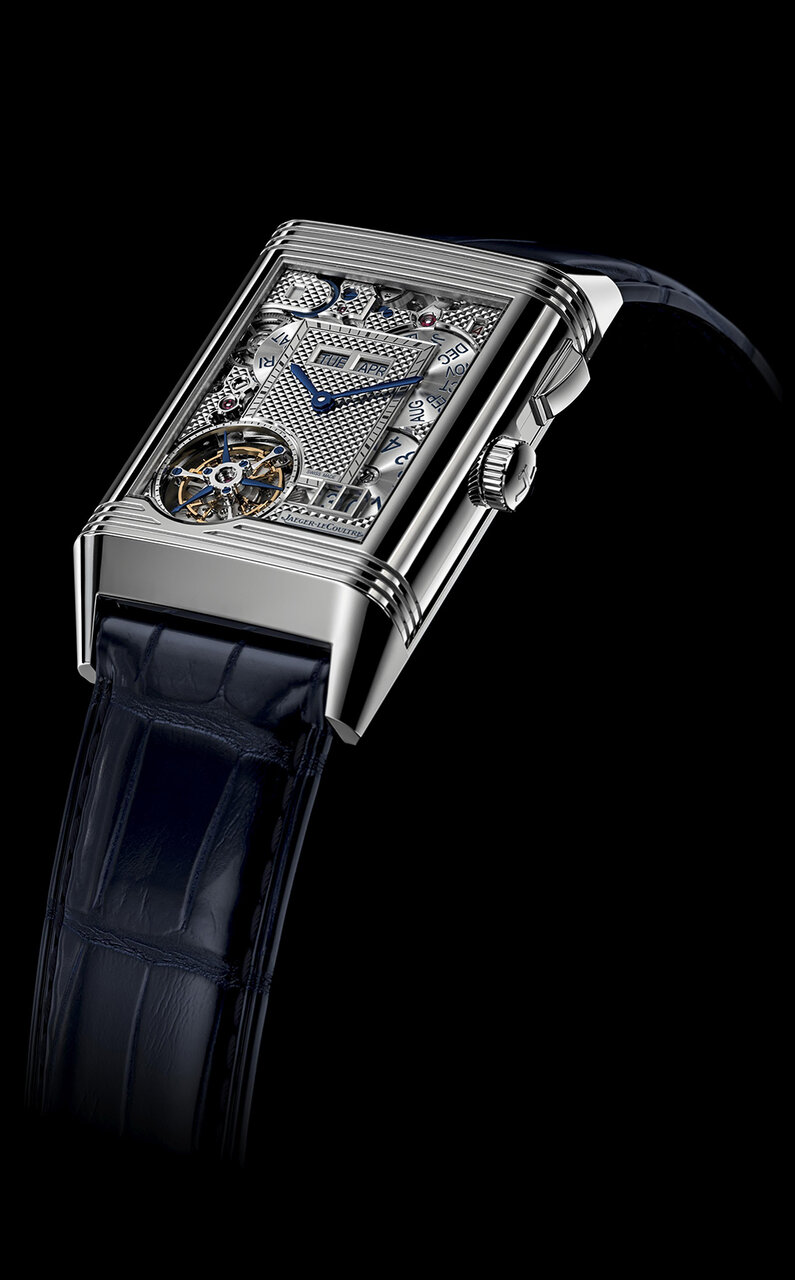
One of the stars of this Quadriptyque is the flying tourbillon, positioned at 7 o'clock on the case surface. Rotating once per minute, it constantly changes the position of the balance wheel, the heart of the movement, to maintain consistent average timekeeping. The balance wheel oscillates at a frequency of 4Hz (28,800 vibrations per hour), meaning one second elapses every eight beats, accumulating seconds to display minutes, hours, days, weeks, months, and years. The front features a perpetual calendar that always displays the correct date, regardless of the varying lengths of months, and reflects leap years by showing February 29th every four years. The perpetual calendar's display, highlighting the precision of this structure, instantly changes at midnight.
A date display disc, newly conceived to match the size of the flying tourbillon and offering excellent legibility, is positioned at 5 o'clock, completing the time indications for daily use on the front. This showcases Jaeger-LeCoultre's powerful statement.
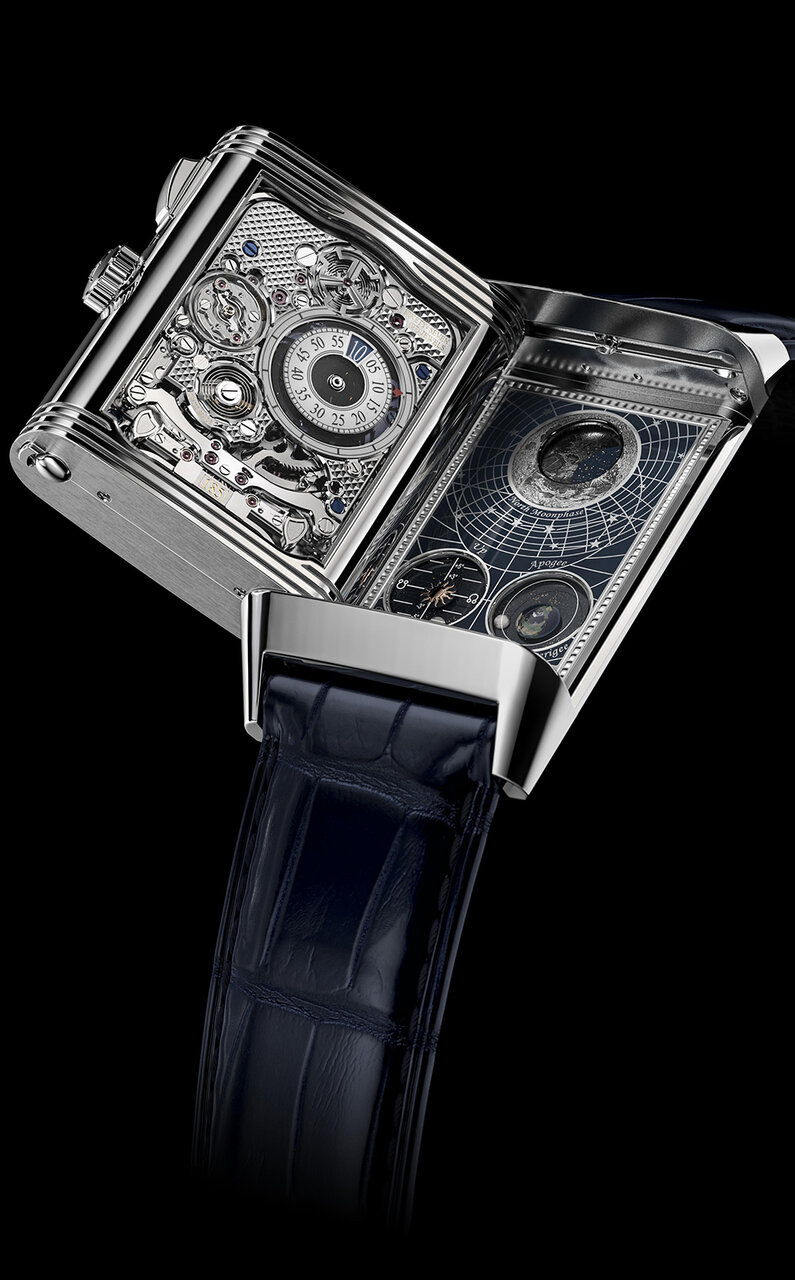
The second star is the chiming mechanism, a hallmark of Jaeger-LeCoultre's excellence. Sliding a lever located just above the crown releases a melody from the Quadriptyque. First, a series of low tones indicating the hours. Then, alternating high and low tones for the quarter hours. Finally, a series of high tones for the minutes past the quarter hour. In essence, the current time can be grasped through the chiming sequence of hours, quarter hours, and minutes. The movements of the Quadriptyque's exceptional barrel, cams, hammers, and gongs can be admired alongside the time display on the subsidiary dials, indicating the same time as the main dial, jumping hours, and surrounding minute indications.
This chiming mechanism is visible through an opening in the movement plates, hand-engraved with a Clous de Paris guilloché pattern. It features a silent strike governor to eliminate the buzzing sound of older anchor mechanisms, crystal gongs to elicit optimal acoustic properties from the material, and articulated trebuchet hammers that transmit clear, powerful energy to the gongs. These technical innovations enable Jaeger-LeCoultre's minute repeater to achieve a chime with a large, clear tone. Furthermore, the mechanical sequence of the minute repeater mechanism has been refined to eliminate the silent intervals that previously occurred between chime groups, resulting in a continuous, exceptionally beautiful sound.
The third star is the sidereal time display (time determined by reference to stars rather than the sun), one of Jaeger-LeCoultre's signature complications. For the first time in the history of mechanical watchmaking, Jaeger-LeCoultre has made it possible to display three pieces of lunar information—synodic, nodal, and anomalistic months—on a single wristwatch. This unique combination of micromechanical displays, positioned inside the cradle of this piece, allows for the measurement of rare lunar phenomena such as eclipses of both the sun and moon, and supermoons.
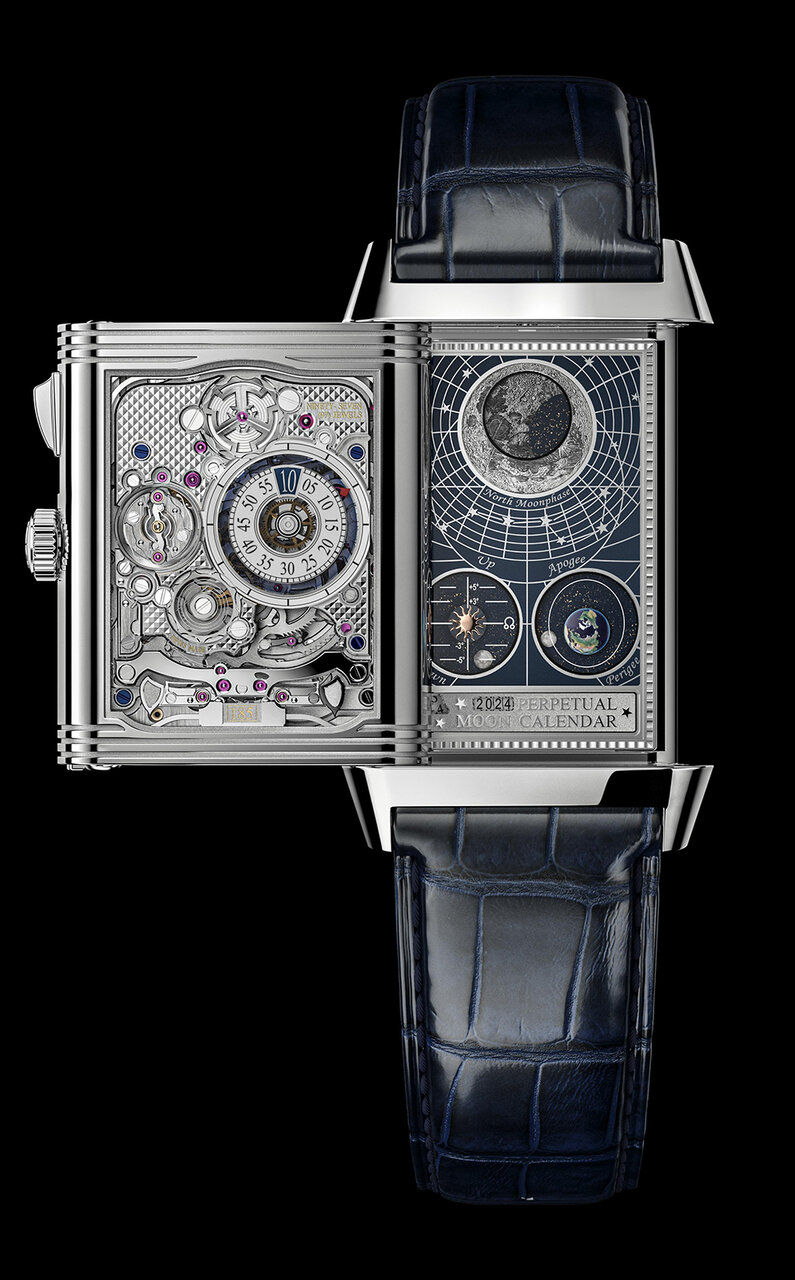
The upper half of the cradle's interior displays the Northern Hemisphere's moon phase. The laser-engraved moon reveals its phase corresponding to the lunar cycle through the movement of a movable blue-lacquered disc adorned with gold embellishments. While conventional moon phase displays have an error of one day every 32.5 months, the Quadriptyque's moon phase display boasts exceptional accuracy, requiring adjustment only once every 1,111 years.
To the left, directly below the moon phase display, a counter depicts a small moon orbiting a 3D finely sculpted pink gold sun. This counter represents the nodal month, indicating when the moon's orbit intersects Earth's orbit around the sun (the ecliptic). Such intersections occur twice per cycle and are indicated when the moon and sun counters align horizontally, signifying that the moon, Earth, and sun are all on the same plane. When these positions align and the moon is either new or full, it is called a syzygy. In this case, an eclipse occurring on Earth is a lunar eclipse when the moon is full, and a solar eclipse when the moon is new. However, whether an eclipse can actually be observed depends on various factors, such as the observer's geographical location.
To the right of the nodal month counter is a domed Earth, micro-painted in enamel, with a moon depicted on an eccentric orbit around it. This counter represents the anomalistic period, displaying the changing distance between the Earth and the moon. When a full moon occurs at perigee, the point where the moon is closest to Earth, a supermoon is observed, appearing up to 14 percent larger than usual. Thus, displaying synodic, nodal, and anomalistic month indications on a watch is a world first in watchmaking. The latter two displays are protected by patents, making the Reverso Hybris Mechanica Calibre 185 unique in its ability to represent these astronomical phenomena on a single watch.
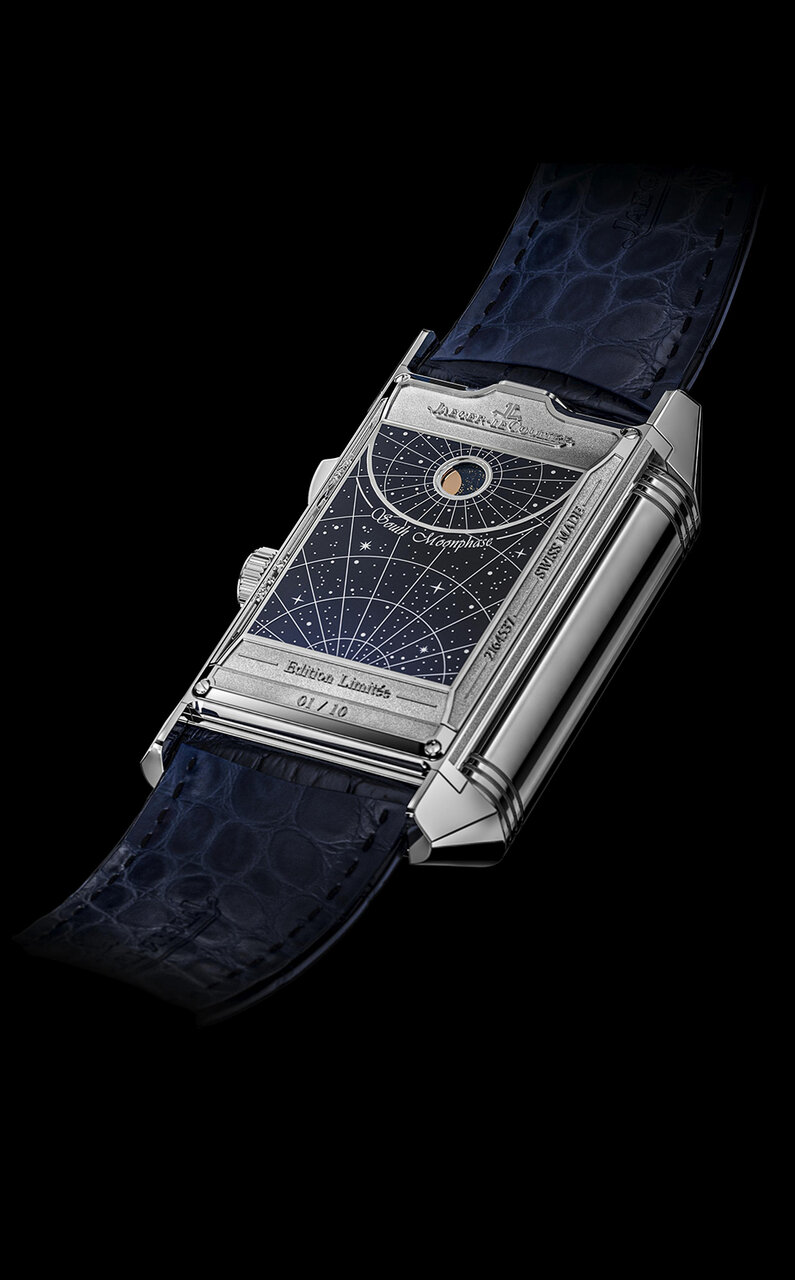
And, of course, the ultimate feature of this watch is its four dials. While the 2006 Reverso Hybris Mechanica Triptyque featured a third dial inside the cradle, this piece represents a further leap in technical innovation by incorporating a fourth dial on the exterior of the cradle, displaying the Southern Hemisphere's moon phase. Most moon phases are depicted from the Northern Hemisphere, but this embodies the duality that forms the foundation of the Reverso. The components, adorned with pink gold moons and stars and finished with engraved and lacquered blue gradients, were all crafted by Jaeger-LeCoultre's Métiers Rares® workshop.
Every day at midnight, these four dials synchronize. A lever extends from the main case's movement, activating a collector within the cradle, which synchronizes the cradle's displays. The mechanism driving these is mounted directly onto the cradle itself, without requiring additional parts that would increase thickness. This exceptional expertise in ultra-miniaturized watchmaking by Jaeger-LeCoultre results in one of the most wearable high-complication watches, despite its multiple displays and complex mechanisms.
This timepiece also comes with a dedicated presentation box equipped with a mechanism that allows for the immediate setting of all calendar and astronomical displays, even after periods of non-use. A two-position crown on the side of the box is first used to set the number of days that have passed since the watch was last worn. Once the watch is placed in its setting support frame, the box's setting crown can be pulled out to a second position, allowing for rapid adjustment of all calendar and astronomical displays to the current date. The entire process is controlled by the setting mechanism, eliminating any concerns about over-correction, under-correction, or damage to the movement.
The development of this piece is the result of six years of research, built upon 188 years of expertise accumulated by the Manufacture. The Reverso Hybris Mechanica Calibre 185 stands as a testament to Jaeger-LeCoultre's mastery at the pinnacle of mechanical watchmaking, while continuously pushing the boundaries of horological knowledge.
Reverso Hybris Mechanica Calibre 185
- Ref. | Q7103420
- Movement | Manual-winding (Jaeger-LeCoultre Calibre 185)
- Power Reserve | 50 hours
- Case Material | 18K White Gold
- Case Size | 51.2 x 31 x 15 mm
- Functions | Face 1: Hours, minutes, tourbillon (seconds display), instant perpetual calendar, grand date, day, month, leap year, day/night indicator. Face 2: Digital jumping hours, minutes, minute repeater (with system to prevent dead time). Face 3: Northern Hemisphere moon phase, nodal month (lunar position), anomalistic month (apogee and perigee), month, year. Face 4: Southern Hemisphere moon phase.
- Strap Material | Alligator leather
- Water Resistance | 3 bar
- Price | 1.35 million Euros
- Limited Edition | 10 pieces