Oris's Popular Rectangular Series Finally Returns | ORIS
ORIS
The Popular Rectangular Series is Finally Back
High Value-for-Money Watch with Moon Phase, Day, Date, and GMT Functions
It was about four to five years ago that Oris's popular rectangular case, also favored for couples' watches, was discontinued. Since then, except for the Bob Dylan Limited Edition announced in 2009, Oris's catalog only featured round models. However, the long-awaited rectangular model has made a comeback, and deliveries have begun.
Photographs & Text by parametric
Enjoying the Moon Phase
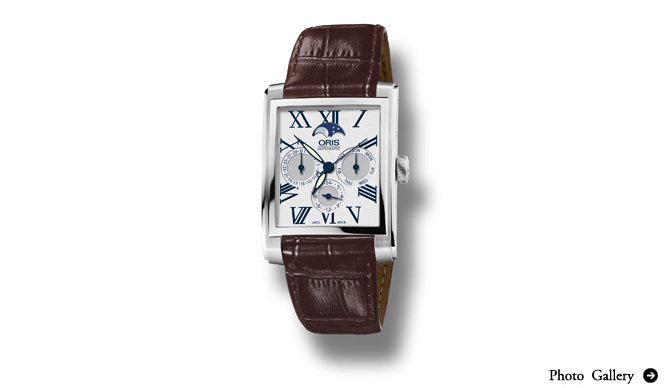
The case shape is a classic rectangle. It is thinner than previous rectangular models. The indices have an Art Deco feel. This allows for a balanced dial, even though a smaller movement is used relative to the case size, preventing wasted space. The overall dial composition is harmonious.
The models featuring this case come in two types: the "Rectangular Date" with three hands, and the "Rectangular Complication" equipped with moon phase and calendar functions. The model introduced here is the "Rectangular Complication."
A watch should be enjoyable to wear on the wrist. While there are many options, a watch with a comprehensive calendar is surely a top contender.
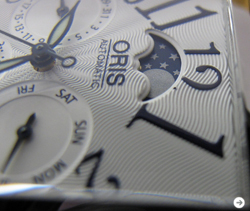
Guilloché dial. The moon has no face. The dot in the moon phase window (around the 21st day of the lunar cycle) is not a blemish but part of the '12'.
The day and date are important elements related to time and are essential functions for a watch. The moon phase is also a significant aspect related to time. While it may not serve any practical purpose in modern society, so detached from lunar calendars, this mechanism brings joy to the owner.
The joy of looking up at the night sky and seeing the moon in the same shape is exceptional. It's also fascinating to imagine the positional relationship between the sun, Earth, and moon in your mind. As the name "Complication" suggests (though the naming might feel a bit unusual), it features moon phase, day, date, and GMT functions.
Ideally, it would have a month display as well, but that might be asking too much at this price point. For a price under 200,000 yen, the number of functions offered is more than sufficient. After all, the "Rectangular Complication" is a mechanical watch, not a quartz timepiece. It would be an ideal watch for those new to moon phases.
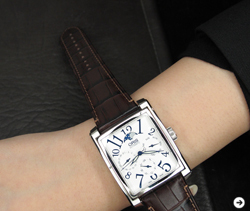
The model with Arabic numerals for indices is Ref. 581 7658 4061D. It is thinner than previous rectangular models. The large crown not only enhances the design but also contributes to ease of operation.
Beginners to moon phases will likely be puzzled by how to adjust (set) the moon phase. The lunar day found in newspapers or online often has a non-zero digit in the first decimal place. How do you set that onto the moon phase disk...?
The moon phase is called 'getsu-shō' in Japanese. It refers to the visual appearance of the moon, such as new moon, full moon, or half moon. However, the moon phase function on a watch displays the lunar day. Lunar day refers to the number of days elapsed since the new moon (朔), with the new moon being day 0.
Since the moon's orbital period is not constant, the moon phase and lunar day are not identical. Lunar day is calculated based on the number of days elapsed since the new moon, using noon as a reference. Therefore, unless the new moon occurs precisely at noon, there will be a fractional part.
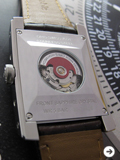
The movement is Oris 581, based on the ETA 2688/2671. The red rotor, Oris's symbol, is visible through the see-through case back.

Mikié Okuno of Europassion, who is eyeing this Rectangular Day-Date next, notes that the size is suitable even for women.
Furthermore, the watch's moon phase function accumulates an error of about one lunar day every 2 years and 8 months (though some moon phases have an error of one day over 122 years). This is not an error like daily or monthly deviation, but an inherent error known from the design stage. The synodic month, the average period from one new moon to the next (not the orbital period), is 29.5305... days, but since it's designed with 29.5 days, the error is unavoidable.
Although this may seem a bit complicated, the point is that a rough adjustment of the moon phase is sufficient. After all, whether an accurate lunar day can be set depends on the synodic month (when the decimal part is zero), and the watch will accumulate an error of one day within a few years. Moreover, it's unlikely that one would keep the same watch running continuously for several years without stopping it. This means it will need to be reset. If the stopped period is only one or two days, you can adjust it by turning the hour hand with the crown, but for longer periods, you'll need to use the push-piece. Will you reset everything, or will you use it by "correcting only the time"...?
Please note that the calendar mechanism is neither perpetual nor annual, so adjustments are necessary when transitioning to months with 31 days.
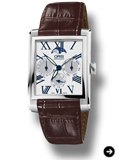
The model with Roman numerals for indices.
The strap is embossed calf leather.
If replaced with genuine alligator,
it should gain a significantly more luxurious feel.
Ref. 581 7658 4071D
Price | ¥184,800
SS Case
Automatic
46×33mm
5 ATM Water Resistant
Europassion
Tel. 03-5295-0411
http://www.europassion.co.jp/