March 26, 2015
SEIKO: Crystallizing 130 years of history, technology, and passion for watchmaking, Japan's first minute repeater arrives with perfect timing.
SEIKO
130 Years of History and Craftsmanship, a Crystallization of Passion for Watchmaking
Japan's First Minute Repeater Makes Its Grand Debut
Founded in 1881 (Meiji 14) as Hattori Watch Store. Since manufacturing the first Japanese-made wall clock in 1892 (Meiji 25) as Seikosha, a pocket watch in 1895 (Meiji 28), and the first Japanese-made wristwatch, the "Laurel," in 1913 (Taisho 2), Seiko has consistently reigned as Japan's No. 1 wristwatch brand. Now, they present an ultimate minute repeater, a crystallization of the craftsmanship of watchmakers and cutting-edge technology.
Reporting and Writing by Yasuto Shibuya
The Pinnacle of "Japanese Complication" Finally Arrives
Beyond the quartz wristwatch, launched ahead of the world in 1969, Seiko's technological prowess has always been one step ahead of the world, earning high praise and respect from the Swiss watch industry. This includes their world-class mechanical watch technology that rivaled and surpassed prestigious Swiss brands in the late 1960s, the "Kinetic" auto-relay technology, the world's first heat-powered watch technology "Thermo-ic," and the world's only "Spring Drive" technology, which combines the basic mechanics of a mechanical watch with a quartz regulator. It is also known among Swiss watch professionals that Seiko is one of the world's leading manufacture, possessing in-house development and manufacturing capabilities for all watch-related technologies, from the hairsprings and tiny gears of mechanical watches to the electronic circuits and quartz crystal oscillators that are the heart of quartz watches.
For those involved in watchmaking at this brand, which Japan proudly presents to the world, and especially for the watchmakers engaged in the planning, development, and manufacturing of high-end timepieces, the development and production of complex watches (complication models) – which have always occupied the pinnacle of the product lineup for venerable and prestigious Swiss brands – has been one of the greatest dreams of the past few decades. They have longed to challenge this uncharted territory, which requires craftsmanship and know-how far beyond the technology of mass-produced wristwatches.
And in 2006, this long-held aspiration was finally fulfilled by the hands of the watch technicians at Seiko Epson's Shiojiri Plant, Micro Artist Studio, who have been honored with the "Yellow Ribbon Medal" and recognized as "Contemporary Master Craftsmen." This marked the birth of the "Credor Node Spring Drive Sonnerie," the first Japanese complication model, which combines Seiko's unique Spring Drive movement with a sonnerie mechanism that chimes the hours. It was a groundbreaking event, signaling that Japanese watchmaking technology had reached an unprecedented height and entered a new dimension.
However, they were not content with this success. They challenged themselves further, aiming for the pinnacle of complex watchmaking: a minute repeater mechanism that indicates the time through sound, and they have finally succeeded in commercializing it.
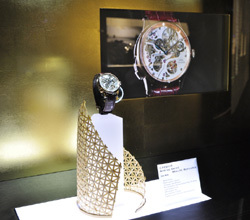
Unique Japanese Technology and Delicate Aesthetics Beautifully Crystallized
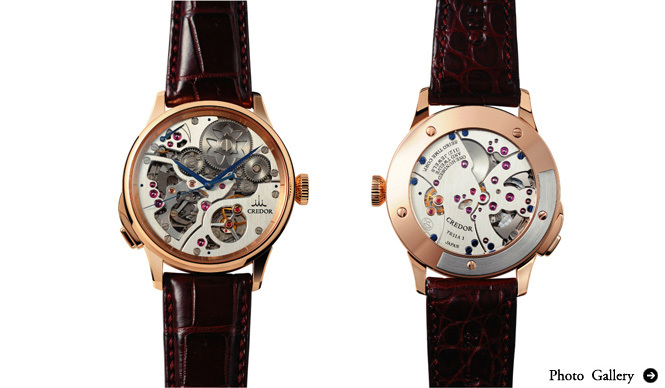
This first Japanese-made minute repeater model, the "Credor Node Spring Drive Minute Repeater," released as a 130th-anniversary model, is not only powered by Seiko's unique Spring Drive movement – which operates on the power of a mainspring and is regulated by a quartz circuit – but also boasts numerous features not found in Swiss minute repeaters.
One such feature is the adoption of a "decimal" system for indicating the time, which is easy for anyone to understand. While Swiss minute repeaters use a combination of complex tones for 15-minute intervals and single tones for individual minutes, this model strikes complex tones for 10-minute intervals. For example, to indicate 1:59, it will strike the hour once for the hour, five times for the 10-minute intervals, and nine times for the individual minutes.
Another significant feature is the use of iron forged using the traditional techniques of "Myochin Hibashi," a traditional craft from Himeji City, Hyogo Prefecture, known for its beautiful wind chimes and gongs that produce sound when struck. This results in a uniquely crisp and clear Japanese tone. We hope that the readers of OPENERS will savor the exquisite sounds and remarkable mechanisms of this magnificent complication watch.
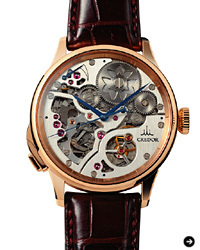
Seiko Credor Node Spring Drive Minute Repeater
The Pinnacle of Japanese Complication Watches, Condensing the History of Japanese Watchmaking
To achieve a clear and beautiful tone for time indication, a unique minute repeater regulator that uses air viscosity for regulation, eliminating mechanical contact noise, has been adopted. Furthermore, the case shape and material were determined through advanced technical analysis, showcasing a Made in Japan minute repeater wristwatch completed with an abundance of cutting-edge technology alongside the craftsmanship of watchmakers. Thoughtful details for user-friendliness include a double-layered case structure to enhance water resistance by preventing moisture from entering the movement, and a safety mechanism that prevents simultaneous operation of the crown and the minute repeater. The total number of parts exceeds 660. The planned annual production is 3 units.
Hand-wound, 42.8mm pink gold case, crocodile strap, ¥34,650,000. Scheduled for release in late December.
Seiko Watch Corporation Customer Service Center
0120-061-012