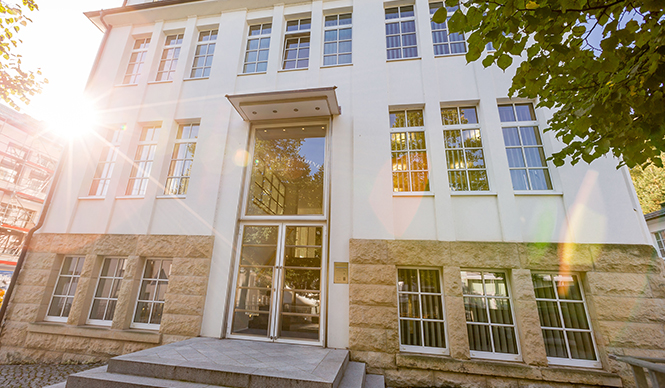
Feature | Experiencing Watchmaking at the A. Lange & Söhne Headquarters | A.LANGE&SÖHNE
A.LANGE&SÖHNE | A. Lange & Söhne
Germany's Solitary Brand: Its "Commitment"
Why Do Watch Enthusiasts Admire Lange?
The Truth Behind A. Lange & Söhne's Appeal (1)
Among the many luxury watch brands, only a select few are truly recognized as special by watch professionals. A. Lange & Söhne of Germany is one of those rare brands. Their approach to watchmaking involves a distinct "commitment" that differs from Swiss brands. What exactly is this commitment? We experienced it firsthand at a special seminar for industry professionals, the "Lange Academy."
Text by SHIBUYA YasuhitoPhotographs by BEN Gierig
What is the "Lange Academy" Special Seminar?
The "Lange Academy" is an exclusive, small-group seminar designed to explain the essence of A. Lange & Söhne's watchmaking to staff at authorized retailers and journalists. The program includes not only product knowledge but also hands-on experience with parts of the manufacturing process, allowing participants to truly feel the unique characteristics and appeal of their timepieces. Five journalists and editors from the UK, Italy, Mexico, China, and Japan participated in the Lange Academy I attended in September 2014.
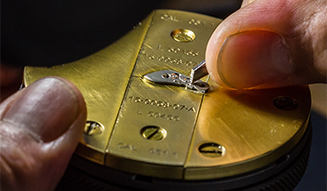
Engraving on the balance cock, performed by hand. The small size of the part is evident when compared to a finger.

The engraving work is done while looking through a stereoscopic microscope. The graver is skillfully moved with force to engrave.
A Commitment to "Artistic Craftsmanship"
In the world of mechanical watchmaking, the scope of what can be called craftsmanship has been diminishing year by year, except for a few ultra-high-end models. Even for luxury watches exceeding one million yen, the work requiring skilled craftsmanship is limited to a small part of the entire process, such as movement assembly, finishing, and precision adjustment. It is rare, except for skeleton models, for the entire design and finish to be entrusted to the craftsman's sensibility and skill. However, A. Lange & Söhne fully incorporates this artistic craftsmanship into its standard models, starting with the "Lange 1," which celebrated its 20th anniversary.
One example is the engraving on the "balance cock," which securely fixes the balance wheel with a swan-neck regulator to the mainplate, a characteristic feature of Lange's mechanisms. While there is a basic pattern, the detailed execution of the pattern is entirely left to the craftsman responsible for the work, who uses a chisel held in their palm to engrave the metal surface of the balance cock with the tip of the blade freehand. Even for a skilled artisan, this process takes considerable time, and the pattern and finish will vary subtly even when done by the same craftsman. Strictly speaking, no two are exactly alike.
Although all models are expensive, with prices exceeding one million yen, incorporating such labor-intensive elements into standard models and maintaining them unchanged for 20 years is unusual in the luxury watch industry, which has increasingly focused on efficiency in recent years, with the exception of high-end models.
Experiencing Decoration of Internal Mechanisms
At the Lange Academy, we actually experienced this engraving on the balance cock under the guidance of a skilled craftsman. We held the part, cut to the shape of the balance cock, in a holder, and after carefully finishing the edges with an electric grinder held in the other hand, we fixed the part and engraved the pattern as the craftsman did, with the tip of the chisel applied. The material is harder than regular brass (described later), making each engraving a struggle. It is said that at least two to three years of training are required to become proficient in this engraving.
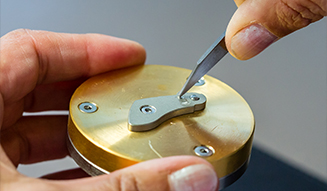
Holding the chisel firmly, the pattern is carved while rotating the balance cock fixed to the baseplate.
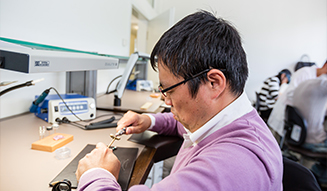
Assembling a watch yourself reveals just how intricate the work of a watchmaker is in such a short time.
A.LANGE&SÖHNE | A. Lange & Söhne
Germany's Solitary Brand: Its "Commitment"
Why Do Watch Enthusiasts Admire Lange?
The Truth Behind A. Lange & Söhne's Appeal (2)
A Commitment to "German Silver"
In today's watchmaking world, except for a very small number of special brands and models, the standard material for the mainplate and bridges (which fix parts) of mechanical watch movements has long been brass, an alloy of copper and zinc. This is due to its excellent properties: moderate hardness, ease of processing, a gold-like luster, and resistance to rust.
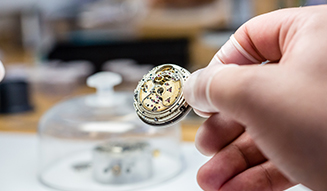
A complication model during final assembly. This balance cock also features delicate engraving.
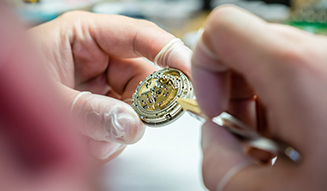
Final assembly with adjustments in progress. The watchmaker is always wearing rubber finger cots.
However, A. Lange & Söhne uses German silver (also known as nickel silver, though it contains no actual silver; the name comes from its silver-like luster) for its movement mainplates, a material harder than brass. This offers superior strength due to its hardness and possesses a beautiful silvery-white luster. Unlike brass, it slowly develops a golden oxide layer over time, creating a unique patina.
This, however, increases material costs and makes processing more difficult due to its hardness. Furthermore, unlike brass, its surface is prone to oxidation, so direct contact with bare hands must be avoided during work. This means that rubber finger cots must always be worn. Nevertheless, Lange is committed to the beautiful luster and rich patina of German silver.
Craftsmen's Constraints for a Beautiful Finish
Our assembly experience at the Lange Academy also began with wearing rubber finger cots on all fingers, just like the craftsmen. As the working time extended, the lack of breathability in the rubber naturally led to a feeling of discomfort in the fingertips. It made me realize how challenging it must be to perform precision work like this for extended periods.
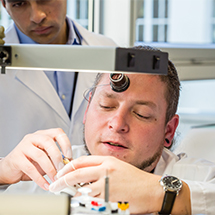
From the perspective of a watchmaker assembling complex timepieces, one can feel their passion for watches.
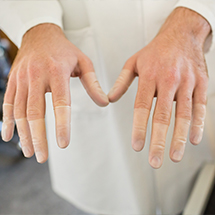
The watchmaker wears finger cots on all ten fingers. This is also a practice unique to Lange's workshops.
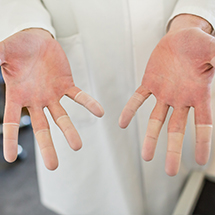
Performing delicate work while wearing finger cots is extremely difficult. It is a consideration by the craftsmen to produce the highest quality products.
A.LANGE&SÖHNE | A. Lange & Söhne
Germany's Solitary Brand: Its "Commitment"
Why Do Watch Enthusiasts Admire Lange?
The Truth Behind A. Lange & Söhne's Appeal (3)
A Commitment to "Assembling the Same Part Twice"
Assembling a mechanical movement, even a simple one, requires more than a dozen steps and is a time-consuming and labor-intensive process, thus costly. For complex watches with hundreds of parts, the number of steps increases accordingly, and highly skilled technicians are required. Therefore, the method of partially assembling key components to check if the movement functions correctly, then disassembling it again, decorating and finishing those parts, and finally reassembling it – known as "double assembly" – is typically reserved only for complex movements. For standard movements, functional checks are usually performed after the initial assembly.
However, A. Lange & Söhne employs this time-consuming, labor-intensive, and costly "double assembly" process for all its movements, including standard ones. This reflects a German commitment to mechanical perfection and a German value system that prioritizes the complete functionality of the mechanism above all else. This value, distinct from the Swiss approach, is the primary reason why A. Lange & Söhne watches captivate the hearts of mechanical enthusiasts.
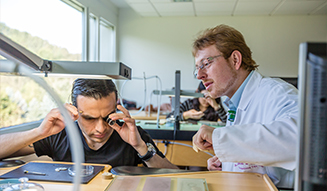
The assembly process is guided by an instructor from the Lange Watchmaking School, who is also a master watchmaker.
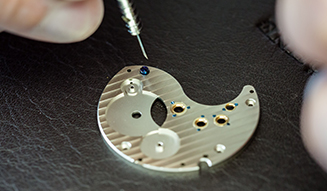
Blue steel screws are set into the mainplate after decoration. This is surprisingly difficult.
Witnessing the "Double Assembly" Process, a Truly Astonishing Experience
The movement assembly experience at this Lange Academy involved actually performing the "double assembly" process. In line with the tradition of the pocket watch era, A. Lange & Söhne's movements feature jewel bearings made of synthetic ruby secured by gold chatons.
The task involved removing the chatons, secured by small blue steel screws, from a partially assembled movement with an undecorated mainplate. These were then placed on a soft wooden block. Using four types of sandpaper with varying grits attached to a glass plate, they were polished to a shine before being reattached to the mainplate, which had already undergone finishing with Geneva stripes.
Simply removing the minuscule screws, which are less than 1mm in diameter and could easily be lost if one exhales too strongly, and which would be missed without a loupe, was a challenge in itself, requiring great care not to scratch the screw heads or the mainplate. Grasping the meticulously polished chatons with tweezers without damaging their polished surfaces and setting them in the precise position on the mainplate was difficult. Furthermore, when securing them with screws, it required extreme caution not to scratch the chatons while ensuring the screws were set perfectly vertically into the screw holes. Frankly, I was exhausted just from removing the screws and chatons from the original mainplate.
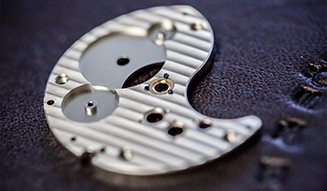
The screws securing the gold chatons are less than 1mm in diameter. Finding and gripping them is difficult.
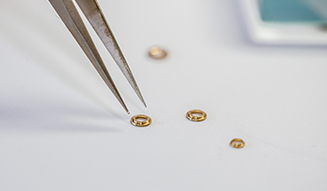
Gold chatons for securing the jewel bearings. This is also part of Lange's unique approach.
A.LANGE&SÖHNE | A. Lange & Söhne
Germany's Solitary Brand: Its "Commitment"
Why Do Watch Enthusiasts Admire Lange?
The Truth Behind A. Lange & Söhne's Appeal (4)
Rust-Resistant Parts: "Blue Steel Screws"
Blue steel screws, which are made rust-resistant by heat treatment that creates a blue oxide layer on the surface, also provide a visually appealing accent to the movement. They have long been used in the movements of high-end watches. A. Lange & Söhne also employs these blue steel screws in its movements. However, the color subtly changes depending on the heat treatment temperature. Starting with a light yellow at 200°C, it turns purple at 260°C.
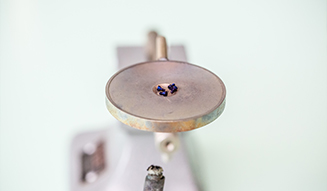
We also experienced the creation of blue steel screws. They are made by heating the screws with an alcohol lamp like this.
Continuing past blue, it finally reaches a cherry-like red at temperatures above 770°C. Lange's blue steel screws are heat-treated at 300°C, achieving the most attractive blue hue known as cornflower blue.
At the Lange Academy, we experienced firsthand how delicate the heat treatment of these blue steel screws is by attempting the process ourselves using an alcohol lamp. Just when you think it's ready, the temperature rises too high, and it passes through the blue stage. I was once again impressed by the meticulous attention to detail, even for such small screws.
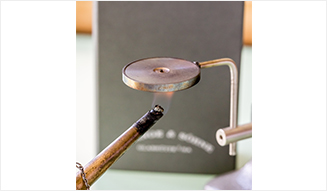
While heating, the color of the screw changes moment by moment, so you cannot look away.
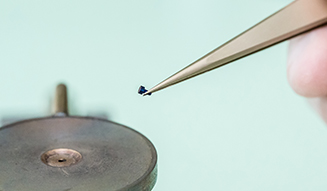
Checking the color of the heated screw. The orientation is changed occasionally to ensure even heating.