March 31, 2015
Audemars Piguet | Jules Audemars Equation of Time
AUDEMARS PIGUET
Jules Audemars Equation of Time
Jules Audemars Equation of Time
Text by OPENERS
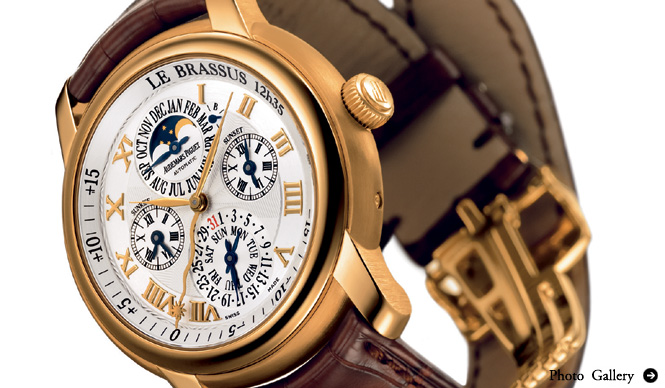
This is a classical round watch collection named after Jules Audemars, one of the founders of Audemars Piguet. Among them, the "Equation of Time" is an exquisite complication watch that captures the extremely complex celestial movements on a dial of only 43mm in diameter.
The "Equation of Time" translates to "Kinji-sa" in Japanese. In our daily lives, we define a day as the period from when the sun reaches its highest point in the sky (solar noon) until the next solar noon. We then divide this day into 24 hours. However, the actual time it takes for the sun to complete one circuit of the sky varies by approximately -16 minutes to +14 minutes throughout the year. The time calculated from the actual movement of the sun is called "true solar time," while the time conventionally set as 1 day = 24 hours is called "mean solar time." The equation of time is the time difference between these two solar times. In this model, the equation of time can be displayed using a golden hand shaped like the sun.
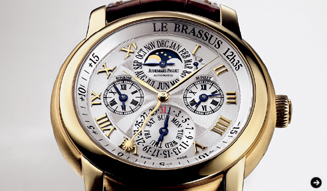
Furthermore, pay attention to the two subdials at the 9 and 3 o'clock positions. Here, hour and minute dials labeled "Sunrise" and "Sunset" are arranged, allowing you to check the times of sunrise and sunset throughout the year. At the 6 o'clock position, there is an analog display for the "Date" and "Day of the week." At the 12 o'clock position, you can see the "Month" for all 12 months, and next to it, a "Leap Year" indicator that counts every four years. Additionally, it is programmed as a "Perpetual Calendar," meaning that date corrections are theoretically unnecessary for about 100 years.
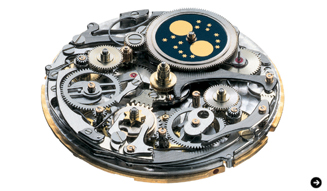
In addition, a "Moon Phase" display showing the waxing and waning of the moon is laid out at the 12 o'clock position. In this watch, the moon phase display is exceptionally precise, so much so that it is specially called the "Astronomical Moon." By increasing the pitch of the gears controlling the moon's movement from the usual 59 teeth to 135 teeth, the need for moon phase correction, which would normally occur every 2 years and 7 months, has been extended to a cycle of approximately once every 120 years.
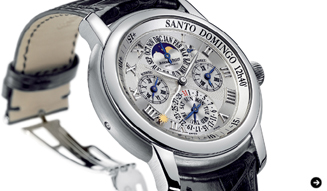
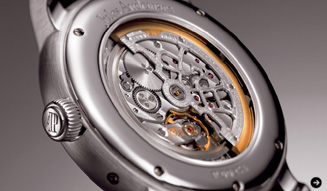
This is truly a romantic celestial clock, encapsulating the movements of the heavens on its dial. Moreover, despite being such a complex timepiece, the movement's thickness is kept to a mere 5.35mm, achieving an elegant and slim case profile. The case material can be chosen from 18K yellow gold, 18K pink gold, or 18K white gold, and the dial designs, matched to each material, are exceptionally classical, reminiscent of Audemars Piguet pocket watches from the early 20th century. Of course, since the equation of time and sunrise/sunset displays vary depending on the owner's longitude and latitude, some degree of customization is possible. In the photograph, names such as Le Brassus in Switzerland are engraved on the flange of the dial, but if tuned to, for example, Akashi City in Japan, it would be inscribed as "AKASHI."
would be inscribed as "AKASHI."
Self-winding. 19,800 vibrations per hour. 40-hour power reserve. 43mm case diameter. 18K yellow gold case. Crocodile strap. 20m water resistance. ¥8,925,000.
18K pink gold case. ¥8,925,000.
18K white gold case. ¥9,135,000.