March 18, 2015
PATEK PHILIPPE | World Time 5130
PATEK PHILIPPE
5130 World Time
Text by OPENERS
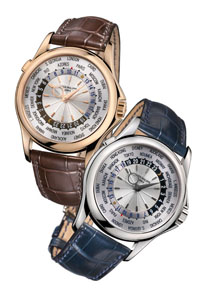
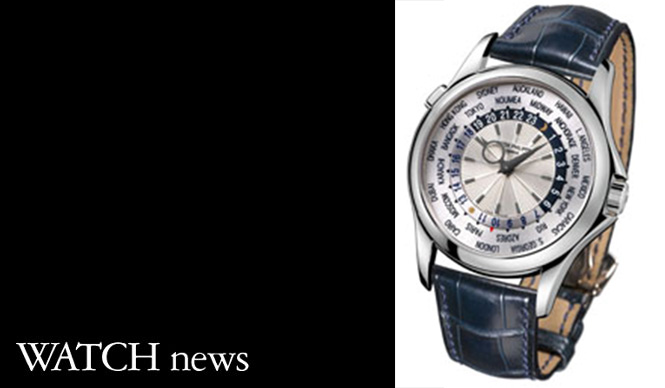
Do you know of a watch that was once traded for the highest price in history? It was a wristwatch that sold for approximately 500 million yen at an overseas auction in 2002, a 1939 "World Time" by Patek Philippe. The "World Time" of that era featured city names engraved on a rotating bezel, and a 24-hour disc on the outer edge of the dial rotated counter-clockwise to display the time in various cities around the world. It adopted a ring-shaped hour hand, inspired by a globe, and an enamel dial depicting a world map. It is a rare masterpiece with a classical face.
The "5130 World Time" is the descendant of that rare masterpiece. It succeeded the previous "5111 World Time" and was introduced in 2006. It is often regarded today as the most user-friendly world timer. Its ease of operation is thanks to a mechanism patented in 1959. Let's assume that it is currently 6 o'clock in Tokyo and 22:00 in Paris. The hour hand on the main dial shows 6 o'clock, the city name ring on the outer edge of the dial has Tokyo at the 12 o'clock position, and the 24-hour ring inside it shows 6 below the Tokyo marking. To adjust it to Paris local time, it is remarkably simple: just press the crown at the 11 o'clock position.
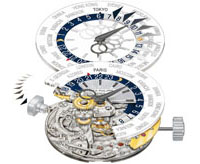
The city name ring and the 24-hour ring rotate, and you simply keep pressing until the Paris marking reaches the 12 o'clock position. At the same time, 22 on the 24-hour display ring will align below Paris. With a conventional world timer, you would need to adjust the hour hand at this point, but this is not necessary with Patek Philippe's "World Time." The hour hand moves in conjunction with the rotation of the two rings. Adjusting the time on the main dial is also done automatically.
The "5130" inherits this world time function, which allows all time displays to be adjusted with a single touch, and features a slightly larger case than its predecessor, the "5111," to enhance legibility.
And, like the 1930s masterpiece that sold for approximately 500 million yen, it is equipped with a ring-shaped hour hand, evoking its past. The slim case side, under 10mm despite being a semi-complication, is also noteworthy. It is a superb creation that embodies Patek Philippe's philosophy of always striving for evolution while respecting tradition.
Automatic winding. 21,600 vibrations per hour. 48-hour power reserve. Case diameter 39.5mm. Case thickness 9.4mm. Alligator strap. 3 ATM water resistance. 3,759,000 yen (18K WG or RG case), 5,229,000 yen (Pt case).
BRAND HISTORY
Patek Philippe, an exceptional brand that has reigned at the pinnacle of the watchmaking world since the mid-19th century. Revered by watch enthusiasts as the ultimate height they aspire to, this world's foremost watch brand was founded by two individuals passionate about timepieces.
The foundation was first laid by Antoine de Patek, an exiled nobleman from Poland. He fled his homeland, Poland, which was under the oppression of the Russian Empire, to Geneva, the heart of the Swiss watch industry. There, he became interested in the local watchmaking industry, and through his encounter with watchmaker François Czapek, he established a watch company in 1839.
The company steadily grew, but Antoine de Patek sought further possibilities in watch manufacturing. Around that time, he visited a World Exposition held in Paris, France, and was greatly impressed by the world's first pocket watch with a crown-winding mechanism.
The watchmaker who created this timepiece was Jean-Adrien Philippe. Antoine de Patek brought him in to succeed François Czapek. The encounter between these two men led to the development of new mechanisms such as the "mean time" in '46 and the "free-sprung balance" in '48. Then, in 1851, the year they won a gold medal at the London Exposition, the company name was changed to the current "Patek Philippe."
Subsequently, Patek Philippe actively pursued complex mechanisms, developing the first perpetual calendar mechanism in '89. Notably, the "Graves Supercomplication" of 1927 earned high acclaim as a historic complication watch equipped with 24 complex mechanisms. Furthermore, in 1932, they introduced the Calatrava, which is still regarded today as the benchmark for dress watches. They established a solid position in the field of wristwatches as well.
Having thus taken a leading role in the watchmaking world, Patek Philippe continues to produce numerous masterpieces, from simple watches to complications, even in the 21st century. While preserving traditional techniques to pass on the heritage of Swiss watchmaking to future generations, they also actively challenge themselves to develop new technologies and materials to forge new possibilities.
Year of Establishment: 1839
Place of Establishment: Geneva, Switzerland
Main Series Names: Calatrava, Gondolo, Grand Complications, Nautilus
Contact: Patek Philippe Japan Information Center 03-3255-8109
Official Website: http://www.patek.com/