
March 3, 2015
PATEK PHILIPPE | Annual Calendar Chronograph 5960P
PATEK PHILIPPE
Annual Calendar Chronograph 5960P
Text by OPENERS
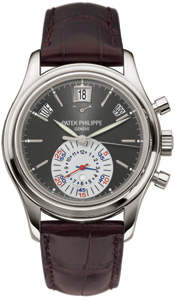
Masterpieces Underpinned by Unrivaled Technical Prowess
Patek Philippe's reputation as the world's finest is not solely due to its history and status. It is a manufacture that handles everything from watch development to production in-house, and its true technical strength is evidenced by numerous sublime complications and over 70 patents.
In 2005, the company succeeded in fully in-house production of the chronograph, a mechanism notoriously difficult to develop. The following year, in 2006, it unveiled the "5690P," a self-winding chronograph developed in-house.
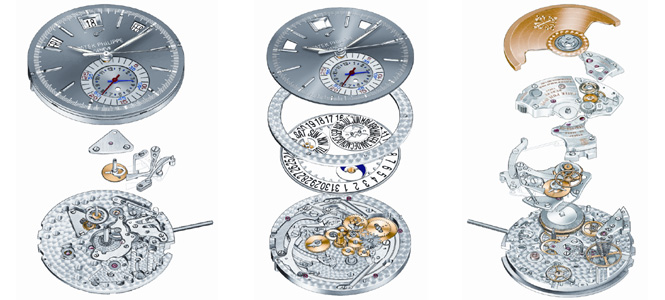
The "5960P" features not only a chronograph but also an annual calendar mechanism. This mechanism, also known as the Annual Calendar, eliminates the need for calendar adjustments except on March 1st in a leap year. It is a highly complex mechanism for a semi-complication and is one of the company's signature practical complications, for which it holds a patent.
Furthermore, the 30-minute and 12-hour totalizers, crucial for the chronograph's timing function, are concentrically arranged at the 6 o'clock position. Integrating the annual calendar mechanism inevitably leads to increased complexity on the dial side.
The chronograph's start-stop mechanism employs a vertical clutch system. In a conventional chronograph, the chronograph runner is connected to and disconnected from the chronograph intermediate wheel horizontally. In this mechanism, however, the clutch disc, which serves as the power source, is pressed against and released from the chronograph runner vertically to control the chronograph's on and off states.
This face-to-face clutch engagement prevents jumping of the hands and reduces wear, offering significant advantages. This is another of the innovative chronograph mechanisms that only a handful of manufactures have managed to achieve.
Self-winding. 28,800 vibrations per hour. 55-hour power reserve. Case diameter 40.5mm. Case thickness 13.55mm. Platinum case. Alligator strap. 2.5 bar water resistance. ¥7,539,000.
BRAND HISTORY
Patek Philippe, an exceptional brand that has reigned at the pinnacle of the watchmaking world since the mid-19th century. Revered by watch enthusiasts as the ultimate destination, this world-leading watch brand was founded by two individuals passionate about timepieces.
The initial foundation was laid by Antoine de Patek, an exiled nobleman from Poland. He fled his homeland, then under Tsarist Russian oppression, to Geneva, the heart of the Swiss watch industry. There, he became interested in the local watchmaking trade, and through his encounter with watchmaker François Czapek, he established a watch company in 1839.
The company steadily grew, but Antoine de Patek sought further possibilities in watch manufacturing. Around this time, he visited the Universal Exposition in Paris, France, and was profoundly impressed by the world's first pocket watch with a winding crown.
The watchmaker behind this innovation was Jean-Adrien Philippe. Antoine de Patek invited him to join the company, succeeding François Czapek. This partnership led to the development of new mechanisms such as the 'split-seconds' in '46 and 'free-sprung balance' in '48. In 1851, the year they won a gold medal at the London Exposition, the company changed its name to the current "Patek Philippe."
Subsequently, Patek Philippe actively pursued complex mechanisms, developing its first perpetual calendar in '89. Notably, the "Graves Supercomplication" of 1927 earned high acclaim as a historic complication watch featuring 24 complex functions. Furthermore, in 1932, they introduced the Calatrava, still regarded today as the benchmark for dress watches, solidifying their position in the realm of wristwatches.
Having thus established itself as a leader in the watchmaking world, Patek Philippe continues to produce numerous masterpieces, from simple watches to complex timepieces, even in the 21st century. While preserving traditional techniques to pass on the heritage of Swiss watchmaking to future generations, the company also actively challenges itself by developing new technologies and materials to forge new possibilities.
Founding Year: 1839
Place of Founding: Geneva, Switzerland
Main Collection Names: Calatrava, Gondolo, Grand Complications, Nautilus
Inquiries: Patek Philippe Japan Information Center 03-3255-8109
Official Website: http://www.patek.com/