March 3, 2015
JUNGHANS | MEGA 1000
JUNGHANS
MEGA 1000
Text by OPENERS
An Evolution of the World's First Radio-Controlled Watch, MEGA 1, Arrives
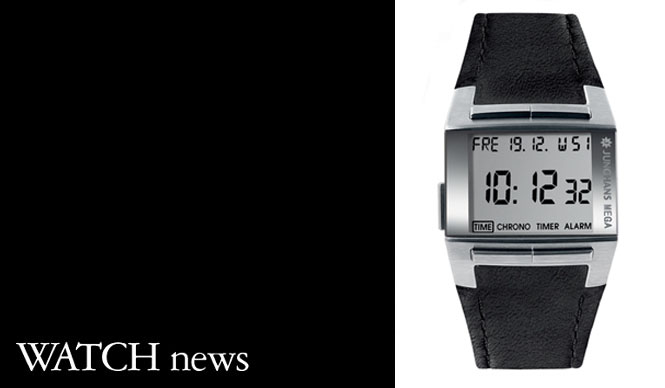
This digital multi-function radio-controlled watch, released in 2005, carries on the lineage of the world's first radio-controlled watch, the MEGA 1.
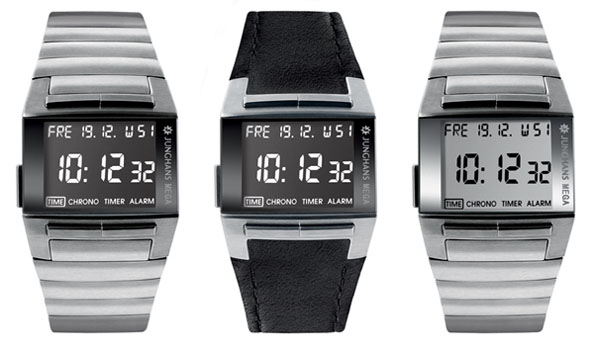
It features a digital display for time and various functions, illuminated by a blue backlight. The striking design, enhanced by the stainless steel case, is a stylish selling point that enlivens the MEGA 1000.
Pressing the smartly designed buttons reveals not only the time but also the date, day of the week, calendar, year, and number of radio signal receptions. Additionally, it includes a stopwatch (with a rattrapante function) and an alarm, making it a versatile timepiece suitable for everything from business to casual wear.
Quartz. Case diameter 38.0mm. Stainless steel case & bracelet. 5 ATM water resistance. ¥61,950 (leather strap). ¥70,350 (stainless steel bracelet).
BRAND HISTORY
In the southwestern region of Germany, near the Swiss border, lies a deep forest stretching 160 kilometers north to south. Known as the Black Forest, or Schwarzwald, due to the dense fir trees that cast a perpetual shadow, this area has been a haven for skilled German artisans since the Middle Ages. It is a primary production center for cuckoo clocks, familiar in Japan, and today serves as a hub for Germany's precision machinery industry.
Junghans was founded in 1861 in Schramberg, a town at the heart of the Black Forest. While crafting traditional mechanical watches, the company also embraced cutting-edge technology, developing Germany's first quartz watch, the 'Astro-Chron,' in 1967. In 1972, Junghans was chosen as the official timekeeper for the Munich Olympics, solidifying its position as a leading German watch manufacturer.
Then, in 1985, Junghans unveiled the world's first radio-controlled table clock. Since then, driven by the pursuit of ultimate time accuracy, the company has relentlessly advanced radio-controlled watch technology. In 1986, they introduced the world's first solar-powered radio-controlled watch. This was followed by the development of the world's first analog radio-controlled watch movement in 1991, and the world's first radio-controlled watch movement with an integrated antenna in 1994.
Furthermore, Junghans shares a deep connection with the artist Max Bill, considered the last master of the Bauhaus movement. His designs were applied to wall and table clocks in the 1950s. The former is now part of the permanent collection at the Museum of Modern Art (MoMA) in New York, offering a fascinating glimpse into Junghans' artistic side. To this day, Max Bill clocks are manufactured by Junghans without any alteration to their simple, clear Bauhaus-inspired designs.
In 1999, Junghans began a new chapter under the umbrella of Egana Goldpfeil. Since 2007, a classical new brand bearing the name of its founder, Erhard Junghans, has also been developed.
Founding Year: 1861
Place of Founding: Schramberg, Germany
Main Series: MEGA, Worldtimer, Max Bill by Junghans
Inquiries: Egana Goldpfeil Japan, Watch Division, 03-5995-2806
Official Website: http://www.junghans.de/html/pages/index.htm
Domestic Site: http://www.eganagoldpfeiljapan.co.jp/junghans/