A. Lange & Söhne | A Visit to the Homeland of A. Lange & Söhne
A. LANGE & SÖHNE
The Revival of a World-Class Haute Horlogerie in Dresden, Germany
A Visit to the Homeland of A. Lange & Söhne
About an hour's drive from Dresden, a city in the easternmost part of Germany, lies Glashütte, a major watchmaking hub alongside Switzerland. Here is the manufacture of "A. Lange & Söhne," founded in 1845 by Ferdinand Adolph Lange. We delve into the roots of watchmaking at this prestigious brand, which has become one of the few true manufactories through its meticulous craftsmanship and unparalleled spirit of innovation.
Text by AKIZUKI Shinichiro (OPENERS)Photographs by courtesy of A. LANGE & SÖHNE / IKUO YAMASHITA
Treasures of Monarchs
This past May, I visited Dresden, the birthplace of "A. Lange & Söhne." The Elbe River divides the city center into the Old Town on the right bank and the New Town on the left. Along its banks stand masterpieces of Baroque architecture, such as the Zwinger Palace and the Semper Opera House, which represent Dresden. The somber, cold cityscape of the former East Germany has faded, and bright sunlight now strongly illuminates the buildings.
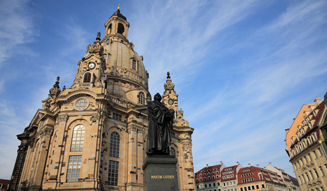
The Frauenkirche (Church of Our Lady), bombed by Allied forces during World War II, was rebuilt in 2005 by meticulously returning the rubble to its original positions. It once again stands as Dresden's symbol, watching over the city.
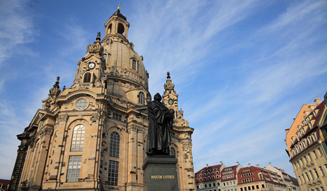
The Frauenkirche, rebuilt in 2005
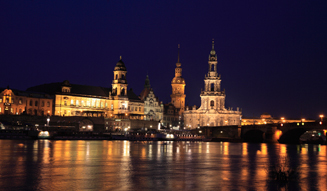
Dresden's night view. The Old Town is in the distance, with the Elbe River flowing in the foreground.
The foundation of this city was laid by the Kingdom of Saxony, which once flourished here. However, the history of "A. Lange & Söhne" began in 1845 when Ferdinand Adolph Lange, who had trained under Friedrich Gutkaes, a court watchmaker of the time, opened his own watchmaking workshop in Glashütte, a suburb of Dresden.
Before delving into its history, however, we need to understand more about the Kingdom of Saxony.
Five hundred years ago, in the 16th century, Elector Augustus of Saxony (1526-1586) possessed a collector's passion, typical of monarchs of his era. Augustus established a chamber to house his collections of paintings, weapons, jewelry, crafts, curiosities, and practical items. After his death, he instructed future monarchs to continue adding to this collection.
Notably, his collection included globes, celestial spheres, astronomical and geodetic instruments, and surveying equipment. In 1729, the "Mathematical-Physical Salon" was established on the second floor of the Zwinger Palace to house these artistic treasures.
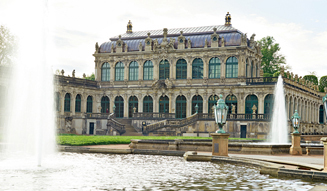
The Zwinger Palace, where the "Mathematical-Physical Salon" was established
This institution not only became a crucial development hub for high-precision timepieces under its later director, the astronomer and meteorologist Johann Gottfried Köhler, but it also brought about decisive advancements in timekeeping and heralded the dawn of a new industry for Dresden, one that would replace its declining silver mines. It goes without saying that this foundation laid the groundwork for the later birth of A. Lange & Söhne.
A. LANGE & SÖHNE
The Revival of a World-Class Haute Horlogerie in Dresden, Germany
A Visit to the Homeland of A. Lange & Söhne (Part 2)
The Relationship Between the Development of the Kingdom of Saxony and the Mathematical-Physical Salon
The Mathematical-Physical Salon, which has been revived after surviving numerous wars, is now housed in the Zwinger Palace, just as it was in its heyday, with the support of A. Lange & Söhne. It is the world's oldest collection room of scientific history, displaying exquisite pieces collected from the 16th to the 19th centuries by the Electors of Saxony, offering insights into the history of automata and timepieces since the Renaissance.
Among the collection's most prized possessions is the astronomical clock by Eberhard Baldewein (1525-1593). Crafted between 1563 and 1568, its case is made of brass with gold and silver plating. It is a work based on the geocentric model, where the Earth is the center of the universe, depicting the seven known planets revolving around the Earth.
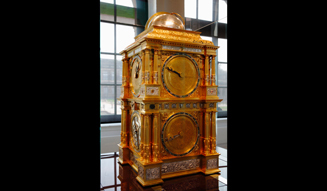
The astronomical clock by Eberhard Baldewein (1525-1593)
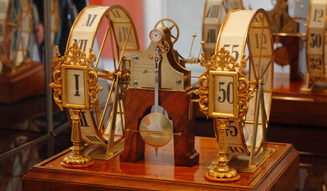
A 1/10 scale model of the "Semperoper Five-Minute Clock"
The "Semperoper Five-Minute Clock" is one of the crucial pieces in the history of A. Lange & Söhne. Conceived by Ferdinand Adolph Lange and his mentor Friedrich Gutkaes, a 1/10 scale model created in 1896 is exhibited at the Mathematical-Physical Salon. The original clock, once housed in the Semperoper, was lost long ago, but a rebuilt version based on the original blueprints is still in operation today.
Unfortunately, we were unable to enter the theater on the day of our visit due to opera rehearsals. However, we highly recommend it to anyone planning a trip to Dresden.
A. LANGE & SÖHNE
The Revival of a World-Class Haute Horlogerie in Dresden, Germany
A Visit to the Homeland of A. Lange & Söhne (Part 3)
The Reason It Is Called the Pinnacle of Watchmaking
Let us now return to the history of A. Lange & Söhne.
Seven years before its founding, in 1837, Adolph Lange embarked on a journey to Switzerland and France to hone his skills as a watchmaker under the tutelage of master craftsmen, after completing his apprenticeship with his mentor, Gutkaes. Lange's notebook, "Travelogue," meticulously documented the cutting-edge watchmaking techniques he acquired, including designs, mechanisms, and calculations. Based on this, A. Lange & Söhne developed its own innovations, and by the end of the 19th century, the town of Glashütte had rapidly grown into a watchmaking metropolis, rivaling Switzerland.
However, this progress was unfortunately interrupted by World War II. The dark era continued even after the war, and with the company nationalized as a state-owned enterprise in the former East German territory, the illustrious name of A. Lange & Söhne effectively disappeared from history.
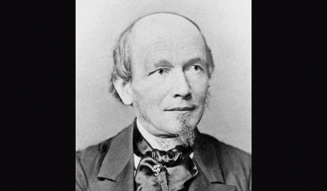
Adolph Lange, founder of A. Lange & Söhne
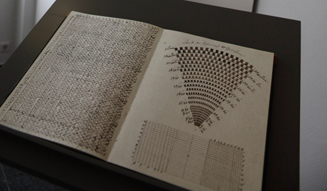
Lange's notebook, "Travelogue"
The End of the Cold War and History Moves Again
But in 1990, the year of German reunification, history began to move once more. Walter Lange, the great-grandson of the founder, revived the watchmaking traditions in his homeland. He poured the accumulated expertise and decorative techniques from the Kingdom of Saxony era, including the renowned 3/4 plate, which remains a celebrated traditional technique today, into wristwatches, successively releasing superb masterpieces such as the "Lange 1" and "Datograph."
At this year's "SIHH" luxury watch exhibition, they unveiled the new "Richard Lange Perpetual Calendar "Terraluna"", demonstrating their vigorous spirit of innovation. They remain unwavering in their commitment to meticulous mechanisms and the spirit of a manufactory where each watch is carefully assembled by the hands of watchmakers.
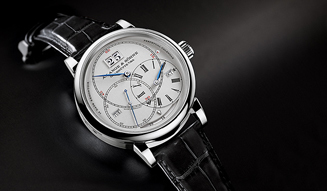
The new "Richard Lange Perpetual Calendar "Terraluna"" unveiled at this year's SIHH
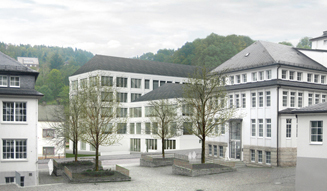
An artist's rendering of the new factory, scheduled for completion in 2015
A notable aspect of A. Lange & Söhne's watchmaking is the standardization of a production method called "double assembly" across all models. This means that once a watch is assembled by a watchmaker, it undergoes several quality checks, is then disassembled for adjustment and finishing, and finally reassembled to completion. The effort and labor involved are truly remarkable. This rigorous manufacturing process and quality control are precisely why it is considered the pinnacle of watchmaking.
Currently, A. Lange & Söhne's factory is undergoing significant expansion, with completion planned for 2015. We will be reporting on the details in future issues of this magazine. We eagerly anticipate how this esteemed German brand will evolve into the next era.
A. Lange & Söhne
Tel. 03-3288-6639